Establishing secure connection…Loading editor…Preparing document…

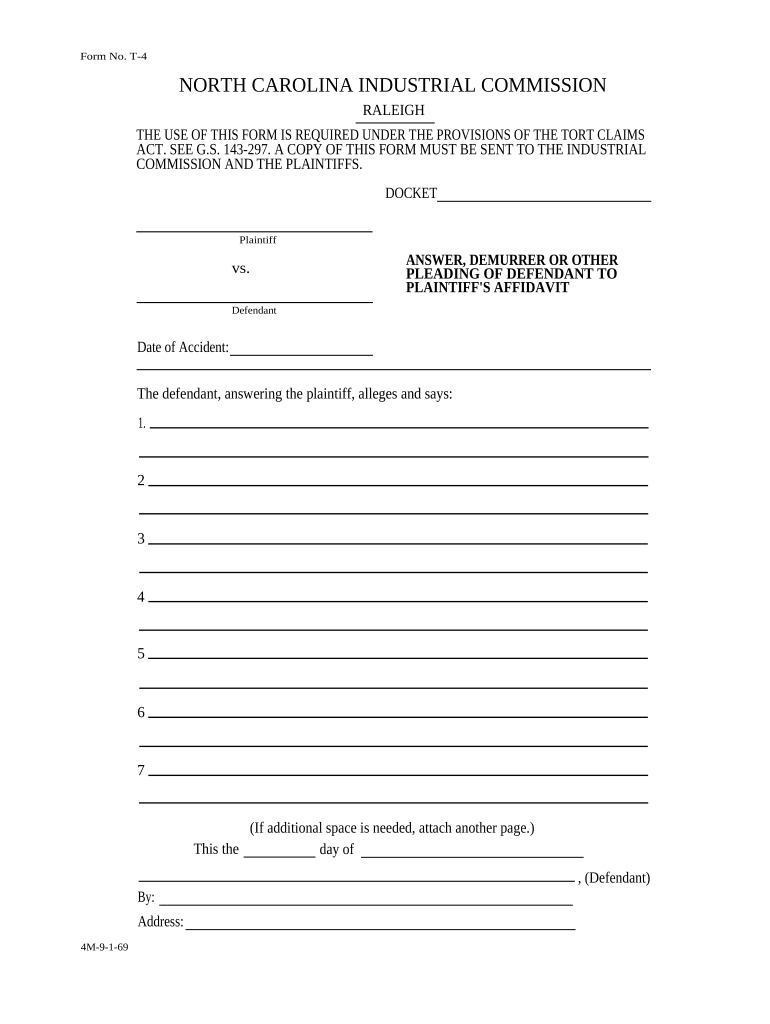
North Carolina Answer to Plaintiff's Affidavit

This template is fully customizable. Edit the text, fill out the fields, and send it for signature. Give it a try!
North Carolina Answer to Plaintiff's Affidavit

What the North Carolina Answer to Plaintiff's Affidavit Is

A North Carolina Answer to Plaintiff's Affidavit is a written, sworn response filed by a defendant or respondent to address factual statements or claims a plaintiff has presented under oath. The document typically identifies which facts are admitted, denied, or require clarification, and may include affirmative defenses, counterstatements, or requests for additional time to respond. In many cases the answer must be notarized to attest to the signer’s oath. Filing and service procedures are governed by local court rules and civil procedure requirements in the county where the action is pending.

Why a Proper Answer Matters

Filing a timely, accurate Answer to Plaintiff's Affidavit preserves your defenses, prevents default rulings, and creates a formal record disputing factual assertions. A well-prepared answer narrows issues for the court and helps avoid unnecessary sanctions or loss of rights.

Why a Proper Answer Matters

Who Typically Prepares or Files This Answer

The exact preparer depends on representation status and court rules; timely filing and proper notarization are the shared responsibilities.

  • Defense attorneys and law firms handling civil litigation and tenant/landlord disputes.
  • Self-represented defendants preparing a formal sworn response to preserve rights.
  • Paralegals or legal assistants assembling supporting exhibits and service copies.

Representative Signers and Roles

Defense Attorney

A licensed attorney prepares and signs the answer on behalf of an represented party, typically certifying the factual bases and attaching exhibits. The attorney ensures compliance with North Carolina civil procedure, local rules, and service obligations while preserving client privileges where applicable.

Pro Se Defendant

A self-represented litigant signs the answer under oath and may attach supporting documents. The signer must follow court-specific formatting, notarization requirements, and service rules to avoid default or dismissal for procedural defects.

Step-by-step: Completing an Answer to Plaintiff's Affidavit

Follow these sequential actions to prepare, verify, sign, and submit an effective Answer to Plaintiff's Affidavit.

  • 01
    Prepare Document: Use court caption, list docket number, and reference the plaintiff's affidavit.
  • 02
    Draft Responses: Clearly admit, deny, or state lack of knowledge for each allegation.
  • 03
    Notarize: Sign in front of a notary or use an authorized remote notarization process if permitted.
  • 04
    File and Serve: Submit to court per local e-filing or clerk procedures and serve opposing counsel.

Setting Up an Electronic Workflow for This Answer

Configure an e-filing workflow to collect signatures, notarization, and court filing metadata.

Upload File Submit a final PDF version for consistent e-filing.
Add Fields Place signature, date, and initial fields where required.
Set Authentication Choose email, SMS, or stronger signer authentication.
Notary Step Insert remote notary or in-person notary action as applicable.
E-file Metadata Attach court case number and filing type before submission.

Technology and File Requirements for eSubmission

Check the specific county clerk’s e-filing rules before submission and preserve the signed certificate of service for the record.

  • File Formats: PDF/A preferred for court filings
  • Integrations: Works with e-filing portals and case management systems
  • Authentication: Support for email, SMS, and advanced auth methods

Electronic Filing Flow at a Glance

A simplified sequence shows how an electronic answer moves from drafting to court acceptance.

  • Draft and Review: Create the answer, attach exhibits, and verify citations.
  • Sign and Notarize: Collect signatures and notarization via in-person or RON if allowed.
  • E-file Submission: Upload to the court’s e-filing portal and include service information.
  • Service and Record: Serve opposing parties and retain certified filing receipt.

Essential Parts of a Professional Answer

Include these sections to make the answer clear, enforceable, and admissible in court.

Caption

The court name, county, case caption, and docket number identify the matter and align the answer with the plaintiff’s filings.
Introduction

A brief statement identifying the answering party and the document being responded to, with reference to date and paragraph numbers.

Responses

Numbered replies to each allegation in the plaintiff’s affidavit: admit, deny, or state lack of knowledge with concise language.

Affirmative Defenses

List statutory or equitable defenses with supporting factual summaries to avoid waiver of legal arguments.

Counterclaims or Setoffs

If applicable, assert counterclaims or setoffs with factual bases and requested relief; attach supporting exhibits.

Verification

A sworn statement under oath, dated and notarized, attesting to the truth of the answers and subject to penalty of perjury.

Practical Tips for Accurate and Efficient Answers

Apply these recommendations to reduce error, speed acceptance, and protect procedural rights.

Organize by Allegation Number
Respond paragraph-by-paragraph using the plaintiff’s numbering to make the court’s review straightforward and to avoid inadvertent omissions or misalignment between documents.
Attach Relevant Exhibits
Include only essential exhibits, label them clearly, and reference them in specific responses to tie evidence directly to disputed facts.
Confirm Notary and Jurisdiction Rules
Verify whether the county accepts remote notarization and whether the notary certificate must appear on the same page as the signature for local acceptance.
Keep a Certificate of Service
File and retain a signed certificate of service showing how and when opposing counsel or parties were served to prove compliance with procedural requirements.

Common Timing Considerations

Deadlines vary by court and document type; these items reflect typical timing elements to track during the response process.

Answer Period:

Courts commonly set an answer deadline; many jurisdictions require responsiveness within days to weeks of service.

Notarization Timing:

Sign in front of a notary before filing; delayed notarization may be rejected.

E-filing Cutoffs:

Electronic portals may have daily cutoffs; plan submissions accordingly to meet courtroom schedules.

Extension Requests:

If additional time is needed, file a timely motion or stipulation before the answer deadline.

Hearing Scheduling:

After filing, expect scheduling for motions or hearings that may occur within weeks to months.

Key Milestones from Service to Outcome

A sequential timeline highlights the principal stages from initial service through potential judgment.

01

Service of Process

Plaintiff serves complaint and affidavit; clock for response begins.

02

File Answer

Defendant files notarized answer or seeks extension before the deadline.

03

Pretrial Motions

Parties may exchange motions, briefs, or discovery requests before hearing.

04

Court Hearing or Judgment

Court resolves disputes at hearing or enters judgment if issues remain.

Comparison: eSignature Platforms for Preparing and Delivering Answers

Trusted eSignature platforms vary by price model and capabilities; signNow appears first as a widely used option for secure signing and notarization workflows.

signNow DocuSign Adobe Sign PandaDoc HelloSign
Starting Price $8/user/mo $15/user/mo $14/user/mo $19/user/mo $15/user/mo
Free Trial 7-day free trial Varies by vendor Varies by vendor Varies by vendor Varies by vendor
Bulk Send Yes (Business Premium+) Yes Yes Yes Limited
Audit Trail Yes Yes Yes Yes Yes
HIPAA Compliant Yes (BAA available) Varies by plan Varies by plan Varies by plan Varies by plan
Envelope Cap No cap 100 envelopes/user/year Depends on plan Depends on plan Depends on plan

Security and Compliance Essentials for Signed Answers

Encryption: TLS 1.2/1.3 in transit; AES-256 at rest
Audit Trail: Full tamper-evident activity log and timestamps
HIPAA: BAA available for protected health information
ESIGN/UETA: Electronic signatures supported under ESIGN and UETA
21 CFR Part 11: Controls available for FDA-regulated records
Certifications: SOC 2 Type II and ISO 27001 compliant

Consequences of Incomplete or Incorrect Answers

Default Judgment: Risk of default against the defendant
Sanctions: Court sanctions for procedural lapses
Evidentiary Loss: Waiver of certain defenses or claims
Perjury Risk: False sworn statements may trigger perjury charges
Rejected Filing: Clerk may reject improper formatting or unsigned documents
Increased Costs: Additional fees and attorney time to cure defects

Common Pitfalls to Avoid

  • Missing notarization or late notarization that leads to rejection or delays in filing and service.
  • Failing to respond to each numbered allegation, which can create ambiguity and permit adverse inferences.
  • Using inconsistent party names or wrong docket numbers that cause misfiling or administrative rejection.
  • Relying on informal signatures or initials when an explicit sworn signature and notarization are required.

Practical Examples of Digital Document Handling

These real customer stories illustrate how secure eSignature workflows have supported legal and property-related document processes.

Optica Ventures (Brian Fitzgibbons)

When responding to client affidavits we needed a simple signing flow that customers could complete quickly.

  • The platform’s interface simplified remote signing for our team and clients.
  • The interface is simple and easy-to-use for our team; more importantly, it is just as easy for our customers.

Martin Properties (Tim Martin)

Property managers often respond to tenant affidavits outside normal office hours, requiring mobile and offline capabilities.

  • Mobile signing and offline access allowed execution on the spot.
  • I can process and execute all of these documents online with 100% compliance and built-in security, whether on mobile or working offline.

Frequently Asked Questions and Troubleshooting

Answers to common questions about preparing, notarizing, signing, and filing an Answer to Plaintiff's Affidavit in North Carolina.


Need help? Contact support

be ready to get more
Join over 28 million airSlate SignNow users