Parties
Identify full legal names and capacities (individual, corporation, trustee).
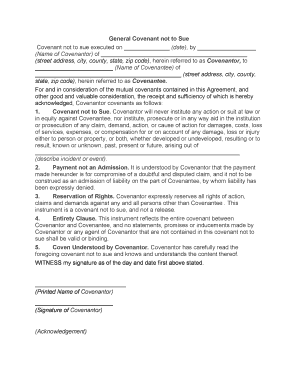
A Covenant Not to Sue reduces litigation risk by replacing threatened or potential claims with negotiated terms, clarifies mutual obligations, and can be structured to permit specific future claims while barring others under clearly defined conditions.

The Covenant Not to Sue is used by private parties, businesses, and their counsel to resolve disputes without litigation and by third parties (insurers, lenders) to secure predictable risk allocation.
When properly executed and documented, it becomes part of the transaction record and may be relied on as the exclusive remedy within its defined scope.
An individual or entity giving up the right to bring specified claims; signs after consideration is confirmed. Counsel often confirms scope before execution to avoid inadvertent waiver of unrelated claims.
The party receiving the covenant; signs to acknowledge consideration and mutual terms. May attach exhibits or reserved exceptions describing permitted future claims.
Identify full legal names and capacities (individual, corporation, trustee).
Describe claims covered (by statute, act, time period, or transaction) and any explicit exceptions.
State payment, credit, or other consideration that supports the covenant.
Specify when the covenant starts and, if applicable, when it ends.
Name the state law that will interpret the covenant and venue for disputes.
Include title lines and representation statements confirming signers have authority.
| Field | Configuration |
|---|---|
| Signer Order | Sequential or parallel based on negotiation and approvals |
| Authentication | Email + SMS OTP or stronger KBA for high-risk matters |
| Attachment | Include settlement schedules, release exhibits, and payment confirmation |
| Retention | Archive signed PDF with audit trail for the required retention period |
Choose a platform that produces a tamper-evident signed file, supports strong signer authentication, and preserves an audit trail.
Retain the final signed document and audit record in secure storage with access controls and regular backups to meet legal and compliance needs.
Set MM/DD/YYYY and ensure consideration is delivered by that date
Specify when settlement funds must clear to avoid revocation
Require signed originals or verified e-signed copies within a set window
Archive executed documents immediately per retention policy
Consider tolling or waiver effects on statutes of limitations
Terms agreed and draft covenant finalized for signatures
Authorized signers sign; notarization performed if required
Settlement funds, credits, or other consideration confirmed
Store signed document and audit trail in secure records
| signNow | DocuSign | Adobe Sign | PandaDoc | HelloSign | |
|---|---|---|---|---|---|
| Starting Price | $8/user/mo | $15/user/mo | $14/user/mo | $19/user/mo | $15/user/mo |
| Free Trial / Plan | Yes, 7-day trial | Varies by plan | Varies by plan | Limited free option | Limited free option |
| Bulk Send | Yes | Yes | Yes | Yes | No |
| Audit Trail | Yes | Yes | Yes | Yes | Yes |
| HIPAA Compliant | Yes | Yes | Yes | No | No |
A vendor and client resolve payment claims through a release
A contractor and owner settle delay claims tied to Project A