Establishing secure connection…Loading editor…Preparing document…

California Notice of Appeal—Juvenile

This template is fully customizable. Edit the text, fill out the fields, and send it for signature. Give it a try!
California Notice of Appeal—Juvenile

What the California Notice of Appeal—Juvenile Is

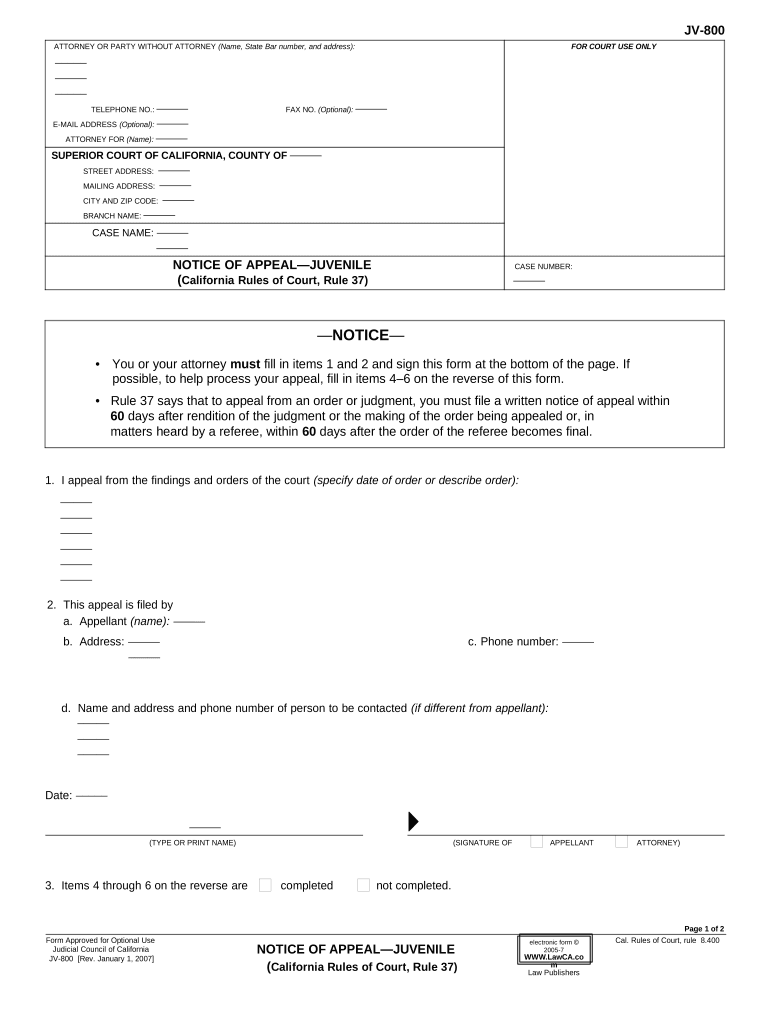
The California Notice of Appeal—Juvenile is a formal filing used to notify a juvenile court and opposing parties that a party intends to appeal an appealable juvenile court order. It identifies the appellant, the case number, the specific order or disposition being appealed, and the relief sought. The notice initiates the appellate process and triggers deadlines for briefs, records preparation, and service requirements. Procedures and practical steps can vary by county and by whether the appeal proceeds to the California Court of Appeal, so confirm local rules and statutory requirements before filing.

Why this Notice Matters for Appellate Rights

Filing a timely and complete Notice of Appeal preserves the right to appellate review of juvenile court determinations and starts the formal appellate timeline.

Why this Notice Matters for Appellate Rights

Who commonly files or receives this Notice

Parties and professionals involved in juvenile appeals use this form to preserve appellate rights and notify the court.

  • Appellant (Parent or Guardian) — A parent, guardian, or the juvenile may file or authorize filing to challenge an order.
  • Appellant's Attorney — Private counsel or public defender files the notice to commence appellate proceedings and coordinate the record.
  • Respondent / Social Services Agency — The agency receives notice and prepares responsive filings and records as required by the court.

Primary signers and filers

Parent/Guardian

A parent or guardian named as appellant signs to preserve the juvenile's right to appeal. They should confirm identity, relationship to the minor, and that they understand the appeal's immediate deadlines and potential consequences for custody or services.

Appellate Counsel

An attorney acting for the appellant signs or verifies the filing, ensures the Notice matches the appellate brief strategy, and coordinates lodging of the record and service on opposing parties and the appellate court.

Essential data fields to include

Case Number: Court-assigned docket number
Court Name: Name of juvenile court
Appellant Name: Full legal name
Order Date: Date of challenged order
Relief Sought: Brief statement of appeal purpose
Service Information: Names and addresses for parties served

Consequences of an incorrect or late notice

Missed Deadline: May forfeit appeal rights
Incomplete Filing: Court may reject or strike
Service Failure: Delay or default consequences
Wrong Appellant: Procedural dismissal risk
Record Mismatch: Record preparation delays
Cost Exposure: Potential fee or sanctions

Common pitfalls to avoid

  • Filing the notice for the incorrect order or failing to identify the specific disposition being appealed, which can limit appellate review.
  • Using inconsistent names or case numbers that do not match the juvenile court record, causing record assembly delays or rejection.
  • Failing to serve all required parties in the proper manner, which can result in contested service and extensions.
  • Relying on informal or unsigned copies rather than filing the court’s required form or a signed verified notice, risking non-acceptance.

Filing the Notice: Step-by-step

Follow these essential steps to prepare and file the California Notice of Appeal—Juvenile.

  • 01
    Gather case details: Confirm court, case number, and order date from the final disposition.
  • 02
    Complete the form: Enter appellant, respondent, statement of appeal, and signature blocks accurately.
  • 03
    Serve required parties: Provide copies to all respondents, counsel, and the juvenile court per local rules.
  • 04
    File with court clerk: Submit original with required copies and proof of service to the juvenile court clerk.

From Notice to Record: the filing flow

The Notice triggers a sequence that moves the matter toward appellate briefing and record preparation.

  • Notice Filed: Court receives notice and docket entry is made.
  • Record Ordered: Clerk or reporter prepares transcripts and clerk’s record.
  • Briefing Schedule: Appellate court sets deadlines for briefs and responses.
  • Decision Issued: Court of Appeal issues a written opinion or order.

Core elements of a professional Notice of Appeal—Juvenile

A well-prepared notice is clear, accurate, and aligned with appellate procedure to ensure the record is complete and timelines are met.

Clear identification

Include the court name, full case number, and the juvenile’s full legal name exactly as they appear on court records to avoid mismatches in the appellate docket.
Precise order citation

Identify the specific order or dispositional ruling being appealed by date and page or minute order reference so the clerk locates the correct record materials.

Statement of appellant

State whether the appellant is the parent, guardian, juvenile, or another party and include contact information for counsel to facilitate service and communications.

Service details

List the names and addresses of parties served and the method of service; attach proof of service conforming to California procedural rules.

Signature and verification

Provide a dated signature of the filer and, where required, verification or declaration under penalty of perjury to confirm the truth of statements.

Request for record

Indicate whether a reporter’s transcript and clerk’s record are requested to ensure timely compilation and availability for brief preparation.

Practical tips for accurate completion

Use these best practices to reduce errors, speed processing, and maintain a defensible appellate record.

Confirm spelling and numbers against court docket
Always cross-check the juvenile’s name, case number, and order date with the official court docket and minute order to avoid clerical rejection or misfiled records.
Attach proof of service and keep copies
File a proof of service simultaneously and retain stamped copies for your client file; lack of timely service can lead to delays or jurisdictional challenges.
Request transcripts early
Order reporter transcripts and clerk’s record promptly after filing to avoid briefing delays and to allow time for any necessary record correction motions.
Coordinate with counsel and agencies
Notify public agencies, counsel for other parties, and the juvenile's guardian ad litem early to streamline evidence exchange and record assembly.

Timing considerations and common deadlines

Deadlines in juvenile appeals are time-sensitive and vary by jurisdiction; act promptly after an appealable order is entered.

Initial filing window:

Varies by county; often within 30–60 days of the appealable order.

Service timing:

Serve notice on all parties promptly as required by local rules.

Transcript requests:

Order transcripts immediately to meet briefing schedules.

Briefing schedule follow-up:

Appellate deadlines set after record is filed; comply with court-provided schedule.

Extensions and motions:

File extension or relief motions before deadlines when necessary.

eSignature vendor pricing and features for filing and service

Compare common vendor starting prices and key capabilities relevant to filing and service of a California Notice of Appeal—Juvenile. Do not rely on this table for final purchasing decisions.

signNow DocuSign Adobe Sign PandaDoc HelloSign
Starting Price $8/user/mo $15/user/mo $14/user/mo $19/user/mo $15/user/mo
Free Trial 7-day free trial Check vendor Check vendor Check vendor Check vendor
Bulk Send Yes Yes Yes Yes No
Audit Trail Yes Yes Yes Yes Yes
HIPAA Compliant Yes Yes Yes No No

Answers to common questions about Notices of Appeal in juvenile cases

Practical answers to frequent concerns when preparing, filing, or correcting a California Notice of Appeal—Juvenile.


Need help? Contact support

be ready to get more
Join over 28 million airSlate SignNow users