Establishing secure connection…Loading editor…Preparing document…

Letter Regarding Conservatorship Oath

This template is fully customizable. Edit the text, fill out the fields, and send it for signature. Give it a try!
Letter Regarding Conservatorship Oath

What the Letter Regarding Conservatorship Oath Is

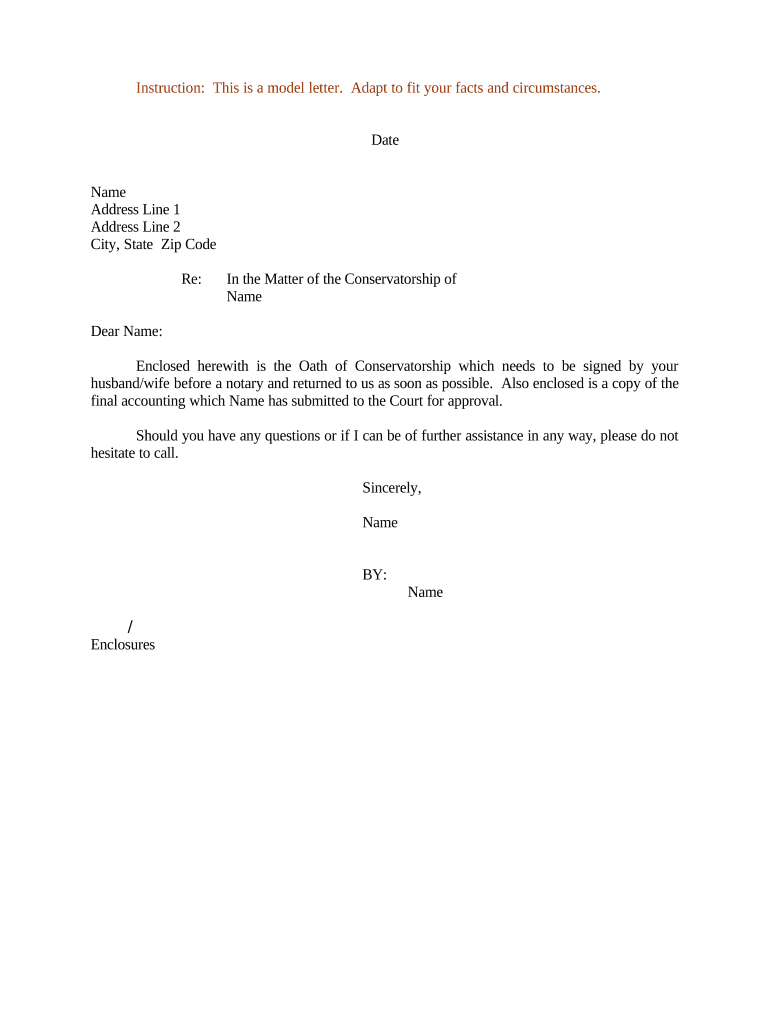
A Letter Regarding Conservatorship Oath documents that a court-appointed conservator has taken the required oath of office and accepted fiduciary duties. The letter typically identifies the conservator, cites the court case or docket number, records the oath language and date administered, and includes signature, notary, or witness information for filing with the probate or guardianship court. Courts, banks, care providers, and public agencies may request a copy to verify the conservator’s authority to act for the protected person.

Why this Letter Matters for Legal Authority and Records

The letter provides formal proof that the conservator swore the oath required by the appointing court, enabling third parties to accept the conservator’s decisions. It creates a clear record for the probate file, supports financial and healthcare transactions, and reduces disputes about authority or successors.

Why this Letter Matters for Legal Authority and Records

Who typically prepares, reviews, or needs this letter

Key audiences for the Letter Regarding Conservatorship Oath include court staff, conservators, attorneys, and institutions that rely on proof of authority.

  • Court clerks and probate judges use the letter to docket proof of oath and to verify the conservator’s compliance with appointment terms.
  • Conservators and their attorneys prepare the letter to satisfy court or third-party requests for formal proof of authority.
  • Banks, healthcare providers, and government benefit administrators request the letter to confirm signature authority and decision-making rights.

Essential parts to include in a professional Letter Regarding Conservatorship Oath

A complete letter follows a consistent structure so courts and third parties can confirm identity, appointment, and the oath itself without additional documents.

Case Reference

Include court name, county, and docket/case number exactly as shown on the appointment order so reviewers can match records.
Conservator Identity

Provide the conservator’s full legal name, any aliases, date of birth, and mailing address to avoid confusion with similarly named persons.

Appointment Details

State the date of appointment, the appointing judge or order citation, and the scope of conservatorship (person, estate, or both).

Oath Language

Transcribe the oath text administered or reference the court form used, include the exact administration date and method (in-person or remote).

Authentication

Add signature blocks for the conservator and for any witnesses or notary, and note whether a notarial acknowledgment or seal was attached.

Distribution Note

Record where the original was filed and list entities receiving certified copies, plus retention instructions for the conservator’s records.

Required information and commonly requested data points

Conservator Name: Full legal name
Court Case Number: Exact docket ID
Appointment Date: MM/DD/YYYY
Oath Date: MM/DD/YYYY
Signatures: Conservator and witnesses
Notary Entry: Notary seal or acknowledgement

Consequences of missing or incorrect oath documentation

Authority Challenged: Third parties may refuse transactions
Court Delay: Additional hearings or affidavits required
Financial Risk: Bank access or asset transfers blocked
Health Care Access: Providers may decline decisions
Potential Sanctions: Court may order corrective measures
Record Rejection: Filing clerk may return incomplete filing

Common preparation errors that delay acceptance

  • Using an informal statement instead of a formal letter tied to the court appointment often causes banks and agencies to request certified copies.
  • Mismatched names between the appointment order and the letter (missing middle name or different spelling) commonly prevents institutions from accepting the document.
  • Failing to include a notarization or witness signature when the receiving party requires it creates avoidable processing delays and duplicate work.
  • Attempting to rely on a scanned signature image without an audit trail or verification can lead to rejection by organizations that require authenticated signatures.

Step-by-step: prepare and finalize the Letter Regarding Conservatorship Oath

Follow these steps to create a letter that courts and third parties accept without additional questions.

  • 01
    Gather documents: Collect appointment order and identification
  • 02
    Draft letter: Include all required fields and oath text
  • 03
    Authenticate: Obtain notary or witness signatures
  • 04
    File and distribute: File with court and send certified copies

Where the letter goes and how it is used

Understanding the routing helps ensure appropriate filing and delivery to institutions that rely on proof of oath.

  • Probate Court: Original filed with the court clerk
  • Financial Institutions: Certified copies to banks and brokers
  • Healthcare Providers: Copies for medical decision records
  • Government Agencies: Provide for benefits administration

Digital signing and platform considerations

Many organizations accept electronically signed letters if the method meets legal and institutional requirements.

  • File formats: PDF or DOCX accepted
  • Authentication: Email, SMS, or ID proofing
  • Integrations: Works with common systems

How to configure an online workflow for the letter

Set up a repeatable workflow to populate, sign, notarize, and distribute the letter efficiently.

Field | Configuration Field name | Workflow action
Template Use a court-formatted template
Signer Authentication Email + SMS code or ID proofing
Notary Step Insert RON or in-person notary stage
Distribution Auto-send certified PDFs to recipients

Time-sensitive steps and typical scheduling expectations

Watch deadlines tied to court orders and institutional policies; exact timelines vary by jurisdiction and the appointing court.

Oath Timing:

Administered at or shortly after appointment; check court order for timing

Filing Deadline:

Some courts require filing within days or weeks of oath; verify local rules

Certified Copies:

Provide certified copies promptly to banks and agencies upon request

Notary/RON Windows:

Schedule notary or RON session before distribution to avoid rework

Record Retention:

Follow court or agency retention requirements after termination

Key milestones from appointment to distribution

A simple milestone sequence helps track completion and distribution of the oath letter.

01

Prepare Draft

Assemble appointment order, identity documents, and template language

02

Administer Oath

Conservator signs oath before authorized official or in court

03

Authenticate

Obtain notary acknowledgement or RON session and any witness signatures

04

File and Send

File original with court and distribute certified copies to stakeholders

eSignature vendor comparison for producing and delivering the letter

Comparison shows typical starting prices and compliance features relevant to court-grade documents and authenticated delivery.

signNow DocuSign Adobe Sign PandaDoc HelloSign
Starting Price $8/user/mo $15/user/mo $14/user/mo $19/user/mo $15/user/mo
Free Trial Yes, 7-day free trial, no credit card No No Yes, limited Yes, limited
Bulk Send Yes Yes Yes Yes No
Audit Trail Yes Yes Yes Yes Yes
HIPAA Compliant Yes (BAA required) Yes Yes No No
Envelope Cap No cap 100 envelopes/user/year Varies by plan Varies by plan Varies by plan

Frequently asked questions about the Letter Regarding Conservatorship Oath

Answers address common concerns about validity, e-signatures, notarization, distribution, and when to consult counsel.


Need help? Contact support

be ready to get more
Join over 28 million airSlate SignNow users