Establishing secure connection…Loading editor…Preparing document…

Affidavit of Abandonment and Intent to Recommence Construction Florida

This template is fully customizable. Edit the text, fill out the fields, and send it for signature. Give it a try!
Affidavit of Abandonment and Intent to Recommence Construction Florida

What the Affidavit of Abandonment and Intent to Recommence Construction Florida is

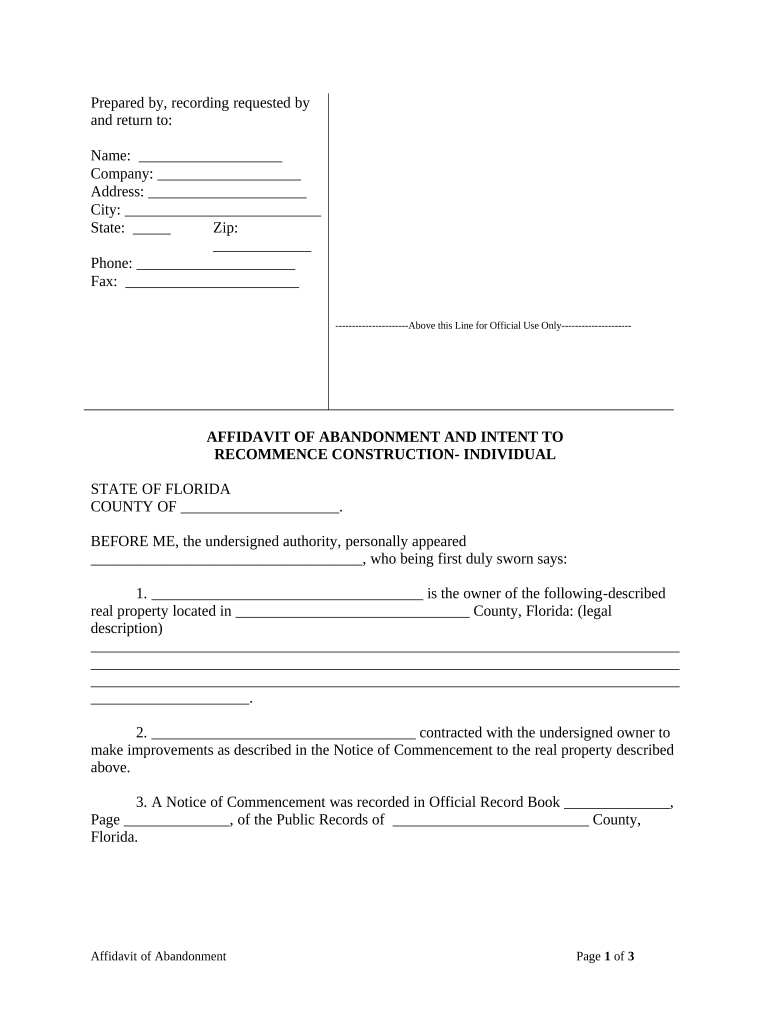
The Affidavit of Abandonment and Intent to Recommence Construction Florida is a sworn statement used in Florida to document that construction on a specific project was halted and that the responsible party intends to restart work. It records project identifiers, dates of abandonment, the legal parties involved, contractor and owner information, permit status, and any steps taken to secure the site. The affidavit is often used with lien law procedures, permit reinstatements, and title or financing matters. Accuracy and proper notarization are essential for legal effect.

Why this affidavit matters for owners, contractors, and lenders

This affidavit preserves a clear record of stoppage and planned restart, supporting permit reconciliation, lien priority decisions, and financing or title reviews. It helps stakeholders document timelines, reduce disputes about abandonment, and show intent to resume work for regulators or insurers.

Why this affidavit matters for owners, contractors, and lenders

Who typically completes and relies on this affidavit

The affidavit is used by parties directly involved with the construction project and by professionals who manage related legal, title, or permitting issues.

  • Property owners and developers who need to document project status for title, sale, or lending purposes.
  • General contractors and subcontractors asserting intent to recommence or protecting lien rights during interruptions.
  • Title companies, lenders, municipal building departments and legal counsel assessing project risk and permitting status.

Primary signers and preparers

Project Owner

Typically the legal owner or developer of record who can confirm project stoppage, authorize recommencement, and provide owner contact and deed information for title and permitting records. Owners often attach proof of ownership or authorization.

Contractor Representative

A licensed contractor or authorized corporate officer who can attest to work status, reason for abandonment, planned scope on recommencement, and scheduling. Contractor contact, license number, and insurance details are commonly included.

Essential fields and legal identifiers to include

Project Address: Street, city, ZIP
Permit Number: Local building permit ID
Owner Name: Legal entity name
Contractor Name: Licensed contractor
Date of Abandonment: MM/DD/YYYY
Intent to Recommence: Yes / planned date

Step-by-step: completing the affidavit correctly

Follow a consistent sequence to complete, notarize, and submit the affidavit so it reliably supports permitting actions, title searches, and lien issues.

  • 01
    Collect Project Data: Confirm address, permit, owner, and contractor details before drafting.
  • 02
    Draft Affidavit: Populate fields accurately and state abandonment facts plainly.
  • 03
    Sign and Notarize: Have authorized signer execute under oath before a notary.
  • 04
    File or Distribute: Submit to building department, title company, or lender as required.

Where to send or file the affidavit after notarization

Routing depends on the purpose: permitting authorities, title/lender records, or contractor files. Send certified copies where required and retain originals.

  • Local Building Department: File for permit reinstatement or record of stoppage.
  • County Recorder: Record a notice if title impact or public record is required.
  • Title Company / Lender: Provide for underwriting and closing reviews.
  • Contract Files: Keep original in project contract and claims folders.

Configuring a digital workflow for this affidavit

Online workflows let you collect signatures, notarize remotely where allowed, and distribute certified copies without paper handling.

Field Configuration
Signer Authentication Use email + SMS or KBA for higher assurance
Notarization Enable RON where state law permits and record session
Automatic Distribution Send signed copies to building dept and title company
Integration Connect to document management or Procore for storage

Technical options for eSigning and eFiling

Choose a platform that supports notarization, audit trails, secure storage, and integrations with your title or permitting systems.

  • Authentication Options: Email, SMS, KBA available
  • Integrations: Salesforce, NetSuite, Procore
  • Document Formats: PDF, DOCX supported

Key sections a professional affidavit should include

A complete affidavit clearly ties factual statements to project records, attaches supporting evidence, and provides explicit attestations about abandonment and intent to resume.

Identification

Project street address, parcel ID, and permit number to uniquely identify the worksite and link municipal records.
Timeline

Dates of initial construction, date work stopped, and planned recommencement schedule to define relevant legal periods.

Parties

Legal names, addresses, contractor license numbers, and contact information for owners and contractors.

Facts of Abandonment

Concise factual narrative explaining the reason for cessation and steps taken to secure or preserve the site.

Intent Statement

Affirmation that the signer intends to recommence work and any conditions for restarting construction.

Notary and Attachments

Notary block, exhibits such as photos, permit copies, and correspondence supporting the affidavit.

Supporting documents commonly attached to the affidavit

Attaching corroborating documents strengthens the affidavit and expedites municipal or title review by providing direct evidence of abandonment events and communications.

Permit Records

Copies of the building permit, inspection history, and any suspension or revocation notices demonstrating official permit status and relevant permit numbers.

Photographic Evidence

Photos showing work stoppage, site condition, and safety measures with timestamps to verify the physical state at abandonment.

Correspondence

Emails, letters, or notices between owner, contractor, and municipality that document decisions, delays, or reasons for suspension.

Contract and Change Orders

Relevant contract excerpts, lien waivers, or change orders showing contractual obligations and any disputed or unfinished scope.

Common timeframes and deadlines to consider

Certain dates affect permit reinstatement, lien rights, and statutory limitations; track them carefully when preparing or filing the affidavit.

Date of Abandonment:

Establishes when work stopped and starts statutory periods.

Notice to Owner:

Issue any required notices promptly to preserve lien rights.

Permit Reinstatement:

Local deadlines vary for reinspection or reissuance.

Recording Availability:

County recorder acceptance times depend on submission method.

Retention Trigger:

Retention periods commence from creation or filing date.

Common mistakes to avoid when preparing the affidavit

  • Using informal or abbreviated party names that do not match recorded deeds or business registrations, causing title confusion.
  • Failing to attach permit numbers or supporting documents, which delays municipal review and may require resubmission.
  • Omitting notarization or using incorrect notary jurisdiction, which can render the affidavit legally ineffective in records.
  • Entering vague recommencement statements without dates or conditional triggers that weaken the affidavit's evidentiary value.

Risks and legal consequences of an incorrect affidavit

Invalid Filing: May be rejected
Title Delays: Closing or mortgage holds
Lien Exposure: Lost priority risk
Permit Denial: Reinstatement blocked
Contract Disputes: Increased litigation risk
Notary Defects: Potential nullification

Real-world scenarios showing how the affidavit is used

The affidavit appears in title clearances, permit reinstatement workflows, and contractor-lender disputes where an official record of stoppage and intent is needed.

Title Clearance Example

A seller attaches an affidavit to clear buyer concerns

  • It links the abandonment date to municipal permit notes
  • The title company accepted the affidavit with permit exhibits, allowing closing to proceed without extended escrow delays.

Permit Reinstatement Example

A contractor submits an affidavit to restart inspections

  • It documents remediation steps and recommencement plans
  • The building department accepted the affidavit and scheduled reinspection, enabling the project to resume under updated permit conditions.

eSignature vendor pricing and capability comparison for affidavit workflows

Platform choice affects notarization options, bulk send, HIPAA support, and per-user costs. Below is a concise comparison with signNow listed first.

signNow DocuSign Adobe Sign PandaDoc HelloSign
Starting Price $8/user/mo $15/user/mo $14/user/mo $19/user/mo $15/user/mo
Free Trial Yes, 7-day trial Varies Varies Varies Varies
Bulk Send Yes Yes Yes Yes No
Audit Trail Yes Yes Yes Yes Yes
Envelope Cap No cap 100 envelopes/user/year Varies Varies Varies

Frequently asked questions about using the affidavit in Florida

Answers below address execution, notarization, eSigning, filing destinations, and recordkeeping to help avoid common pitfalls.


Need help? Contact support

be ready to get more
Join over 28 million airSlate SignNow users