Establishing secure connection…Loading editor…Preparing document…

Office Management Consultant and Marketing Agreement

This template is fully customizable. Edit the text, fill out the fields, and send it for signature. Give it a try!
Office Management Consultant and Marketing Agreement

What the Office Management Consultant and Marketing Agreement Does

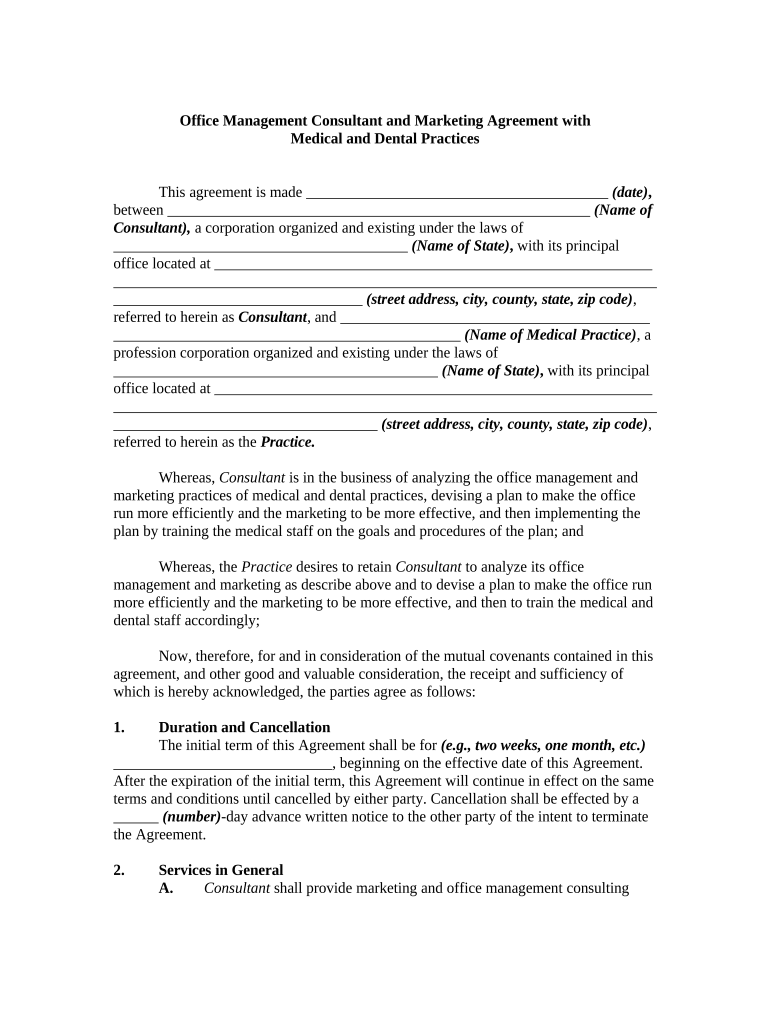
The Office Management Consultant and Marketing Agreement is a written contract that defines the relationship between a client (office owner or organization) and a consultant engaged to manage office operations and deliver marketing services. Typical provisions include the scope of services, deliverables and milestones, payment and invoicing terms, intellectual property ownership, confidentiality and data-handling obligations, term and termination rights, performance metrics and reporting, dispute resolution, and optional addenda for industry-specific compliance such as HIPAA. The agreement creates clear expectations for service levels, responsibilities, and remedies in the event of nonperformance.

Why use a combined management and marketing agreement

A single agreement aligns operational management and marketing activities, reduces scope overlap, and clarifies billing and deliverable schedules. It reduces legal ambiguity by centralizing confidentiality, IP assignment, and termination terms, and it supports consistent performance measurement across both functions.

Why use a combined management and marketing agreement

Who commonly uses this agreement

Organizations and independent consultants use this agreement to formalize recurring office management and marketing engagements.

  • Small business owners seeking outsourced office administration and local marketing support with defined monthly deliverables.
  • Healthcare practice managers contracting for front-desk operations plus patient outreach and digital marketing (HIPAA implications).
  • Law firms or professional services firms engaging consultants for office workflow optimization and client-facing marketing programs.

Use the agreement when duties cross operations and marketing so a single contract governs compensation, confidentiality, and deliverables.

Primary signers and their roles

Client — Office Owner

A business owner, practice manager, or authorized officer who engages the consultant and controls payment. This person must have authority to bind the organization and should confirm billing and procurement approvals before signing.

Consultant — Service Provider

An independent consultant or consulting firm that performs office management and marketing services. The consultant should provide proof of business registration, insurance where required, and an authorized signer for the contract.

Step-by-step: filling and finalizing the agreement

Follow a consistent sequence to reduce errors: define scope, confirm fees, add compliance clauses, complete signatures, and distribute executed copies.

  • 01
    Draft: Define services, deliverables, and payment terms clearly.
  • 02
    Review: Have legal or procurement review for compliance and risk.
  • 03
    Sign: Both parties sign, date, and initial amendments if any.
  • 04
    Distribute: Send executed copies to stakeholders and retain originals.

Set up online execution workflows

Configure your digital workflow before sending to minimize back-and-forth and ensure required fields are completed in order.

Field Configuration
Authentication Method Choose email, SMS code, or higher-assurance ID check.
Routing Order Select sequential or parallel signing depending on approvals.
Conditional Fields Show or hide fields based on earlier responses.
Integration Points Map to CRM, accounting, or document storage systems.

Where to send and file the executed agreement

Decide authoritative filing and distribution points to support audits and vendor management.

  • Primary File: Store a signed PDF copy in the organization's contract repository.
  • Accounts Payable: Send invoices and payment schedules to the finance team.
  • Project Team: Share deliverable schedules with operations and marketing leads.
  • External Counsel: Provide legal counsel a copy when requested for compliance review.

Digital signing and format requirements

Choose a signing platform that supports your required authentication, integrations, and file formats before sending the agreement.

  • File Types: PDF, DOCX supported
  • Integrations: Salesforce, NetSuite, Google Workspace
  • Authentication: Email, SMS, or credential checks

Ensure the platform retains an audit trail, produces a completion certificate, and supports your retention policies and compliance obligations.

Core clauses to include in the agreement

A thorough agreement reduces ambiguity. Include precise language for services, payment, IP, confidentiality, liability, and termination.

Scope of Services

Define tasks, deliverables, timelines, reporting frequency, and acceptance criteria. Use exhibits or schedules for recurring tasks and metrics.
Compensation

Specify rates, invoicing schedule, accepted payment methods, late fees, expense reimbursement, and any retainers or milestone payments.

Intellectual Property

State ownership of work product, whether IP is assigned to the client, and licensing terms for pre-existing consultant materials.

Confidentiality

Include nondisclosure provisions, permitted disclosures, duration of confidentiality, and special handling for sensitive information.

Liability & Indemnity

Cap liabilities where appropriate, list insurer requirements, and define indemnification scope for third-party claims.

Termination

Describe termination for convenience, material breach, cure periods, wind-down obligations, and transition assistance.

Security and compliance elements to verify

Encryption Transit: TLS 1.2/1.3
Encryption Rest: AES-256
Audit Trail: Timestamps and IP
HIPAA BAA: BAA required for PHI
21 CFR Part 11: Available for FDA-regulated records
Access Controls: SSO and role-based access

Key risks and consequences of errors

Payment Disputes: Late fees and collections
IP Misassignment: Loss of ownership rights
Data Exposure: Regulatory fines possible
Noncompliance: Contract unenforceability risk
Invalid Signatures: Challenge to enforceability
Missed Notices: Waived remedies or defaults

Common mistakes to avoid

  • Using vague service descriptions that lead to scope creep and disputes over deliverables or hours billed.
  • Failing to confirm the signatory has authority to bind the organization, which can render a contract unenforceable.
  • Omitting industry-specific compliance addenda such as HIPAA when the consultant will access protected health information.
  • Neglecting to set clear invoicing cycles and late payment remedies, causing cash-flow and collection issues.

Real-world examples of using a consultant agreement

Practical examples show common benefits: faster turnaround, clearer responsibility, and smoother client communication.

Optica Ventures — COO

Optica used an integrated consulting agreement to streamline signatures and approvals across multiple projects.

  • The interface is simple and easy-to-use.
  • The agreement reduced turnaround time and improved client satisfaction while making compliance and recordkeeping consistent across deals.

Fertility Centers of Illinois — Founder

A clinical practice standardized consultant contracts for management and marketing services.

  • The API and responsiveness were helpful.
  • Standardized forms improved internal workflows, ensured audit-ready records, and reduced administrative overhead for patient-facing communications.

Typical timeline and notice periods to include

Build clear timing into the agreement for payments, reporting, renewal, and termination to reduce disputes and missed obligations.

Effective Date:

Enter MM/DD/YYYY; obligations start on this date

Termination Notice:

60 days for convenience or as otherwise negotiated

Payment Terms:

Net 30 from invoice receipt unless specified otherwise

Reporting Frequency:

Monthly performance reports are typical

Renewal Notice:

Provide 30–60 days advance notice for renewals

Key milestones from drafting to ongoing performance

Track milestones to ensure obligations are met and deliverables are accepted on schedule.

01

Negotiation

Finalize scope, fees, and special clauses with stakeholders.

02

Execution

Obtain authorized signatures and distribute executed copies.

03

Onboarding

Set up systems, access, and initial deliverables within agreed timeframe.

04

Ongoing Reporting

Submit regular marketing and operations reports per schedule.

eSignature vendor overview for executing this agreement

Compare common capability and pricing dimensions when choosing an eSignature vendor for contract execution and storage.

signNow DocuSign Adobe Sign PandaDoc HelloSign
Starting Price $8/user/mo $15/user/mo $14/user/mo $19/user/mo $15/user/mo
Free Trial 7-day free trial Varies by vendor Varies by vendor Varies by vendor Varies by vendor
Bulk Send Yes (Business Premium) Yes (plan dependent) Yes (plan dependent) Yes (plan dependent) Plan dependent
Audit Trail Yes Yes Yes Yes Yes
Envelope Cap No envelope cap 100 envelopes/user/year Varies Varies Varies

Frequently asked questions and practical answers

Answers to common legal and execution questions about using electronic signatures and executing a consultant and marketing agreement.


Need help? Contact support

be ready to get more
Join over 28 million airSlate SignNow users