Grant Clause
Explicit language stating the grantor, grantee, type of easement, scope of rights granted, and any limitations or conditions applicable to use.
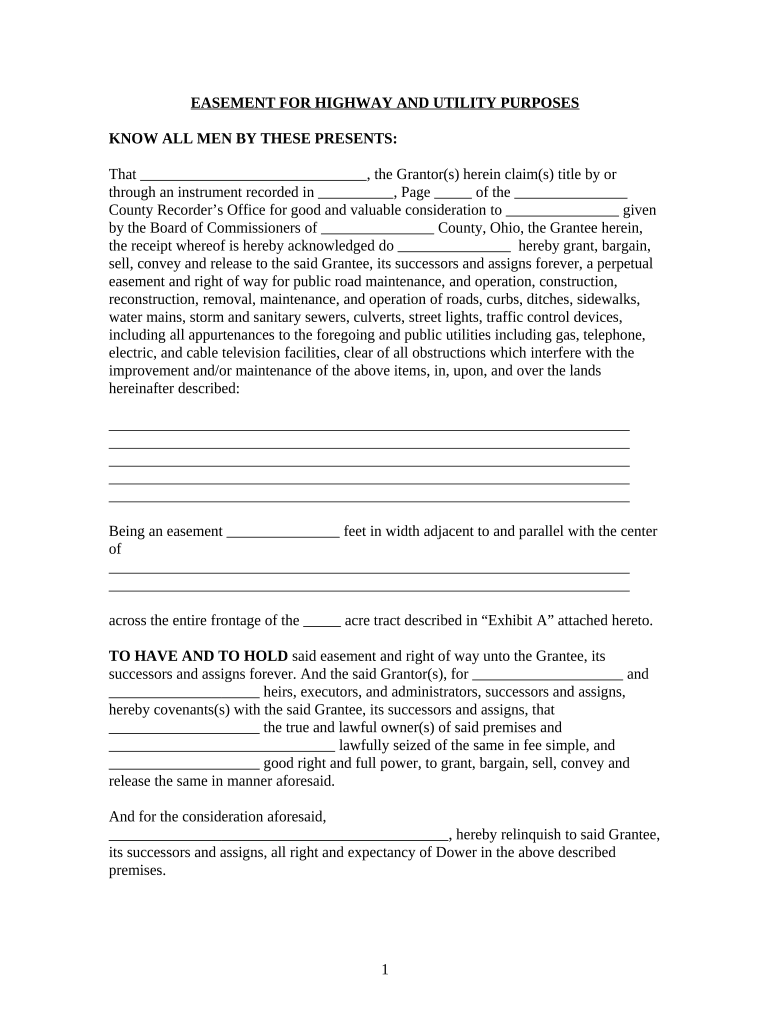
A properly drafted and recorded Ohio Easement establishes enforceable rights and clarifies maintenance, access, and liability between parties. It reduces disputes, protects title priority against third parties after recording, and preserves predictable land use for owners and service providers.

Parties involved vary by transaction; roles should be identified early to avoid delays.
Clear role definition helps ensure proper authorization, accurate recording, and enforceability against third parties.
Explicit language stating the grantor, grantee, type of easement, scope of rights granted, and any limitations or conditions applicable to use.
A metes-and-bounds description or parcel ID that unambiguously identifies the servient estate; attach the recorded plat or survey as an exhibit when possible.
Specify whether the easement is perpetual, for a fixed term, or terminable on conditions; include renewal or termination mechanics.
Define permitted uses, maintenance responsibilities, access protocols, and standards for repair or replacement of facilities.
Allocate liability for personal injury, property damage, and third-party claims, and address insurance requirements where applicable.
A clause stating the parties will record the instrument in the county recorder’s office to provide notice and preserve priority.
| Field | Configuration |
|---|---|
| Signature Fields | Required, date, printed name fields for each signer |
| Authentication | Email plus SMS code or ID verification for higher assurance |
| Exhibits | Attach survey PDF/A and recorded plat as exhibits |
| Notary | Require in-person or RON verification if permitted |
Use a platform that supports secure signatures, notarization workflows, and common legal formats when preparing an online easement.
Ensure the chosen service preserves an audit trail, supports notarization methods used in your county, and stores a tamper-evident copy.
No federal deadline; record promptly to protect priority
Typical local recording takes 1–10 business days depending on county
Notarization must occur prior to recording
Local tax impact may follow recording next assessment cycle
Keep originals until recording confirmation is received
Complete legal description and finalize terms before signatures.
Signatures and dates establish the parties’ intent and effective date.
Notary confirms signer identity and acknowledgment of signature.
County recorder indexes and assigns book/page or instrument number.
An owner of record or authorized agent signs for grantor interests. If an entity owns the property, an officer or authorized representative must sign and show title authority; mismatch with title records can delay recording.
Title agents or closing attorneys sign on behalf of parties only when properly authorized by power of attorney or closing instructions; they often prepare the recorded form and ensure county requirements are met.
Tim Martin processed easements online to avoid in-person meetings and ensure compliance.
Brian Fitzgibbons streamlined document routing for property transactions using templates and audit trails.
| signNow | DocuSign | Adobe Sign | PandaDoc | HelloSign | |
|---|---|---|---|---|---|
| Starting Price | $8/user/mo | $15/user/mo | $14/user/mo | $19/user/mo | $15/user/mo |
| Free Trial | 7-day free trial (no card) | Vendor-specific terms | Vendor-specific terms | Vendor-specific terms | Vendor-specific terms |
| Bulk Send | Yes | Yes | Yes | Yes | No |
| Audit Trail | Yes | Yes | Yes | Yes | Yes |
| HIPAA Compliant | Yes | Yes | Yes | No | No |
| Envelope Cap | No envelope cap | 100 envelopes/user/year | Varies by plan | Varies by plan | Varies by plan |