Issue Summary
Succinctly state what happened, when, and who was affected to avoid ambiguity and focus the reader on the specific incident.
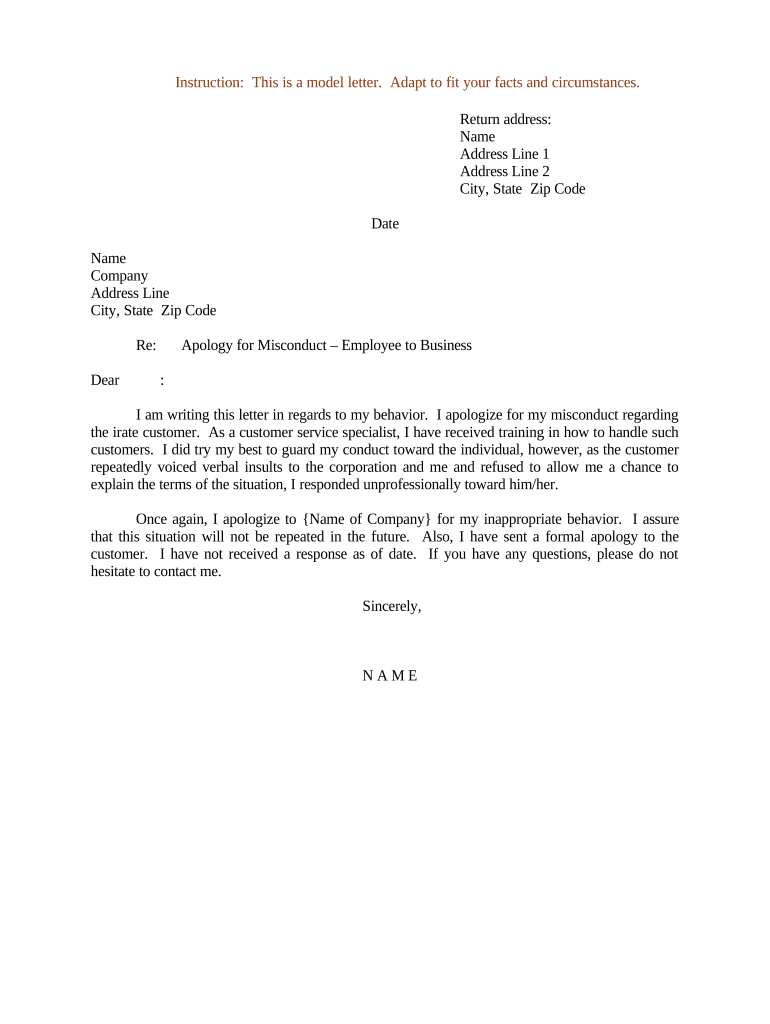
A well-constructed Apology Letter preserves relationships, reduces misunderstandings, and documents intent to remedy a problem in writing. It also creates a neutral record of communication that may be relied on by internal teams or third parties.

Organizations and individuals prepare apology letters to acknowledge mistakes and propose remediation; recipients may be customers, colleagues, regulators, or service users.
Succinctly state what happened, when, and who was affected to avoid ambiguity and focus the reader on the specific incident.
Explicitly accept responsibility where appropriate without speculative or defensive language; avoid statements that unintentionally admit legal liability unless cleared by counsel.
Describe concrete steps taken or planned to remedy the issue, including timelines and responsible parties, to rebuild trust and set expectations.
If refunds, credits, or corrective services apply, state amounts or actions plainly and how the recipient will receive them.
Provide a named contact, phone and email, and hours of availability so the recipient can follow up directly about resolution.
Note that the communication is documented, identify any referenced records, and indicate next review or closure dates for internal tracking.
| Field | Configuration |
|---|---|
| Signature Field | Required for sender and approver; supports typed or drawn signatures. |
| Authentication | Email link or SMS code for signer verification. |
| Notification | Automatic email copies to sender, approver, and records custodian. |
| Storage | Save final signed PDF to secure document repository. |
Choose a delivery method that balances recipient convenience, authentication, and record integrity.
Match the delivery method to legal sensitivity: use stronger authentication and secure storage when the content could affect legal rights.
Acknowledge receipt within 24–48 hours when feasible.
Provide a remedial action timeline (e.g., 3–10 business days).
State when you will follow up and how (phone, email).
Document closure once remediation is complete.
Keep a copy as part of the case record per retention policy.
Letter text finalized and saved in draft form for review.
Manager or legal review completed and documented.
Letter sent and delivery method recorded with timestamp.
Corrective action implemented and closure confirmed in record.
| signNow | DocuSign | Adobe Sign | PandaDoc | HelloSign | |
|---|---|---|---|---|---|
| Starting Price | $8/user/mo | $15/user/mo | $14/user/mo | $19/user/mo | $15/user/mo |
| Free Trial | Yes, 7-day trial | Varies | Varies | Varies | Varies |
| Bulk Send | Yes | Yes | Yes | Yes | Yes |
| Audit Trail | Yes | Yes | Yes | Yes | Yes |
| Envelope Cap | No cap | 100 envelopes/user/year | Varies | Varies | Varies |
A manager or department head who has authority to approve remedial actions and communicate remedies should sign corporate apology letters; include title and contact details to demonstrate authority and enable follow-up.
When communications touch on liability or settlements, a legal representative or authorized counsel may sign or co-sign the letter to ensure accuracy and to document the organization’s formal position.