Establishing secure connection…Loading editor…Preparing document…

Oklahoma Post-Judgment General Garnishment Summons

This template is fully customizable. Edit the text, fill out the fields, and send it for signature. Give it a try!
Oklahoma Post-Judgment General Garnishment Summons

What the Oklahoma Post-Judgment General Garnishment Summons Is

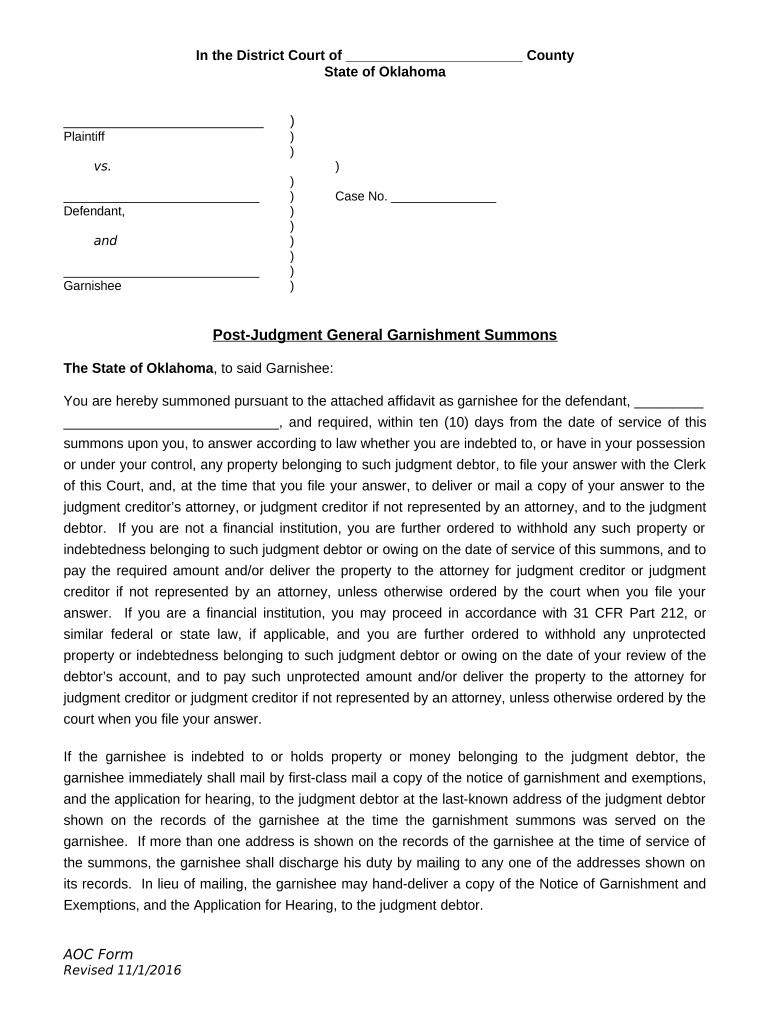
The Oklahoma Post-Judgment General Garnishment Summons is a court-issued document used to enforce a money judgment by directing a third party (garnishee) to surrender funds or property of a judgment debtor. It follows entry of judgment and initiates service on banks, employers, or other holders of the debtor’s assets so the creditor can collect. The summons sets deadlines for the garnishee to respond and allows the court to schedule a hearing if disputes arise. Proper completion, timely filing, and correct service are required for enforceability.

Why this Summons Matters for Collecting on a Judgment

A properly prepared garnishment summons converts an abstract money judgment into enforceable collection by targeting third-party holders of assets, preserving creditor rights and creating court-supervised collection steps.

Why this Summons Matters for Collecting on a Judgment

Who Typically Prepares or Responds to a Garnishment Summons

Creditor attorneys, collection specialists, self-represented creditors, and court clerks commonly prepare or handle garnishment summons forms.

  • Creditor attorneys — prepare filings, confirm jurisdiction, and handle contested garnishments.
  • Collections departments — coordinate service, track deadlines, and reconcile collected funds.
  • Garnishees (banks, employers) — review summons, withhold assets, and file statutory responses.

Parties should confirm local court rules in the venue where judgment was entered and document service to avoid procedural defects.

Essential Parts of a Professional Garnishment Summons

A complete Oklahoma post-judgment garnishment summons includes case identifiers, judgment details, precise garnishee information, service and response instructions, and a clear signature block for the issuing court official.

Case Caption

Full court caption with venue, case number, and judge where the underlying judgment was entered so the garnishment links to the correct record.
Judgment Details

Exact judgment amount, date entered, and docket references so the garnishment reflects the enforceable sum including post-judgment interest and costs.

Garnishee Information

Name, address, branch (for banks), or employer details to ensure proper service and reduce misdirected or invalid service attempts.

Service Instructions

How to serve the garnishee (personal, certified mail, or statutory methods), with required proofs or returns of service attached.

Response Requirements

Deadlines and form of garnishee response (answer, funds withheld), plus instructions for filing with the clerk to create a record.

Court Endorsement

Signature and seal line for the clerk or judge, and space for hearing dates and judicial orders that finalize the garnishment process.

Step-by-Step: Filing and Serving a Garnishment Summons

Follow this concise sequence from preparing documents through court enforcement to minimize processing delays.

  • 01
    Prepare Documents: Assemble judgment, summons, and proof of judgment for filing.
  • 02
    File with Clerk: Submit the summons and pay required court filing fees.
  • 03
    Serve Garnishee: Serve per statute and obtain return of service or affidavit.
  • 04
    Enforce/Distribute: Attend hearing if contested and request disbursement to creditor.

Configuring an Online Garnishment Workflow

Set up a repeatable digital workflow to prepare, sign, serve, and archive garnishment summonses securely and consistently.

Field Configuration
eSignature Method Choose ESIGN/UETA-compliant signing; require signer authentication.
Authentication Use email + SMS or stronger ID for creditor and clerk verification.
Template Reuse Create a template with magic fields to populate case and judgment data.
Audit Trail Retain signed PDF with timestamp, IP, and signer attribution.

Where to File, Serve, and Return the Summons

The process requires filing at the clerk where judgment was entered, service on the garnishee, and timely evidence of service returned to the court.

  • File with Clerk: Submit the summons and judgment docket entry to the issuing court’s clerk for filing.
  • Serve Garnishee: Serve per statutory method; obtain proof for the court record.
  • Return Documents: File return of service or garnishee answer with the clerk promptly.
  • Hearing (if needed): Request a hearing when garnishee disputes or claims exemptions.

Digital Signing and eSubmission Requirements

Electronic completion and submission must meet federal and state e-signature tests and court local rules for e-filings.

  • ESIGN/UETA Compliance: Intent, consent, attribution, and record retention required (15 U.S.C. ch. 96; UETA).
  • Authentication: Use email, SMS, or stronger methods for signer attribution and to satisfy court acceptance.
  • Document Formats: Use PDF or court-acceptable formats; include the audit trail and signed certificate.

Confirm local court e-filing rules and whether the court accepts electronically signed summonses or requires in-person filing or wet-ink originals.

Key Timelines and Deadlines to Track

Timely actions preserve garnishment rights; track service windows, garnishee response periods, hearing dates, and deadlines for distribution of funds.

Service Window:

Serve the garnishee according to statute and local rules without undue delay.

Garnishee Response:

Garnishee typically must answer or remit funds within the period set by statute or the summons.

Hearing Scheduling:

If disputed, request the court schedule a hearing and notify all parties.

Return of Service:

File proof of service or affidavit with the clerk promptly after service.

Distribution Timing:

After court order, funds are disbursed to satisfy judgment according to court direction.

Common Preparation Mistakes to Avoid

  • Using incomplete garnishee details that result in failed service and wasted fees.
  • Filing without attaching the underlying judgment or correct docket number, causing clerk rejection.
  • Missing the garnishee response deadline and losing the opportunity for court-ordered turnover.
  • Failing to account for exemptions or mischaracterizing exempt funds leading to contested hearings.

Risks and Consequences of Errors

Service Defect: Dismissal risk
Incorrect Amount: Funding shortfall
Late Filing: Enforcement delay
Wrong Garnishee: Liability exposure
Noncompliance: Contempt risk
Data Errors: Rejected e-filings

eSignature Pricing and Feature Comparison for Garnishment Workflows

Common eSignature plans differ by pricing model, envelope caps, and specialty compliance features; signNow is listed first for comparison across standard vendor criteria.

signNow DocuSign Adobe Sign PandaDoc HelloSign
Starting Price $8/user/mo $15/user/mo $14/user/mo $19/user/mo $15/user/mo
Free Trial 7-day free trial No No Yes, limited Yes, limited
Bulk Send Yes Yes Yes Yes No
Audit Trail Yes Yes Yes Yes Yes
HIPAA Compliant Yes Yes Yes No No

Frequently Asked Questions and Troubleshooting

Answers to common questions about preparing, serving, and enforcing an Oklahoma post-judgment garnishment summons, including e-signature considerations and recordkeeping.


Need help? Contact support

be ready to get more
Join over 28 million airSlate SignNow users