Establishing secure connection…Loading editor…Preparing document…

Oklahoma Civil Forms

This template is fully customizable. Edit the text, fill out the fields, and send it for signature. Give it a try!
Oklahoma Civil Forms

What Oklahoma Civil Forms Cover

Oklahoma Civil Forms are standardized court and administrative documents used to start, respond to, or record civil matters in state courts or related agencies. Typical forms include complaints, petitions, summons, affidavits, motions, and proof of service. These forms capture parties, factual allegations, relief sought, and procedural requests; they may require filing fees, service on opposing parties, and adherence to Oklahoma Rules of Civil Procedure for formatting, signatures, and notarization. Using the correct form version and completing required fields reduces processing delays and preserves parties’ procedural rights.

Why Accurate Oklahoma Civil Forms Matter

Accurate civil forms ensure the court accepts filings, protect deadlines and statutory rights, and support enforceable judgments. Properly completed forms reduce the risk of dismissal, service defects, or procedural challenges that can delay or derail a case.

Why Accurate Oklahoma Civil Forms Matter

Who Completes Oklahoma Civil Forms

Different parties prepare and sign Oklahoma civil forms depending on the stage of the case and the document type.

  • Plaintiffs and their counsel preparing complaints, petitions, and service documents to initiate cases and request relief.
  • Defendants and their attorneys filing answers, motions, or counterclaims and documenting defenses and procedural objections.
  • Clerks, process servers, and notaries completing service proofs, affidavits, or acknowledgements required by court rules.

Knowing the expected preparer for each form helps assign responsibilities and confirm required signatures, notarization, and filing steps.

Step-by-Step: Completing a Typical Civil Form

Follow a consistent sequence when preparing Oklahoma civil forms to avoid common errors and filing rejections.

  • 01
    Prepare Case Header: Enter court name, case number, and correct party names exactly.
  • 02
    State the Relief: Concise factual allegations and specific remedies requested.
  • 03
    Attach Supporting Documents: Exhibits and declarations must be referenced and attached.
  • 04
    Sign and Notarize: Signatures and any required notarization or verification complete the form.

Common Questions about Oklahoma Civil Forms

Answers to frequent procedural and technical questions about completing and filing civil forms in Oklahoma.


Need help? Contact support

Core Elements That Appear on Civil Forms

Most Oklahoma civil forms share several structural and informational features; ensure each is completed accurately.

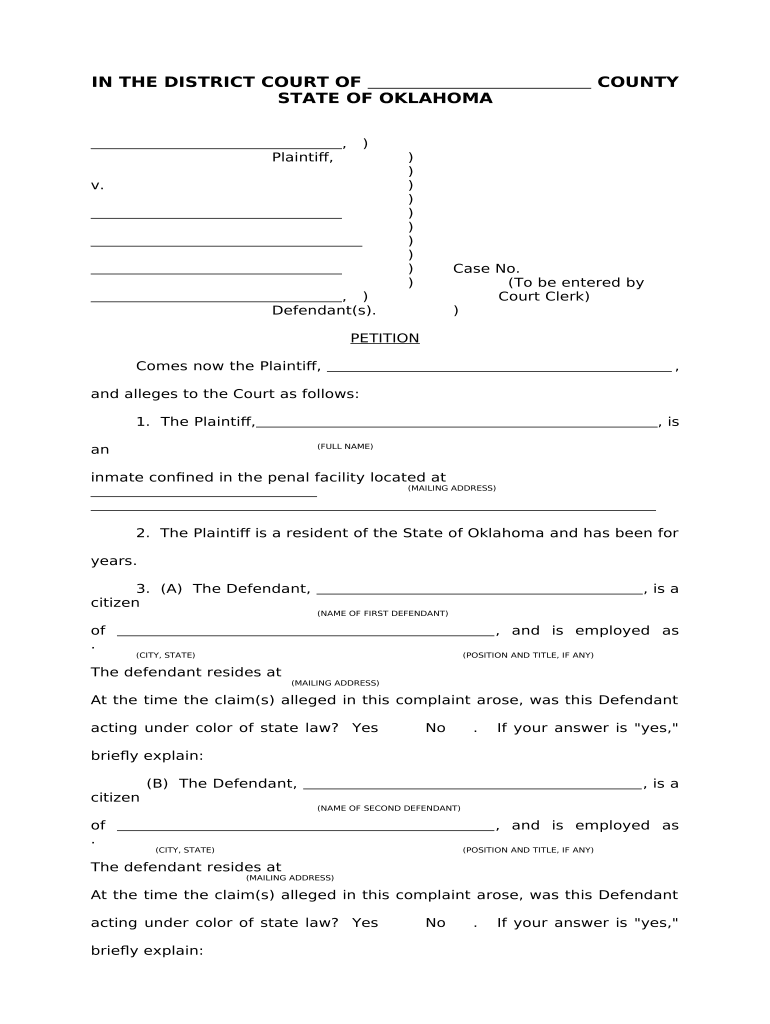
Caption

The caption identifies the court, parties, and case number; an incorrect caption can misdirect the filing and delay assignment to the proper judge or calendar.
Statement of Facts

A concise, chronological statement that supports the legal claims or defenses. Facts must be factual assertions, not argument, and should reference attached exhibits where applicable.

Claims or Relief Requested

Clear enumeration of legal claims, statutory bases, and the specific relief sought, including monetary amounts or injunctive language when relevant.

Verification or Affidavit

Where required, a sworn or verified statement confirming the truth of the facts in the document; notarization or judicial verification may be required.

Signature and Contact

Printed name, signature, counsel information, address, phone, and email. Courts rely on accurate contact details for notices and scheduling.

Certificate of Service

A dated statement indicating how and when copies were provided to other parties, including method (hand, mail, electronic) and recipient addresses.

Data and Authentication Details to Include

Full Legal Name: Exact name
Signature Date: MM/DD/YYYY
Notary Acknowledgment: If required
Service Method: E.g., mail, hand
Contact Information: Address and phone
Case Identifier: Court and number

Risks of Incorrect or Late Civil Filings

Dismissal Risk: Case may be dismissed
Missed Deadlines: Statute limits apply
Service Defects: Judgment may be void
Sanctions: Court fines possible
Evidentiary Loss: Delay harms proof
Fee Forfeiture: Filing fees may be lost

Typical Filing and Service Flow

A standard path for civil filings includes preparing documents, filing with the clerk, serving opposing parties, and appearing for scheduled events.

  • Create Document: Draft and attach exhibits in court-ready format.
  • File With Clerk: Electronically or paper file with required fee.
  • Serve Opposing Parties: Use authorized methods and complete proof of service.
  • Court Processing: Clerk assigns a case number and schedules hearings.

Digital Workflow Settings for Online Completion

Configure e-filing and e-signature workflow settings to match court rules and internal review steps.

Field Configuration
Signer Authentication Email + SMS code or stronger KBA if needed
Signature Placement Fixed signature fields and date stamps
Document Versioning Enable revision history and audit trail
Delivery Notifications Email confirmations to parties and counsel

Digital Filing and eSignature Considerations

Electronic completion and filing require tools that meet authentication, retention, and court-format standards.

  • File Formats: PDF/A or searchable PDF
  • Integrations: Court e-filing portals and docketing systems
  • Security: TLS and AES-256 encryption

Ensure the chosen platform supports audit trails, role-based signers, and storage that preserves printable records for court submission and compliance.

Typical Timelines for Civil Case Filings

Common timeframes govern filing, service, responses, and hearings; confirm local rules for precise deadlines.

Initial Filing:

Complaint filed to start the case; local docketing determines next steps.

Service Window:

Service must occur within a court-prescribed period after filing.

Response Deadline:

Defendant typically has a set number of days to answer or move to dismiss.

Scheduling Conference:

Court sets deadlines for discovery and pretrial events.

Appeal Period:

Post-judgment timelines for appeals are strictly limited.

eSignature Vendor Comparison for Civil Form Workflows

Compare common eSignature vendor features and starting prices to align platform capabilities with civil filing and retention needs.

signNow DocuSign Adobe Sign PandaDoc HelloSign
Starting Price $8/user/mo $15/user/mo $14/user/mo $19/user/mo $15/user/mo
Free Trial 7-day free trial Varies by plan Varies by plan Varies by plan Varies by plan
Bulk Send Yes Yes Yes Yes No
Audit Trail Yes Yes Yes Yes Yes
HIPAA Compliant Yes Yes Yes No No

Real-World Examples from Document Workflows

How organizations use eSignature and digital forms to complete civil-related paperwork and reduce turnaround time.

Optica Ventures LLC

Optica simplified signature capture for clients and staff with digital forms

  • "The interface is simple and easy-to-use for our team; more importantly, it is just as easy for our customers."
  • This reduced manual handoffs and improved form return rates while preserving audit trails and consistent document appearance for court submissions.

Martin Properties

A property manager replaced in-person signing with online execution

  • "I can process and execute all of these documents online with 100% compliance and built-in security."
  • That change shortened lease and settlement cycles, minimized travel and notarization bottlenecks, and centralized records for future enforcement or litigation.

Practical Tips for Accurate and Efficient Completion

Apply these practices to reduce rejections, preserve evidence, and speed courtroom processing.

Use the Correct Form Version
Confirm the court’s current form version before filing. Local rules and form templates change; using an out-of-date form can cause the clerk to reject a filing or require re-submission, which delays proceedings.
Verify Names and Parties
Ensure party names match official registrations and IDs. Mismatched names can create service problems and may require amended pleadings or additional affidavits to correct.
Keep an Audit Trail
When using electronic signatures, maintain complete audit records (timestamps, IP addresses, signer authentication) to support attribution and admissibility in court if signature authenticity is challenged.
Confirm Local Filing Procedures
Review the local court’s e-filing and paper submission rules for required file formats, exhibit labeling, and fee schedules to avoid administrative delays.

Common Preparation Errors to Avoid

  • Leaving required sections blank or entering partial case identifiers causing clerk rejection and processing delays.
  • Using inconsistent dates or formats across related documents that create ambiguity about deadlines and effective dates.
  • Failing to notarize or verify sworn statements when the form explicitly requires an acknowledgement or jurat.
  • Incorrect service methods or incomplete proof of service that may result in a motion to quash or dismissal.
be ready to get more
Join over 28 million airSlate SignNow users