Establishing secure connection…Loading editor…Preparing document…

Oklahoma Order for Change of Name

This template is fully customizable. Edit the text, fill out the fields, and send it for signature. Give it a try!
Oklahoma Order for Change of Name

What the Oklahoma Order for Change of Name Is

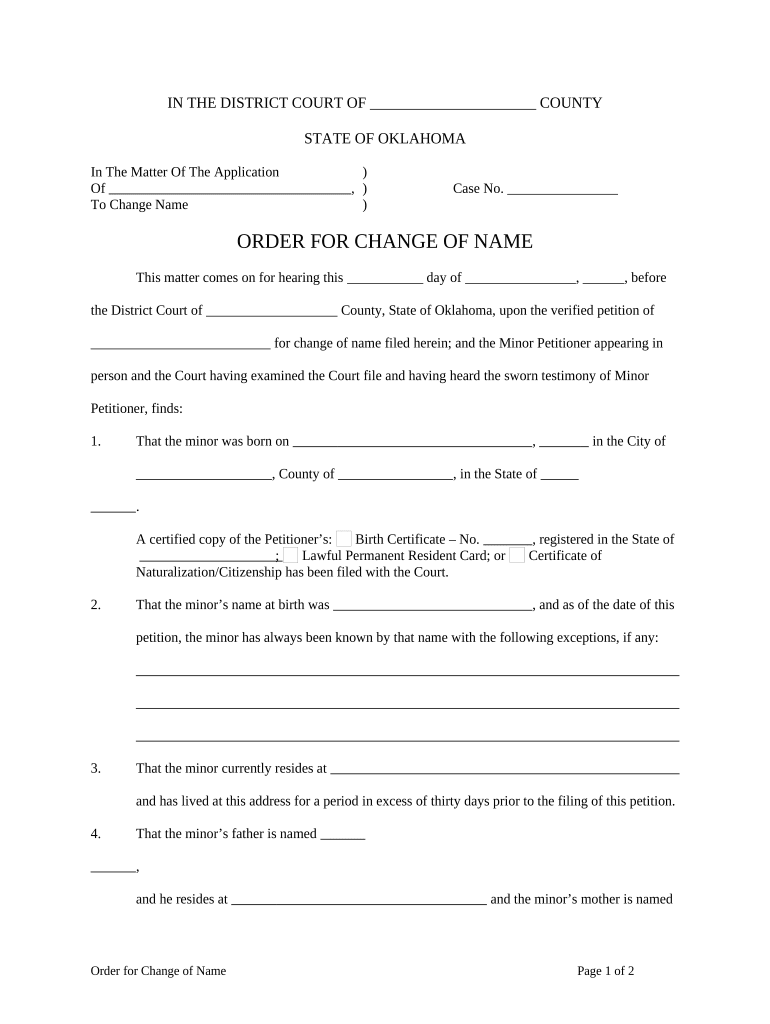
An Oklahoma Order for Change of Name is a court-issued document that legally replaces an individual's current name with a new name after a district court reviews and approves a properly filed petition. The process typically begins with a petition filed in the appropriate county district court, may include background screening or publication requirements, and concludes with a signed judicial order that authorizes use of the new name for legal, financial, and identification purposes.

Why an Approved Order Matters

A signed order creates an authoritative public record that allows changing government IDs, financial accounts, and legal records. It clarifies identity for contracts, social security, passport, and employment while documenting the court’s review and approval of the change.

Why an Approved Order Matters

Who Commonly Files for a Name Change

People seek name changes for many reasons: marriage, divorce, gender transition, personal preference, or to correct records.

  • Adults updating their legal identity across IDs, benefits, and contracts without involving guardians or conservators.
  • Parents or guardians petitioning on behalf of minor children with court approval and required consents.
  • Individuals correcting errors or restoring former names after divorce, adoption, or annulment.

Procedures and documentation requirements vary by petitioner type; minors and those with criminal records may face additional steps.

Primary Parties and Typical Roles

Petitioner

The person requesting the change. The petitioner signs the petition, supplies identifying documents, and appears at any required hearing or consents to remote procedures where allowed.

Guardian

When a minor is involved, a parent or legal guardian petitions on the child’s behalf, provides required consents, and may need court approval depending on the county and case circumstances.

Essential Information Required on the Petition

Full legal name: Current legal name as on ID
Proposed name: New name being requested
Date of birth: MM/DD/YYYY format
Address: Full street address
Criminal history: Any felony convictions noted
Court case number: Assigned after filing

Consequences of Incomplete or Incorrect Filings

Denial of petition: Court may dismiss incomplete filings
Identity mismatch: Delays updating government IDs
Unnotarized filings: Rejected by clerk in some counties
Publication omission: May violate local notice requirements
False statements: Potential perjury or contempt risk
Unaddressed liens: Credit and title records remain unchanged

Common Preparation Pitfalls to Avoid

  • Failing to use the exact legal name on identification documents, which causes banks and agencies to reject requests to update accounts.
  • Skipping required publication or failing to request a waiver, which can delay the hearing or result in denial in some counties.
  • Not checking for outstanding criminal or civil judgments that the court may consider before granting a change.
  • Assuming all agencies update records automatically after the order; many require separate applications and supporting documents.

Step-by-Step: Filing an Oklahoma Name-Change Petition

Follow these core steps to prepare, file, and obtain the court order; local court rules may add requirements.

  • 01
    Prepare petition: Complete required district court petition form
  • 02
    Attach ID: Include government ID and proof of residency
  • 03
    File in court: Submit petition and pay filing fee
  • 04
    Attend hearing: Appear for scheduled hearing or remote review

How the Court Review and Order Issuance Works

The court verifies identity, considers objections, and issues a signed order if statutory criteria are met; some counties use standard scheduling and notice procedures.

  • Initial review: Clerk assigns case number and docket date
  • Background check: Court reviews criminal history records where required
  • Notice or publication: Public notice often required unless waived
  • Judicial order: Judge signs order granting or denying change

Key Sections of a Professional Oklahoma Order for Change of Name

A complete petition and order include standardized elements so clerks and agencies can verify identity, process updates, and create an accurate public record for reissuance of IDs.

Caption

Court caption listing county, case number, and title; used by clerks and agencies to locate the case and link the signed order to records.
Petitioner details

Full petitioner information including current name, proposed name, date of birth, address, and contact details so identity can be confirmed and notices delivered.

Petition statement

A concise statement of the reasons for the change and confirmation that the request is not made to avoid debt or legal obligations.

Publication section

Where required, the petition identifies publication steps or requests a waiver for safety or privacy concerns such as domestic violence exceptions.

Criminal history disclosure

Express disclosure regarding felony convictions or pending criminal matters so the court can apply statutory limitations or safeguards.

Order language

The court’s final paragraph granting the name change, providing the effective name, and instructing agencies and the petitioner on record updates.

Setting Up an Online Filing and Signing Workflow

Configure fields, authentication, and routing to match the court’s requirements and your county’s preferences before sending documents for signature.

Field Configuration
Authentication Email link or SMS code; stronger methods optional
Templates Save petition and order templates for reuse
Conditional fields Show waiver or publication options when applicable
Storage Export signed order as PDF/A or standard PDF

Distribution and Technical Requirements for Electronic Submission

Confirm which file formats and signer authentication methods the court accepts before e-filing or submitting documents electronically.

  • File formats: PDF and DOCX widely supported
  • Integrations: Connectors for Google Workspace and Microsoft 365 available
  • Security: TLS in transit and AES-256 at rest

When using third-party eSignature or e-filing platforms, confirm compliance with court rules and retain audit trails, signer attribution, and exportable signed records for court submission.

Typical Timing and Processing Expectations

Timing varies by county: plan for filing, notice or publication, hearing scheduling, and clerk processing when estimating total completion time.

File petition:

Clerk assigns case number same day or within days

Publication window:

Often requires multiple weekly publications, timing varies

Hearing date:

Scheduled based on court calendar; allow several weeks

Order issuance:

Judge signs order at hearing or on review

Record updates:

Agency updates (SSN, DMV) require separate applications

Typical eSignature Vendor Pricing and Feature Comparison

Below is a concise vendor comparison focused on basic pricing, common capabilities, and compliance notes to support digital signature workflows for petitions and court forms.

signNow DocuSign Adobe Sign PandaDoc HelloSign
Starting Price $8/user/mo $15/user/mo $14/user/mo $19/user/mo $15/user/mo
Free Trial 7-day free trial Varies by vendor Varies by vendor Varies by vendor Varies by vendor
Bulk Send Yes Yes Yes Yes No
Audit Trail Yes Yes Yes Yes Yes
HIPAA Compliant Yes Yes Yes No No

Customizing a Court-Friendly Digital Workflow

Match document structure, required notarization, and signer authentication when configuring online workflows to meet court and agency expectations.

Field Configuration
Petition template Map petition fields to reusable template elements
Signer order Set petitioner as primary signer before clerk
Authentication Use email plus SMS or stronger methods for identity
Export options Ensure signed PDF and audit trail export

Frequently Asked Questions About Oklahoma Name-Change Orders

Answers to common questions about filing, publication, notarization, and updating identity records after the court issues an order.


Need help? Contact support

be ready to get more
Join over 28 million airSlate SignNow users