Establishing secure connection…Loading editor…Preparing document…

Letter Regarding Chapter 7 Proceedings

This template is fully customizable. Edit the text, fill out the fields, and send it for signature. Give it a try!
Letter Regarding Chapter 7 Proceedings

What this letter is and when it’s used

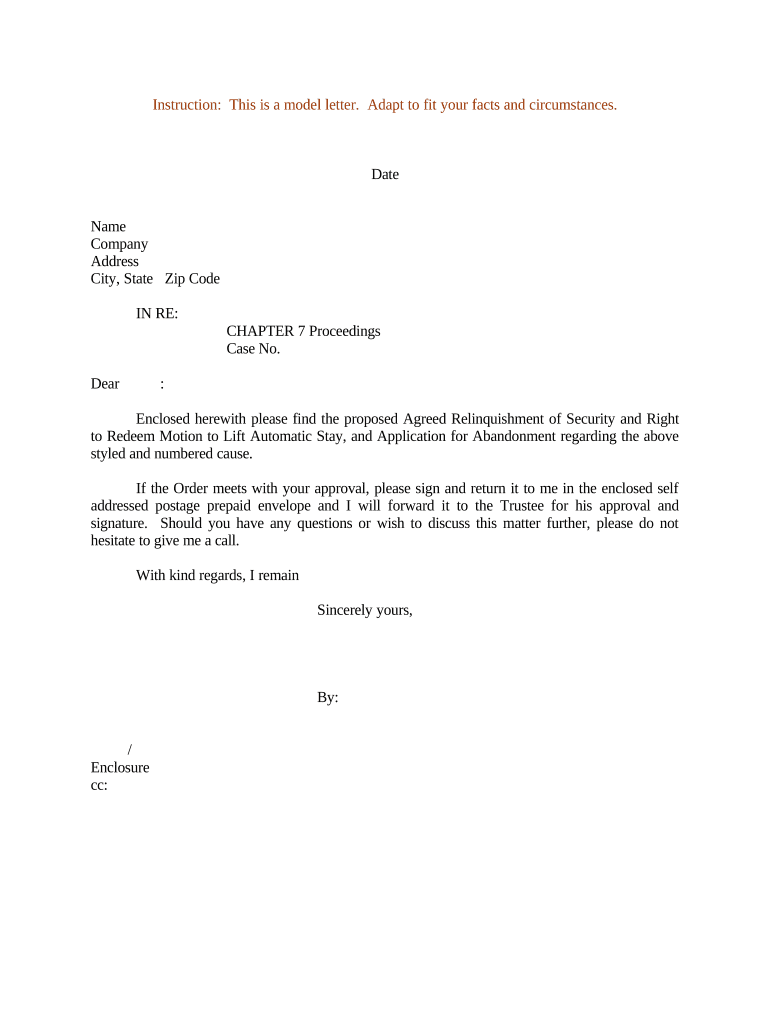
A Letter Regarding Chapter 7 Proceedings is formal written correspondence used during a consumer bankruptcy case under Chapter 7 of the U.S. Bankruptcy Code. Common senders include creditors, the debtor, and attorneys; common recipients are the bankruptcy trustee, the Court clerk, and other parties-in-interest. The letter typically explains a party’s position, provides supporting documents, asserts or opposes a claim, or clarifies procedural matters. Because official court filings follow local bankruptcy rules and electronic filing systems, this letter may accompany or precede formalized filings or proofs of claim.

Why a clear, properly formatted Chapter 7 letter matters

A well-prepared letter communicates essential facts to the trustee and court, reduces confusion, and preserves rights in a time-sensitive process governed by case deadlines.

Why a clear, properly formatted Chapter 7 letter matters

Who prepares and receives these letters

Typical participants who draft or review a Letter Regarding Chapter 7 Proceedings include creditors, debtors, trustees, and bankruptcy counsel.

  • Creditor representatives and in-house counsel who need to assert, protect, or clarify claims against the bankruptcy estate.
  • Debtors or debtor attorneys who must notify the trustee of assets, exemptions, or disputes over schedules.
  • Bankruptcy trustees or court clerks who receive factual updates, supporting documentation, or responses to motions.

Correct routing and a complete letter help preserve deadlines and support efficient case administration by the trustee and the court.

Core elements to include in a professional Chapter 7 letter

Include consistent, case-specific elements so recipients can quickly identify the case, the purpose of the letter, and any action requested.

Case Caption

Provide the bankruptcy case name, docket number, and court division so the trustee and clerk can place your letter on the correct docket and avoid misrouting.
Sender Identity

List the sender’s full legal name, representative firm, mailing address, telephone number, and email so recipients can contact the correct party about the content.

Recipient

Address the trustee, court clerk, or party-in-interest by name and title when possible; include the trustee’s office address and the court’s address for paper deliveries.

Purpose Statement

Open with a concise sentence explaining the letter’s purpose (e.g., submitting documentation, asserting a claim, responding to a notice, or requesting relief).

Supporting Facts

Summarize key facts, attach evidentiary exhibits as labeled attachments, and reference prior docket entries or orders that are relevant to the matter.

Signature Block

End with the authorizing person’s printed name, title, signature, and date. If an attorney signs, include bar number and contact information.

Essential information fields to include

Case Name: Debtor v. Trustee
Docket Number: Court docket number
Court Name: Bankruptcy court division
Sender Contact: Full contact details
Date: MM/DD/YYYY
Signature: Authorized signer

Step-by-step: preparing and sending the letter

Follow these steps to prepare a clear, serviceable letter that the trustee and court can process without delay.

  • 01
    Verify Case Details: Confirm the debtor name and docket number on the court docket.
  • 02
    Draft Purpose: Write a one-sentence purpose and summarize supporting facts.
  • 03
    Attach Evidence: Label exhibits and include an attachments list.
  • 04
    Send or File: Serve parties and file per local court rules.

Preparing a digital workflow for this letter

Configure an electronic workflow so signatures, attachments, and routing meet court and trustee expectations while maintaining an audit trail.

Field Configuration
Document Template Create reusable letter template with caption and attachments section
Signature Field Place signer name and date fields with signer authentication
Attachment Handling Bind exhibits to the letter as labeled PDFs
Routing Add trustee, debtor counsel, and court clerk recipients

Where the letter should be sent and filed

Route the letter to all required recipients and follow local filing methods to ensure it appears on the official docket when appropriate.

  • Bankruptcy Trustee: Deliver to the trustee’s office by email or mail as directed in the case notices.
  • Court Clerk: If required, file with the clerk via the court’s CM/ECF or accepted paper process.
  • Debtor Counsel: Serve the debtor’s attorney to preserve notice and opportunity to respond.
  • Other Creditors: Serve creditors or parties-in-interest listed on the creditor matrix when applicable.

Digital signing and eSubmission considerations

Electronic signing can be used for correspondence in most cases, but check local rules for court filing exceptions and service requirements.

  • Authentication: Use at least email or SMS verification
  • Audit Trail: Maintain timestamps, IP addresses, and signer attribution
  • Court Exceptions: Court filings may require CM/ECF or in-person steps

Timing to watch for in Chapter 7 cases

Deadlines often are case-specific; courts set bar dates and response periods that must be verified in the official docket.

Proof of Claim Bar Date:

Set by the court; missing it can forfeit recovery rights.

Objection Response Deadlines:

Court or local rules set response timeframes for objections.

Motion Hearing Notices:

Follow notice dates listed on the docket for hearings.

Trustee Deadlines:

Trustee may set dates for documents or turnover.

Service Requirements:

Serve parties according to the court’s local rules.

Common risks from incorrect or late letters

Missed Bar Date: Claim disallowed
Misidentification: Letter misfiled or ignored
Insufficient Evidence: Claim lacks supporting proof
Improper Service: Opposing parties not properly notified
Noncompliance: Court may deny relief sought
Confidentiality Breach: Sensitive data exposed

Typical eSignature vendor pricing and capability snapshot

Common eSignature plans differ by starting price and enterprise features; signNow appears first for direct comparison of pricing and core capabilities.

signNow DocuSign Adobe Sign PandaDoc HelloSign
Starting Price $8/user/mo $15/user/mo $14/user/mo $19/user/mo $15/user/mo
Free Trial 7-day trial Varies Varies Varies Varies
Bulk Send Yes Yes Yes Yes No
Audit Trail Yes Yes Yes Yes Yes
HIPAA Compliant Yes Yes Yes No No

Frequently asked questions about Chapter 7 letters

Answers to common procedural and technical questions about preparing, signing, and submitting a Letter Regarding Chapter 7 Proceedings.


Need help? Contact support

be ready to get more
Join over 28 million airSlate SignNow users