Establishing secure connection…Loading editor…Preparing document…

Oregon Emancipation

This template is fully customizable. Edit the text, fill out the fields, and send it for signature. Give it a try!
Oregon Emancipation

What the Oregon Emancipation process is and who it serves

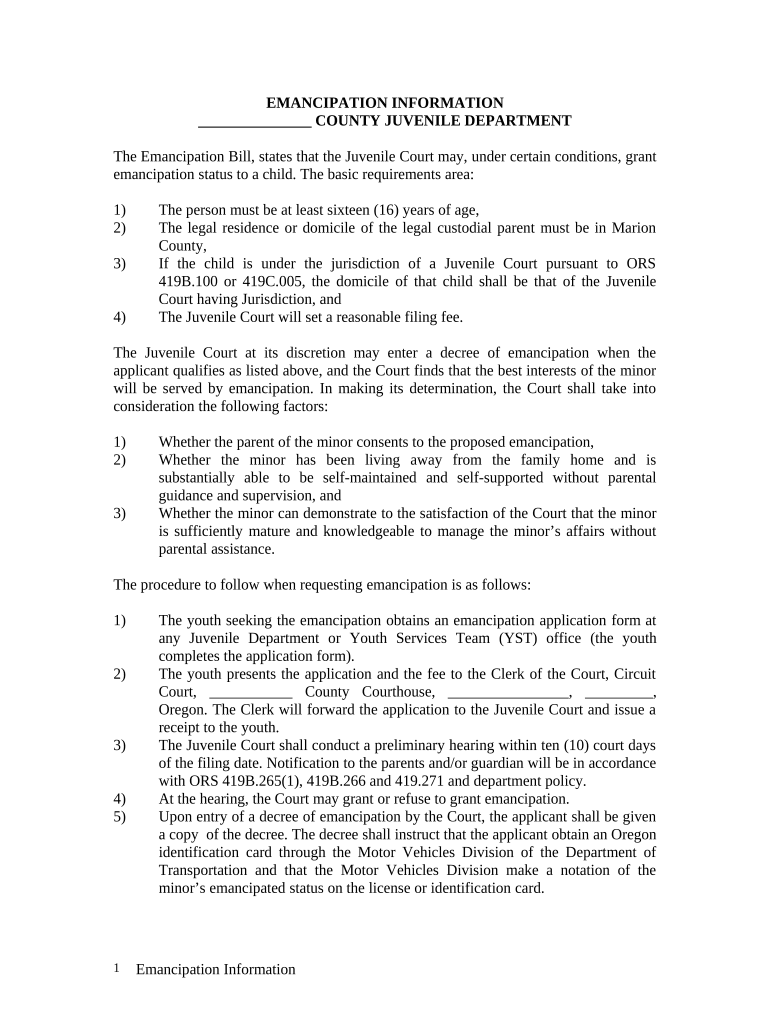
The Oregon Emancipation petition is the court filing used to request that a minor be declared legally independent of parental control. The petition asks a juvenile or circuit court to transfer parental rights and responsibilities so the minor can enter contracts, manage finances, and make certain health and education decisions. Eligibility typically depends on age, proof of self-sufficiency, and a showing that emancipation is in the minor's best interests. The court considers evidence such as employment, housing, education, and the ability to meet living expenses when deciding the petition.

Why an emancipation filing matters

Emancipation creates a legal status change that allows a qualified minor to act as an adult for many civil purposes, including entering leases, consenting to medical care, and managing money. It clarifies legal responsibility and can affect access to benefits, school decisions, and contractual authority in state and federal contexts.

Why an emancipation filing matters

Typical parties involved in an emancipation case

Each party has different documentation responsibilities; attorneys typically handle filings while counselors and social workers collect supporting evidence.

  • Juvenile attorneys and guardians ad litem representing the minor's interests in court proceedings to secure legal emancipation for a qualifying client.
  • School counselors or social workers preparing documentation to support a student who seeks emancipation to make independent education or housing decisions.
  • Self-represented minors who meet statutory criteria and gather supporting evidence such as pay stubs, lease agreements, and school records.

Core sections to include in a professional emancipation petition

A complete petition organizes facts, legal assertions, and supporting exhibits so the court can evaluate eligibility and best interests. Use clear headings and attach verified documents to support claims of independence, stable housing, and income.

Case Caption

Court name, county, case number, parties and petitioner information in a standard caption format used by Oregon circuit courts.
Statement of Facts

Chronological facts about the minor's age, living situation, employment, schooling, and any events relevant to independence and welfare.

Legal Basis

Citation to the state statute or juvenile code section authorizing emancipation and a brief argument tying facts to legal requirements.

Relief Requested

Clear statement of the orders sought—formal emancipation, related orders on custody, support, or records access.

Supporting Exhibits

Pay stubs, leases, school records, letters from employers, and any affidavits that corroborate financial independence and stable living arrangements.

Proposed Orders

Draft order language for the judge to sign, making findings and declaring the minor emancipated if appropriate.

Essential data fields to include on the petition

Minor’s Full Name: Use legal name
Date of Birth: MM/DD/YYYY
Current Address: Street, city, state, ZIP
Parent(s) Names: Full legal names
Employment Details: Employer, position, income
Relief Sought: Emancipation request

Risks and legal consequences of incorrect filings

Dismissal Risk: Incomplete petition
Delays: Missing exhibits
Financial Liability: Unresolved support issues
Records Access: Privacy complications
Appeal Exposure: Insufficient findings
Service Defects: Improper notice

Common mistakes to avoid when preparing an emancipation petition

  • Failing to attach proof of income or housing can make a petition appear speculative rather than evidentiary; include recent pay stubs, lease agreements, or bank statements.
  • Using vague language about ability to support oneself — courts look for concrete evidence of steady income and reliable accommodation rather than aspirational statements.
  • Neglecting proper service on parents or guardians leads to delays or dismissal; follow local rules for personal service or substituted service where permitted.
  • Relying on unsigned or undated documents undermines credibility; ensure exhibits are current, signed, and clearly labeled before filing.

Step-by-step: filing an emancipation petition in Oregon

Follow these sequential steps to prepare and submit a petition; local court rules and timelines may vary by county.

  • 01
    Gather documents: Collect pay stubs, lease, school records
  • 02
    Draft petition: Complete factual and legal sections
  • 03
    Serve parties: Provide notice to parents or guardians
  • 04
    Attend hearing: Present evidence and obtain order

How to prepare an online filing and e-submission workflow

Set up a clear online workflow to collect signatures, notarizations, and supporting exhibits in a single packet for filing with the court.

Step Action required
Upload Petition Attach PDF petition and exhibits
Add Signature Fields Place signer name and date fields
Request Notarization Add notary acknowledgement block
Export for Filing Combine into court-ready PDF

Where an online Oregon Emancipation packet goes next

After assembling documents and signatures, follow the court's filing method and maintain copies for all parties and records.

  • File with Court: Submit to local juvenile or circuit court
  • Serve Parties: Deliver required notice to guardians
  • Attend Hearing: Appear and present exhibits
  • Receive Order: Court signs emancipation order

Digital signing and eSubmission considerations

Ensure the chosen platform complies with ESIGN and UETA, offers retention and export capabilities, and supports any state RON or in-person notarization requirements that apply to your county.

  • File Formats: PDF, DOCX supported
  • Integrations: Court e-filing systems
  • Authentication: Email or SMS code

Typical timelines and processing expectations

Timelines vary widely by county; plan for case preparation, service, and court scheduling when estimating total processing time.

Preparation Time:

1–4 weeks to gather evidence

Service Period:

Depends on local rules and methods

Hearing Scheduling:

Often set within 30–90 days

Court Decision:

May be immediate or take several weeks

Appeal Window:

Follow local appellate deadlines

Realistic filing scenarios to illustrate common approaches

Two representative case scenarios show how documentation and parties differ depending on who files and why.

Juvenile Court Attorney

A counsel files with detailed employment and housing exhibits

  • Attorney submits pay stubs and lease
  • The court relied on verified exhibits and a proposed order to grant emancipation after a contested hearing with testimony and documentary proof.

School District Support

A school counselor compiles attendance and housing statements

  • Counselor attaches school enrollment records
  • The supporting records supplemented the minor’s petition to show independent daily functioning and enrollment stability during the court review process.

Practical tips for accurate and efficient petitions

Apply these practices to reduce defects, accelerate review, and present a compelling, well-documented case to the court.

Organize exhibits clearly
Number and label every supporting document, include dates, and create a table of contents so the judge and opposing parties can find evidence quickly.
Use precise dates and formats
Enter dates as MM/DD/YYYY, include full legal names, and avoid abbreviations that might confuse clerks or the court.
Confirm service rules
Follow the county's rules for serving notice on parents or guardians and keep proof of service to attach to the case file.
Preserve originals
Keep original signed affidavits and certified records in a secure location and provide court-certified copies for filing when required.

eSignature vendor comparison for assembling and signing emancipation packets

Compare vendor starting prices and core capabilities relevant to notarization, audit trails, and HIPAA compliance when choosing a platform for document assembly and signature capture.

signNow DocuSign Adobe Sign PandaDoc HelloSign
Starting Price $8/user/mo $15/user/mo $14/user/mo $19/user/mo $15/user/mo
Free Trial 7-day trial 30-day trial 7-day trial Trial available Trial available
Bulk Send Yes Yes Yes Yes No
Audit Trail Yes Yes Yes Yes Yes
HIPAA Compliant Yes Yes Yes No No
Envelope Cap No cap 100 envelopes/user/year Varies Varies Varies

Frequently asked questions about Oregon Emancipation filings

Answers to common questions about eligibility, service, notarization, and how digital workflows interact with court filing requirements.


Need help? Contact support

be ready to get more
Join over 28 million airSlate SignNow users