Establishing secure connection…Loading editor…Preparing document…

Agreement for Assignment and Sale of Partnership Interest

This template is fully customizable. Edit the text, fill out the fields, and send it for signature. Give it a try!
Agreement for Assignment and Sale of Partnership Interest

What this Agreement Is and when it applies

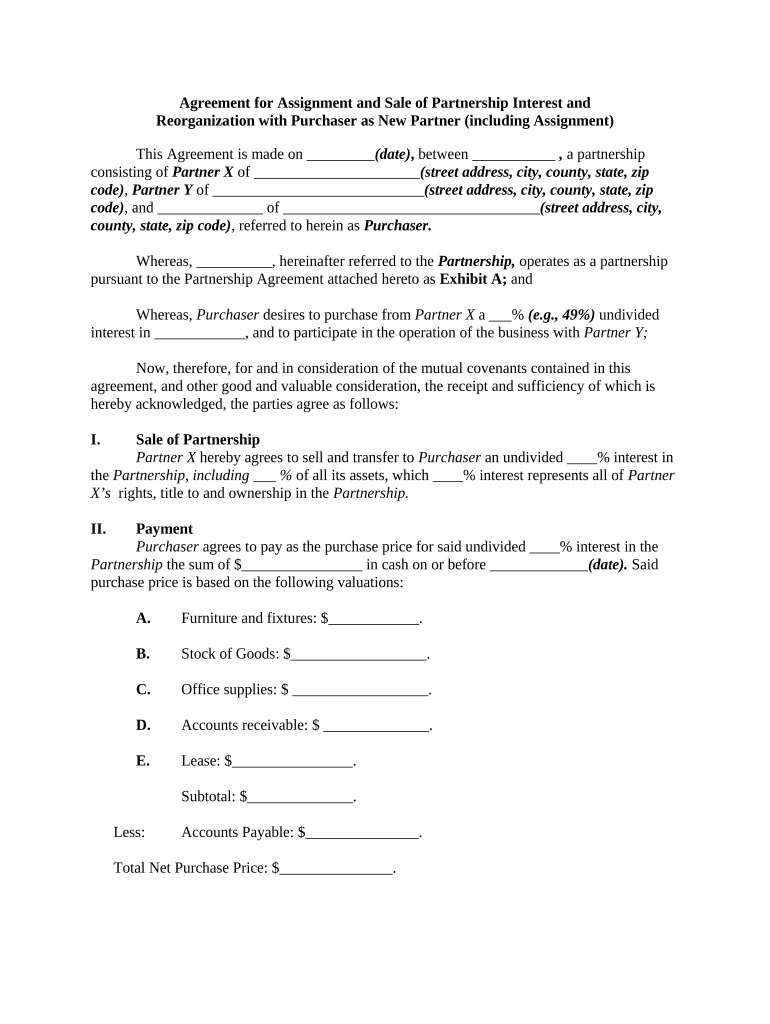
An Agreement for Assignment and Sale of Partnership Interest is a written contract that transfers part or all of a partner’s ownership in a partnership to another party in exchange for agreed consideration. It documents the assignor, assignee, description of the partnership interest, purchase price, effective date, representations, warranties, and any conditions to closing. The agreement often requires notice to other partners and compliance with the partnership agreement, and it may trigger tax reporting obligations and consent requirements under state law and the partnership instrument.

Why a clear assignment agreement matters

A well‑drafted assignment and sale agreement creates a clear record of the transfer, allocates risk, records consideration, and helps ensure enforceability for tax, banking, and ownership purposes. It reduces disputes about effective date, profit allocation, and future management rights.

Why a clear assignment agreement matters

Who typically prepares and signs these agreements

Parties and advisors commonly involved in these transfers and their roles.

  • Selling partner or assignor — Owner transferring all or part of their partnership interest, supplying documentation and executing the assignment.
  • Buying partner or assignee — Purchaser who pays consideration, provides representations, and accepts rights and obligations attached to the interest.
  • Partnership representatives and counsel — Partnership manager or general partner and attorneys who review consent, amend partnership books, and update tax reporting.

Typically the partnership agreement controls consent and notice procedures; consult that document before closing.

Typical signatory roles

Assignor — Owner

A partner assigning their ownership interest. The assignor provides identity documentation, executes representations about authority and title, and delivers signed transfer instruments required by the partnership agreement and any third parties.

Assignee — Purchaser

An acquiring party who accepts the purchased interest, agrees to the stated purchase price and closing terms, provides payment, and often must furnish tax and identity information for partnership records and possible withholding obligations.

Core sections to include in the agreement

A professional agreement organizes the transfer into consistent parts to protect parties and facilitate closing, tax reporting, and partnership recordkeeping.

Parties

Full legal names and entity types for assignor, assignee, and the partnership; include addresses and contact details for notices.
Recitals

Background statements describing the partnership, the interest being transferred, prior approvals, and authority under the partnership agreement.

Assignment Clause

Clear language that assigns the specified percentage or units of partnership interest, effective date, and any contingencies to closing.

Purchase Price

Detailed payment terms, escrow provisions, allocation of consideration, and any contingent or deferred payments.

Representations & Warranties

Seller and buyer promises about authority, title, no undisclosed liabilities, tax status, and absence of restrictions on transfer.

Closing Mechanics

List of closing deliverables, required consents, prorations, effective date, and procedure for updating partnership records.

Step-by-step: completing and closing the transfer

Follow these sequential steps from initial approval to updating partnership records and tax reporting to complete the sale and assignment.

  • 01
    Review partnership agreement: Confirm consent, transfer restrictions, and notice requirements before preparing documents.
  • 02
    Draft assignment: Prepare the agreement with clear parties, interest description, consideration, and closing conditions.
  • 03
    Obtain consents: Secure required partner approvals and any third-party consents before signing.
  • 04
    Close and record: Exchange consideration, sign, notarize if required, and update partnership ledger and tax records.

How to set up the document for online completion

Configure the digital workflow fields and authentication before sending to signers to reduce friction and ensure auditability.

Field Configuration
Signature Type Collected signature field | allow drawn or typed
Authentication Email + SMS code or higher KBA for added identity assurance
Conditional Fields Show payment details only after buyer confirms
Notifications Automated reminders and completion receipts enabled

Digital signing and eSubmission considerations

Ensure the platform supports required authentication, audit trail, and file formats before eSigning or eFiling.

  • File formats: PDF and DOCX accepted
  • Integrations: Connect to NetSuite or Salesforce
  • Security: TLS and AES-256 encryption

Confirm the chosen provider supports audit trails, conditional fields, and any industry-specific compliance such as HIPAA where needed.

Where to file, send, and how to notify stakeholders

After signing, route documents to partnership records, consenting partners, tax preparers, and any filing authorities as required.

  • Partnership records: Deliver executed agreement to the partnership for ledger update.
  • Notices to partners: Send written notice per the partnership agreement terms.
  • Tax advisor: Provide executed agreement and allocation details for reporting.
  • Recording office: If transfer includes real property interest, record deed per county requirements.

Timing considerations and expected processing

Key timing events depend on the partnership agreement, consent periods, and any recording or tax reporting timelines.

Consent period:

Meet any partnership notice or approval window specified in the partnership agreement.

Effective date:

The effective date in the agreement governs allocation of profits and losses.

Recording timeframe:

If real property is involved, record promptly to protect priority and title.

Tax reporting:

Provide documents to tax preparer in time for annual filings and any required information returns.

Partner ledger update:

Update partnership books immediately after closing to reflect new ownership.

Common mistakes to avoid when preparing the agreement

  • Failing to check the partnership agreement’s transfer restrictions and consent requirements before drafting the assignment.
  • Using vague descriptions for the interest transferred instead of precise percentage or unit counts.
  • Neglecting to update partnership records and tax allocations promptly after closing, causing reporting gaps.
  • Overlooking recording requirements when the partnership interest conveys an interest in real property; this can affect priority.

Consequences and legal risks of errors

Invalid Transfer: Transfer may be void absent required consent.
Tax Penalties: Incorrect reporting can trigger IRS penalties and withholding obligations.
Third‑party Claims: Creditors or partners may assert claims against transferee.
Title Problems: Unrecorded property interests can impair marketability.
Withholding Liability: Backup withholding may apply for missing TINs.
Litigation Exposure: Disputes over consideration or representations increase dispute risk.

Real-world scenarios that illustrate typical transfers

Two concise examples show common transfer patterns and practical consequences for parties and the partnership.

Private Partnership Sale

A partner sells a 25% interest to a new investor to raise capital for operations.

  • Buyer provides escrowed funds until consent is confirmed.
  • After partner consent and ledger update, tax preparer adjusts K-1 allocations and the partnership amends its capital accounts to reflect the transfer and consideration.

Admission of New Member

An existing partner assigns a portion of interest to a colleague as part of a succession plan.

  • The partnership agreement requires unanimous consent for admission.
  • Once consent is secured and documents signed, the partnership updates management rights and notifies financial institutions and service providers.

Comparison: eSignature vendor pricing and feature snapshot

Basic pricing and feature availability help evaluate platforms for executing assignments and related closing documents; signNow is listed first per vendor comparison.

signNow DocuSign Adobe Sign PandaDoc HelloSign
Starting Price $8/user/mo $15/user/mo $14/user/mo $19/user/mo $15/user/mo
Free Trial Yes, 7-day trial Varies Varies Varies Varies
Bulk Send Yes Yes Yes Yes No
Audit Trail Yes Yes Yes Yes Yes
HIPAA Compliant Yes Yes Yes No No

Frequently asked questions about assignments and signing

Answers to common legal and process questions encountered when preparing and executing an assignment for sale of partnership interest.


Need help? Contact support

be ready to get more
Join over 28 million airSlate SignNow users