Establishing secure connection…Loading editor…Preparing document…

Answer to Petition to Adopt Child

This template is fully customizable. Edit the text, fill out the fields, and send it for signature. Give it a try!
Answer to Petition to Adopt Child

What an Answer to Petition to Adopt Child Is

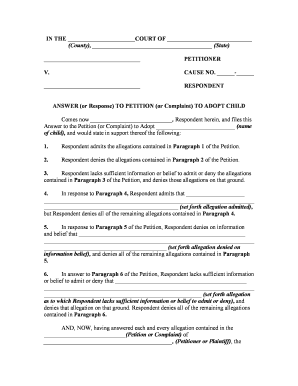
An Answer to Petition to Adopt Child is a formal written response filed by a respondent in family court after receiving a petition for adoption. The document typically admits or denies factual allegations, asserts defenses or objections, and may state the respondent’s consent or opposition to the adoption. It creates an official court record, preserves procedural rights, and triggers case scheduling and discovery events. Because adoption actions affect parental rights and custody, the Answer must follow local court captioning, signature, service, and filing rules to be accepted by the clerk and considered by the judge.

Why Filing a Timely Answer Matters

Filing an Answer preserves the respondent’s right to be heard, prevents entry of a default judgment, and allows the court to consider factual disputes or defenses. A timely Answer also sets the scope for discovery, hearings, and settlement discussions.

Why Filing a Timely Answer Matters

Who Typically Prepares and Files This Answer

Parties and professionals who commonly prepare an Answer to Petition to Adopt Child vary by role and circumstance.

  • Responding parent or guardian — files to admit, deny, or object and to preserve parental rights.
  • Legal counsel (family law attorneys) — drafts pleadings, asserts defenses, and manages filing and service.
  • State agencies or guardians ad litem — file responses when representing a child or public interest.

In contested matters, attorneys typically handle procedural compliance; self-represented respondents must follow local rules on format, signature, service, and deadlines.

Core Parts of a Professional Answer to Petition to Adopt Child

A clear Answer follows the court caption and covers factual responses, affirmative defenses, and a prayer for relief. Organized content improves judicial review and reduces procedural rejection risk.

Court Caption

Full caption with court name, case number, parties, and title (Answer to Petition to Adopt Child) so the clerk can route and docket the filing correctly.
Admissions/Denials

Numbered paragraphs mirroring the petition, clearly stating admission, denial, or lack of information for each allegation to define disputed facts.

Affirmative Defenses

Concise defenses (e.g., improper service, lack of jurisdiction, fraud) asserted with supporting facts to preserve legal arguments for hearing or motion practice.

Relief Requested

A closing section specifying requested court actions — dismissal, evidentiary hearing, visitation terms, or other relief the respondent seeks.

Certificate of Service

A signed statement listing how and when opposing parties and the court were served, including method and date to prove proper notice.

Signature & Verification

Respondent or attorney signature block with printed name, address, phone, bar number (if attorney), and date; include verification or notary where required.

Essential Fields to Include

Petitioner Name: Full legal name
Respondent Name: Full legal name
Child Details: Full name & DOB
Case Number: Court-assigned number
Court Name: County and court
Signature Date: MM/DD/YYYY

Step-by-Step: Preparing and Filing the Answer

Follow these core steps to prepare, file, and serve a compliant Answer to Petition to Adopt Child.

  • 01
    Review the Petition: Read every allegation and note dates and requested relief.
  • 02
    Draft the Answer: Number responses to match the petition and add defenses.
  • 03
    File with Court: Submit to the clerk per local filing rules (electronic or in person).
  • 04
    Serve Parties: Serve petitioner and interested parties; file the Certificate of Service.

Filing and Service Workflow at a Glance

The typical filing flow includes preparation, submission to the court clerk, proof of service, and attending scheduled hearings.

  • Prepare Documents: Assemble Answer, exhibits, and service certificate.
  • File with Clerk: E-file or hand-deliver per local court procedures.
  • Serve Opposing Parties: Use approved service methods and record the date.
  • Attend Hearing: Appear on the date set by the court for arguments.

How to Customize and Complete the Answer Online

When using an e-filing or e-sign platform, configure fields, signer authentication, and delivery options to match court and service requirements.

Field Configuration
Signer Authentication Email link, SMS code, or stronger ID checks
Signature Type Digitally embedded or simple e-signature image
Conditional Fields Show fields only when specific answers are chosen
Return Copies Auto-send signed copies to parties and clerk

Digital Filing and eSubmission Considerations

Courts and clerks vary in e-filing and e-signature acceptance; verify the court’s local rules before relying on electronic submission.

  • Supported Formats: PDF and PDF/A are widely accepted
  • Integrations: Common integrations: Salesforce, Microsoft 365, NetSuite
  • Authentication Options: Email, SMS code, or multi-factor methods

When e-filing or e-signing, ensure the platform supports required audit trails, produces a signed PDF, and can deliver certificates of completion for the court record.

Penalties and Risks of an Incorrect or Late Answer

Default Judgment: Loss of defense
Loss of Rights: Possible parental-rights termination
Sanctions: Court fees or monetary penalties
Perjury Risk: False statements carry legal consequences
Hearing Delays: Procedural errors can postpone resolution
Evidence Excluded: Improper filings may limit admissible proof

Common Mistakes to Avoid

  • Missing or incorrect case number leads to clerk rejection and delays in docketing.
  • Failing to serve the petitioner properly results in vacated hearings or default orders.
  • Using vague denials or failing to mirror petition paragraph numbering creates ambiguity for the court.
  • Not verifying local filing and signature rules (in-person vs electronic) can invalidate the filing.

Typical Deadlines and Scheduling Expectations

Timeframes vary by jurisdiction; below are common deadlines and procedural timelines to monitor after service of a petition.

Answer Deadline:

Typically 20–30 days from service in many states

Service Requirement:

Proof of service filed at or after filing the Answer

Hearing Timeline:

Court schedules hearing after pleadings and mandatory reports

Motions Deadline:

Motions to dismiss or strike often within 20–30 days

Appeal Period:

Varies by state; often 30 days post-judgment

eSignature Vendor Comparison Relevant to Filing and Signing Court Documents

Comparison of common eSignature providers used to sign and share legal filings; signNow is listed first per comparison rules, with key feature and pricing highlights for each vendor.

signNow DocuSign Adobe Sign PandaDoc HelloSign
Starting Price $8/user/mo $15/user/mo $14/user/mo $19/user/mo $15/user/mo
Free Trial 7-day trial Yes Yes Yes Yes
Bulk Send Yes Yes Yes Yes No
Audit Trail Yes Yes Yes Yes Yes
HIPAA Compliant Yes Yes Yes No No

FAQs and Troubleshooting for Answers to Adoption Petitions

Answers to common procedural and technical questions about preparing, filing, and serving an Answer to Petition to Adopt Child.


Need help? Contact support

be ready to get more
Join over 28 million airSlate SignNow users