Establishing secure connection…Loading editor…Preparing document…

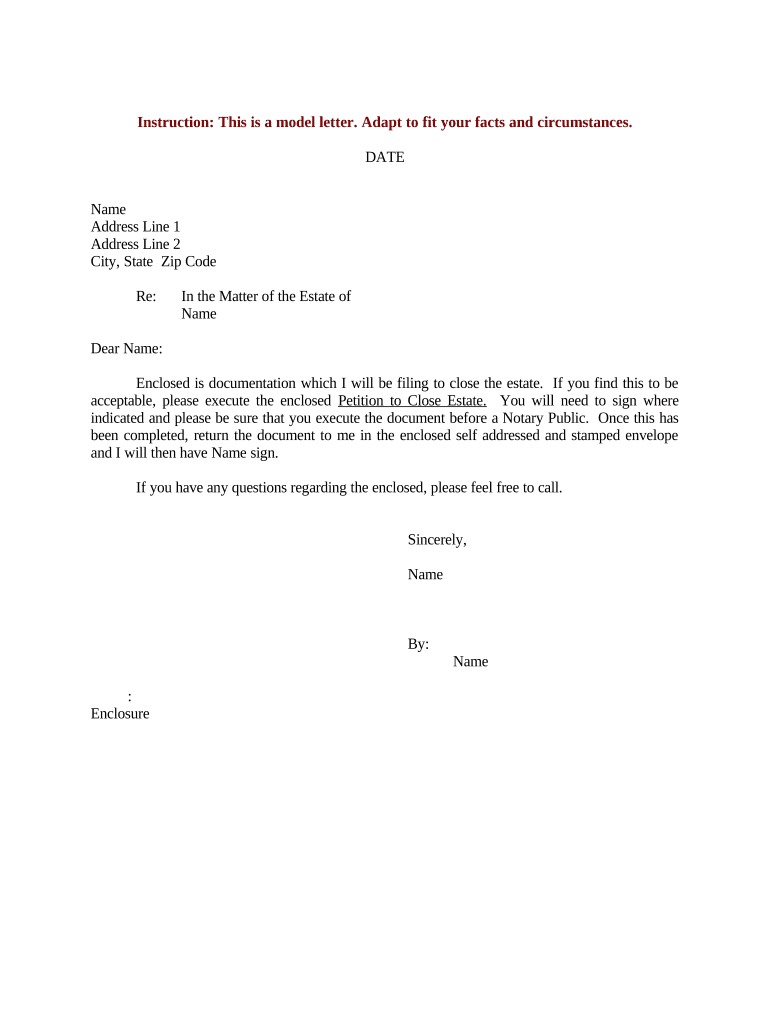
Letter Requesting Execution of Petition to Close Estate

This template is fully customizable. Edit the text, fill out the fields, and send it for signature. Give it a try!
Letter Requesting Execution of Petition to Close Estate

What a Letter Requesting Execution of Petition to Close Estate Is

A Letter Requesting Execution of Petition to Close Estate is a formal cover letter sent to the probate court or interested parties to request that the court enter an order closing an estate after final administration. It summarizes the attached Petition to Close Estate, confirms that all notices, creditor claims, taxes, and distributions have been handled or waived, and identifies the proposed executor or personal representative for final discharge. The letter helps the court and parties locate exhibits such as inventories, accountings, receipts, and releases and provides contact information for follow-up if additional documentation or clarification is required.

Why this Letter Matters in Probate Closing

This letter organizes the closing request, highlights compliance with probate requirements, and helps the court and beneficiaries quickly confirm that administration is complete. It clarifies the relief sought, reduces follow-up requests, and creates a clear administrative record tied to the Petition to Close Estate.

Why this Letter Matters in Probate Closing

Who Usually Prepares and Receives This Letter

The letter is typically prepared by the estate's personal representative or the probate attorney leading the estate administration.

  • Probate Attorney or Law Firm sending a formal closing package to the court and beneficiaries.
  • Personal Representative (Executor) notifying heirs, creditors, and the court of final accounting and distribution.
  • Court Clerk receiving the petition package and docketing the petition to close the estate.

Who May Sign or Authorize the Letter

Personal Representative

The executor or administrator of the estate signs when acting pro se or when counsel is not retained; signature indicates the representative attests to the accuracy of accountings and notices and requests the court to enter a final decree of distribution and discharge.

Probate Attorney

An attorney of record signs on behalf of the estate with client authorization; the attorney includes a certificate of service, case number, and contact details and may file electronically if the court accepts e-filings and electronic signatures.

Essential Elements to Include in a Professional Closing Letter

A clear, concise closing letter should list the case caption, identify attachments, state relief requested, confirm notice and creditor handling, and provide contact details for the estate representative or counsel.

Case Caption

Include the court name, cause or case number, decedent's full legal name, and probate estate identifier so the clerk can immediately locate the matter and associate the letter with the petition and inventory.
Statement of Relief

State explicitly that you are requesting entry of an order closing the estate, discharging the personal representative, and approving final distributions as shown in the attached accounting or decree.

Attachments List

List every attachment by filename or exhibit label: Petition to Close Estate, Final Accounting, Receipts, Releases, Deeds, Estate Tax Clearance, and Certificate of Service to create a self-contained filing packet.

Compliance Summary

Confirm service on beneficiaries and known creditors, notice publication if required, satisfaction or waiver of claims, and payment or reservation for taxes and expenses to demonstrate readiness for closing.

Signature and Authority

Include the signer's printed name, title (Executor/Administrator or Attorney), mailing address, phone number, and bar number for attorneys to establish authority and provide a contact for queries.

Proposed Order

Reference a proposed order or decree closing the estate and note whether a proposed order is attached for the court's convenience to streamline docketing and entry.

Step-by-Step: Preparing and Submitting the Letter and Petition

Follow these core steps to assemble a complete closing packet before submission to the probate court or interested parties.

  • 01
    Prepare Petition: Complete the Petition to Close Estate and final accounting; verify totals and attachments.
  • 02
    Assemble Attachments: Gather receipts, releases, tax clearances, and any deeds or transfers for filing.
  • 03
    Draft Letter: Compose the closing letter referencing the petition, attachments, and relief requested.
  • 04
    Sign and Serve: Execute signatures, file with the court per local rules, and serve beneficiaries and creditors.

How the Closing Letter Fits into the Probate Workflow

This flow shows how the letter interfaces with petition filing, service, hearing, and final entry of decree in the probate process.

  • Upload Packet: Submit petition, letter, and exhibits to court or e-filing portal.
  • Service: Serve all required parties and file certificates of service.
  • Court Review: Clerk and judge review documents; request clarifications if needed.
  • Entry of Order: Court enters order closing estate and discharging representative when satisfied.

Digital Workflow Settings for Completing and Submitting the Letter

Use a structured e-filing workflow to ensure signatures, authentication, and retention are applied consistently before court submission.

Field Configuration
Signer Order Executor signs first, then attorney countersign if applicable
Authentication Email with SMS code or login-based verification for identity attribution
Document Retention Store signed packet in PDF/A with audit trail and timestamp
Notifications Send copies to beneficiaries and file certificate of service automatically

Electronic Submission and Signature Platform Considerations

Verify that the chosen eSignature and e-filing tools meet court technical and authentication requirements before relying on electronic execution.

  • Document Formats: PDF and PDF/A preferred
  • Authentication Options: Email, SMS code, or stronger KBA
  • Audit Trail: Complete timestamped activity log

Timing Considerations and Typical Deadlines

Probate closing timelines vary by jurisdiction; plan for service periods, notice publication, creditor claim windows, and scheduling of a final hearing where required.

File Petition:

File the Petition to Close Estate once final accounting is complete and distributions are ready.

Service on Heirs:

Serve beneficiaries and known creditors according to local rules, often 21–30 days before hearing.

Creditor Claim Period:

Allow statutory creditor notice period to expire before requesting final discharge per state law.

Hearing Date:

Schedule and attend a court hearing if required by the probate local rules.

Entry of Decree:

After review and any objections resolved, the court enters the closing order and discharges the representative.

Common Mistakes to Avoid When Preparing the Letter

  • Omitting the case number or misnaming the decedent, which can cause the clerk to misfile the packet or delay review.
  • Failing to attach required exhibits such as a final accounting, releases, or tax clearance, resulting in requests for additional documentation.
  • Neglecting to include a certificate of service or failing to serve all required parties, which may prevent the court from entering a closing order.
  • Using inconsistent dates or amounts between the accounting, distribution schedules, and attachments, which prompts clerical or substantive objections.

Risks and Consequences of Inaccurate or Incomplete Letters

Delayed Closing: Court may delay entry of the order
Reopen Estate: Estate may be reopened for missed creditors
Surplus Liability: Personal representative may face liability for improper distributions
Tax Exposure: Unresolved tax obligations can trigger penalties
Fee Increases: Additional attorney or filing costs for corrections
Court Sanctions: Possible sanctions for misrepresentations to the court

Real-World Examples of Closing Letter Use

Two brief examples show common contexts where a closing letter accompanies a petition to close an estate.

Small Estate Summary

A personal representative files a concise packet for a small estate

  • Petition lists limited assets and final accounting
  • The clerk accepted the package without hearing because notice and releases were documented, enabling quick discharge and distribution to heirs.

Complex Estate with Real Property

An attorney submits a closing packet including deeds and tax clearance

  • The letter highlights recorded conveyances and outstanding liens
  • The court scheduled a brief hearing, confirmed tax reservations, and entered the closing order after resolving a creditor query.

Comparing eSignature Providers for Executing Probate Closing Documents

Select a provider that supports secure signing, audit trails, and required compliance (for example HIPAA if health data is present). The table lists key price and capability points across common vendors.

signNow DocuSign Adobe Sign PandaDoc HelloSign
Starting Price $8/user/mo $15/user/mo $14/user/mo $19/user/mo $15/user/mo
Free Trial 7-day trial Varies Varies Varies Varies
Bulk Send Yes Yes Yes Yes No
Audit Trail Yes Yes Yes Yes Yes
HIPAA Compliant Yes Yes Yes No No

Integrations and File Formats for Probate Filing

Ensure your eSignature provider supports common integrations and file formats required for filing, archiving, and sharing closing packets.

  • Integrations: Microsoft 365, Google Workspace, NetSuite
  • File Types: PDF, PDF/A, DOCX
  • Storage: Box, Google Drive, Egnyte

Frequently Asked Questions About the Closing Letter and Electronic Execution

Answers below address common execution, eSignature, and filing uncertainties when requesting a petition to close an estate.


Need help? Contact support

be ready to get more
Join over 28 million airSlate SignNow users