Alabama Letter of Administration
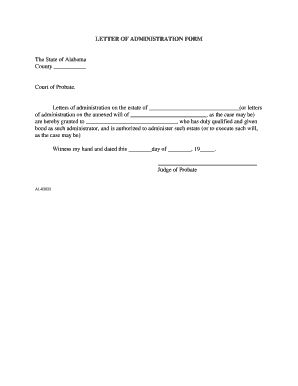
What the Alabama Letter of Administration Is and when it applies
Why the Letter of Administration matters for estate resolution
Used when someone dies without a valid will, the Alabama Letter of Administration enables an eligible person to act legally on behalf of the estate, providing clear authority to manage assets, settle debts, and distribute property in accordance with Alabama probate statutes.

Who typically files or needs an Alabama Letter of Administration
Common users include family members, creditors, and probate attorneys seeking appointment to administer an intestate estate.
- Surviving spouse or adult children seeking to serve as estate administrator.
- Creditors filing claims or securing payment from estate assets during probate.
- Attorneys and professional fiduciaries designated to manage complex estates or settle disputes.
Step-by-step: preparing and filing the petition
-
01Gather Documents: Collect death certificate, asset list, and beneficiary information.
-
02Complete Petition: Fill petition fields accurately and attach required exhibits.
-
03File with Court: Submit petition to county probate court and pay filing fee.
-
04Attend Hearing: Appear at probate hearing for appointment and bond determination.
How to set up online filing and eSubmission
| Field | Configuration |
|---|---|
| Signing Type | Simple e-signature or RON depending on court acceptance. |
| Authentication | Email, SMS, or identity proofing for stronger signer verification. |
| Templates | Use standardized petition templates to reduce omissions. |
| Notary Integration | Enable RON integration if the court accepts remote notarization. |
| Notifications | Set automatic notices to petitioner, heirs, and interested parties. |
Technical requirements for digital signing and file formats
Verify platform capabilities and file formats before eSubmitting an Alabama Letter of Administration to the probate court.
- File Formats: PDF/A or DOCX accepted.
- Integrations: Works with case management and cloud storage.
- Authentication: Supports SMS, email, and SSO.
Where to file and how notices are delivered
-
Filing Location: County probate court in decedent's domicile.
-
Submit Method: In-person filing, mail, or electronic submission if allowed.
-
Service Notice: Clerk issues notices to heirs and creditors.
-
Certified Copies: Obtain certified Letters to present to banks.
Typical timing and deadlines to plan for
Petition Filing:
File as soon as possible after decedent's death; prompt filing avoids delays.
Hearing Scheduling:
Hearing date depends on court calendar; expect weeks to months.
Creditor Claims:
Creditors usually have months from notice to file claims.
Inventory Deadline:
Administrator must file inventory per court timeline, often 3–6 months.
Final Accounting:
Submit closing documents after settling claims; timing varies by estate complexity.
Common mistakes to avoid when preparing the petition
- Using a name on the petition that differs from the death certificate or asset records can cause delays and necessitate corrective filings.
- Failing to include all known heirs or omitting creditor information can produce contested hearings and extend administration timelines significantly.
- Neglecting to secure and value estate assets accurately leads to disputes, incorrect distributions, and potential personal liability for the administrator.
- Relying on unsigned or improperly notarized documents risks rejection at filing and may require re-execution or court-ordered proofs.
Short summary of legal risks and practical consequences
Comparison: signNow and other eSignature vendors for probate documents
| signNow | DocuSign | Adobe Sign | PandaDoc | HelloSign | |
|---|---|---|---|---|---|
| Starting Price | $8/user/mo | $15/user/mo | $14/user/mo | $19/user/mo | $15/user/mo |
| Free Trial | 7-day free trial | Varies | Varies | Varies | Varies |
| Bulk Send | Yes | Yes | Yes | Yes | No |
| Audit Trail | Yes | Yes | Yes | Yes | Yes |
| HIPAA Compliant | Yes | Yes | Yes | No | No |
Real-world examples of how Letters of Administration are used
Community Bank
A county probate clerk accepted a properly completed petition and certified death certificate for a modest estate lacking a will.
- Administrator appointed to manage accounts and distributions.
- The appointed administrator used certified Letters of Administration to access bank accounts, notify creditors, settle liabilities, and distribute remaining assets under Alabama intestate succession rules, completing probate in fewer court appearances.
Estate with Debts
Adult children petitioned for administration where the decedent left multiple unpaid medical bills and a small real property.
- Court set bond and payment schedule.
- The administrator inventoried assets, negotiated creditor claims, sold a minor parcel to cover obligations, and filed final accounting with the probate court; transparent accounting limited personal exposure and satisfied heirs' expectations.
Frequently asked questions about Alabama Letters of Administration
-
Do I need a will to petition?
No. A Letter of Administration is typically used when the decedent left no valid will. The probate court appoints an administrator under Alabama intestacy rules after verifying heirs and jurisdiction; consult probate clerk for county-specific procedures and required documentation.
-
Can the petition be signed electronically?
Possibly. Electronic signatures are generally valid under the ESIGN Act (15 U.S.C. ch. 96) and UETA where adopted, but acceptance of eSigned probate petitions varies by county. Confirm with the local probate court whether they accept eSubmission or require original signatures and notarization.
-
Is notarization required for filing?
It depends. Some probate clerks require notarized signatures or bond acknowledgements; others accept in-court sworn testimony. Remote online notarization (RON) may be accepted in counties that permit it. Verify local rules with the probate clerk before submitting.
-
How long until the probate hearing?
Timing varies with court schedules; expect a hearing within weeks in simple cases or months when the court calendar is congested. Complex estates or disputes can prolong scheduling; communicating with the clerk's office can provide a more accurate timeline.
-
What fees and costs apply?
Filing fees, notary charges, and attorney costs can apply. County filing fees vary; notary fees typically range $5–$15 per signature. Attorney rates commonly fall between $150–$400 per hour. Confirm exact amounts with the local probate office.
-
How long must I retain estate records?
Retain administration records for several years after closing. Federal tax-related documents generally require three years (IRC §6501(a)); HIPAA-protected records require six years (45 CFR §164.530(j)). State retention periods can be longer—consult counsel for specific obligations.