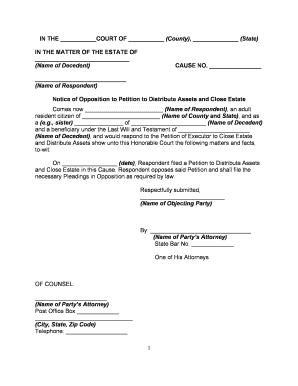
Petition for Estate
What a Petition for Estate Is and When It’s Used
Why the Petition for Estate Matters in Probate
The petition is the official starting point for probate: it secures court supervision, establishes representative authority, preserves estate property, and creates the legal record necessary to collect assets and pay liabilities. Proper preparation reduces later disputes and administrative delay.
Who Typically Prepares and Files a Petition for Estate
Executors, attorneys, close family members, and appointed administrators commonly prepare and file estate petitions depending on the estate’s complexity and jurisdictional rules.
- Individual executors: Family member or named executor filing pro se in straightforward estates.
- Probate attorneys: Legal counsel files petitions for estates with disputes, assets out-of-state, or tax considerations.
- Court-appointed administrators: Courts appoint administrators when no executor is named or no qualified family member is available.
Choosing who files depends on estate size, contested issues, creditor exposure, and whether professional assistance is needed for filings and notices.
Step-by-Step: Completing a Petition for Estate
-
01Identify venue: Select the county and court where the decedent resided at death.
-
02Gather facts: Collect decedent details, heirs, asset inventory, and liabilities.
-
03Draft petition: Complete statutory petition form or template with required exhibits.
-
04File and serve: File with clerk, pay fees, and serve required notices to heirs and creditors.
Penalties and Risks from Incorrect Petitions
Common Preparation Errors to Avoid
- Using inconsistent names or initials across documents, which can complicate service and title transfers.
- Failing to verify venue and county-specific requirements before filing, resulting in transfer or re-filing.
- Omitting statutory attachments (death certificate, will copy, creditor notice statement) required by local rules.
- Underestimating creditor notice obligations or publication requirements, which can expose the estate to claims.
Where to File and How the Petition Is Routed
-
File with clerk: Submit petition and exhibits to county probate clerk.
-
Pay fees: Pay filing fee or request waiver if eligible.
-
Serve parties: Serve heirs, beneficiaries, and creditors per local rules.
-
Court review: Judge issues letters or schedules hearing as required.
Digital Filing, eSignatures, and File Formats
Many probate courts accept electronic filing or PDFs and require PDF/A or court-prescribed formats for uploaded petitions.
- Supported formats: PDF, DOCX accepted
- eSignature rules: Follow ESIGN + state law
- Authentication: Use email or stronger ID
Confirm local clerk requirements for e-filing, accepted file types, and whether electronic signatures or scanned wet-ink signatures must be notarized or accompanied by affidavits.
Configuring an Online Petition Workflow
| Field | Configuration |
|---|---|
| Representative signature | Required signature field with date |
| Death certificate upload | Mandatory file attachment field |
| Heir contact fields | Structured name and address fields |
| Notice generation | Auto-generate creditor notice template |
Comparison: eSignature Providers for Petition Documents
| signNow | DocuSign | Adobe Sign | PandaDoc | HelloSign | |
|---|---|---|---|---|---|
| Starting Price | $8/user/mo | $15/user/mo | $14/user/mo | $19/user/mo | $15/user/mo |
| Free Trial | 7-day free trial, no credit card required | Varies by plan | Varies by plan | Varies by plan | Varies by plan |
| Bulk Send | Yes | Yes | Yes | Yes | Yes |
| Audit Trail | Yes | Yes | Yes | Yes | Yes |
| HIPAA Compliant | Yes | Yes | Yes | No | No |
Real-World Use: How Organizations Handle Estate Documents
Optica Ventures LLC — Brian Fitzgibbons, COO
Optica adopted an online document workflow to streamline client paperwork and approvals.
- The interface is simple and easy-to-use for our team.
- The result was easier client completion and fewer follow-ups, improving processing consistency for legal and administrative forms.
Martin Properties — Tim Martin, Founder
A small real estate operator moved closing-related and estate administration forms online for remote signings.
- I can process and execute all of these documents online with 100% compliance and built-in security.
- This reduced in-person visits and allowed timely filing of probate-related transfers and notices.
Practical Tips for Accurate and Efficient Petitions
Key Timing Items to Track in Probate Administration
File petition promptly:
File as soon as practical after death to secure representative authority; delays can affect asset management.
Creditor notice window:
Creditor claim periods vary by state; commonly 3–6 months after notice or publication.
Inventory deadline:
Many states require an inventory within 60–120 days of appointment.
Accounting schedule:
Final accounting deadlines depend on local rules and court scheduling.
Tax return timing:
Coordinate estate tax and final individual returns with IRS and state deadlines.
Frequently Asked Questions About the Petition for Estate
-
What is included in a petition?
A petition names the decedent, requests appointment of a representative, lists heirs and assets, and asks the court for authority to administer and distribute the estate. Include the death certificate and a copy of the will if available.
-
Who must sign the petition?
The petitioner (proposed representative or attorney) signs the petition. If someone else files on behalf of the representative, include an authorization or verified statement showing authority to file.
-
Can the petition be e-signed?
Electronic signatures are legally valid under the ESIGN Act (15 U.S.C. §7001) and UETA where adopted, but check local court rules and exceptions; wills and certain testamentary documents often remain excluded from e-signature acceptance.
-
Is notarization required?
Notarization needs vary by document and state; some courts accept notarized affidavits and sworn petitions while others accept unsigned originals—confirm county clerk requirements before filing.
-
How to fix filing errors?
Clerks may allow amendments or supplemental filings; submit corrected petition, pay additional fees if required, and notify interested parties as the court directs to preserve due process.
-
When to consult an attorney?
Consult counsel for contested estates, complex asset structures, tax issues, or when creditor exposure or interstate assets create legal complications that require professional advice.