Establishing secure connection…Loading editor…Preparing document…

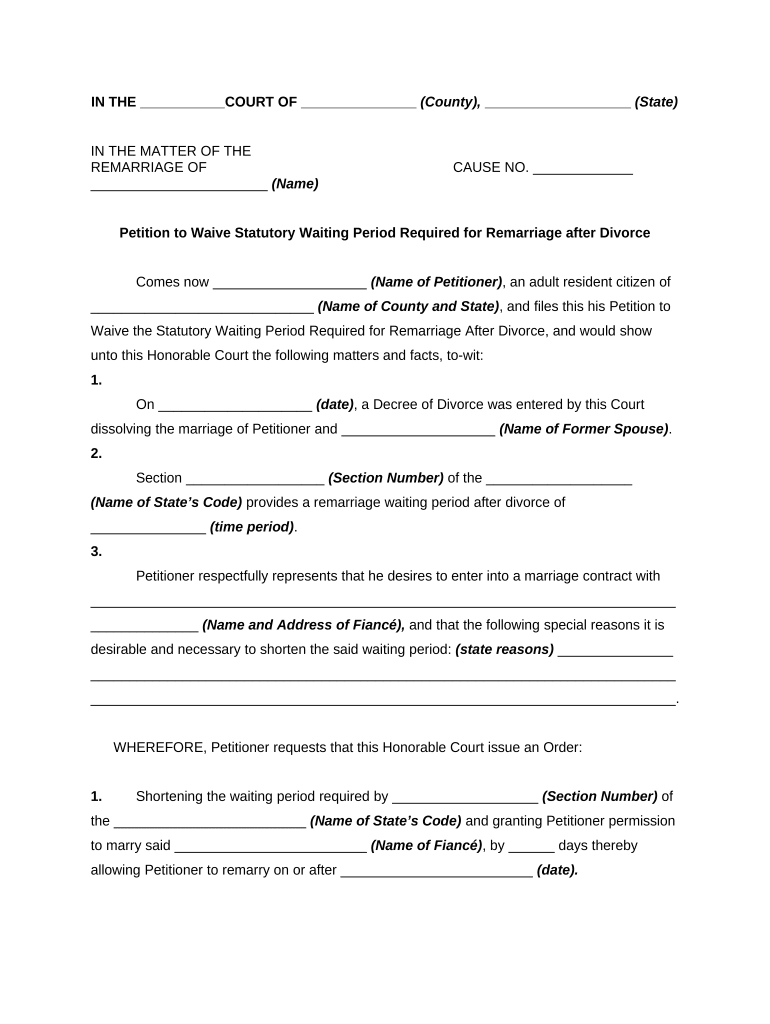
Petition to Waive Statutory Waiting Period for Remarriage

This template is fully customizable. Edit the text, fill out the fields, and send it for signature. Give it a try!
Petition to Waive Statutory Waiting Period for Remarriage

What this Petition Is and when it applies

A Petition to Waive Statutory Waiting Period for Remarriage is a formal request submitted to a court or relevant clerk to shorten or eliminate a statutorily required waiting interval before a person may remarry following dissolution of a prior marriage, annulment, or death of a spouse. The petition explains the requester’s circumstances and legal basis for relief, attaches supporting evidence, and asks the court to exercise discretion under state law. Processing, eligibility, and required supporting documents vary by jurisdiction; some states permit waiver for hardship, military service, or religious reasons while others restrict waiver authority.

Why filing this petition can matter

Filing a petition can accelerate remarriage where state statute sets a mandatory delay, reduce personal or financial hardship, and create an official court record of permission to remarry. Courts evaluate individual circumstances, and a granted waiver removes legal uncertainty tied to attempting to remarry before a statutory deadline.

Why filing this petition can matter

Who typically prepares or files this petition

Parties should confirm local rules for filing, required affidavits, and whether counsel or in-court appearance is required.

  • Individuals requesting earlier remarriage permission
  • Family law attorneys and paralegals
  • Clerks or court staff handling family law dockets

Core parts of a professional petition

A complete petition contains specific factual, procedural, and legal elements so the court can decide whether to grant a waiver; including attachments and a clear remedy request improves clarity.

Caption

Court name, case number (if any), and parties identified at top of the document.
Statement of Facts

Concise factual narrative explaining prior marriage status, date of dissolution or spouse’s death, and the reason for requesting waiver.

Legal Basis

Citation to the state statute or rule authorizing waivers and a short legal argument why relief is appropriate.

Supporting Evidence

Attachments such as divorce decree, death certificate, affidavits, military orders, medical documentation, or hardship declarations.

Request for Relief

Clear statement of the precise waiver requested and any proposed effective date for remarriage.

Verification

Signature block, date, and any required notary or witness lines per state rules.

Essential information to include

Petitioner Name: Full legal name as on government-issued ID
Former Spouse: Full name and date of divorce or death
Case Number: Court case or docket number if available
Grounds Stated: Reason for waiver request in one sentence
Supporting Docs: List of attached documents and dates
Signatory Info: Date, signature, printed name, and contact details

Step-by-step: filling and submitting the petition

Follow these sequential actions to prepare a filing-ready petition.

  • 01
    Draft Petition: Assemble facts, cite statutory authority, and request the specific waiver
  • 02
    Attach Evidence: Add certified divorce decree, death certificate, affidavits, or medical proof
  • 03
    Sign and Verify: Sign petition; complete notary or witness steps when required
  • 04
    File with Court: Submit to clerk per local filing rules, pay fees, and obtain a stamped copy

How to set up an online petition workflow

Configure a digital workflow to collect signatures, attachments, and court-ready copies.

Field Configuration
Document Template Upload PDF or DOCX with fillable fields
Signer Order Set petitioner first, then witness or notary as required
Authentication Use email+SMS or ID verification for stronger signer attribution
Completeness Check Enable required fields and conditional logic to prevent omissions

Where to file and where signed copies go

Understand typical routing so signed petitions reach the correct court file and interested parties receive copies.

  • Local Court Clerk: Primary filing destination for petitions and evidence
  • Opposing Party: Serve notice per local rules if required
  • Attorney of Record: Provide a copy for counsel review and records
  • Petitioner Records: Keep a certified or stamped copy for personal files

Digital signing and e-submission considerations

Verify the court accepts electronically signed filings or requires printed and notarized originals before relying on electronic workflows.

  • File Formats: PDF and DOCX are widely accepted; use flattened PDF for court filing
  • Authentication: Email+SMS or ID proofing increases admissibility and attribution
  • Audit Trail: Ensure timestamps, IP, and signer actions are recorded

Timing and typical processing expectations

Deadlines depend on the court’s calendar, required notice periods, and whether a hearing is necessary; plan for local variations.

Filing Window:

File anytime; earlier filing begins court processing

Notice Period:

Some courts require 7–30 days’ notice to interested parties

Hearing Scheduling:

If a hearing is required, expect 2–12 weeks depending on docket

Clerk Processing:

Administrative review often takes 3–10 business days

Final Order:

Court order timeline varies; expedited relief sometimes available for urgent hardship

Key processing milestones for a petition

A typical petition progresses through predictable stages; each step may involve statutory or local timing obligations.

01

Prepare Petition

Draft and attach required evidence before submission

02

File and Pay Fees

Submit to clerk and pay the court’s filing fee

03

Service of Notice

Serve other parties when required by local rules

04

Hearing and Decision

Appear if ordered; court issues written order or denial

Common mistakes to avoid

  • Failing to attach certified divorce decrees or death certificates, which often causes immediate rejection or requests for supplemental materials.
  • Using inconsistent names or dates between petition, exhibits, and identification, creating identity verification and venue issues.
  • Skipping required service or notice steps under local rules, which can delay hearings or result in order vacatur.
  • Assuming all courts accept electronic signatures — some jurisdictions or specific filings still require original notarized documents.

Risks and consequences of an incorrect petition

Rejection: Filing returns for correction
Delay: Postponed hearings or lost priority
Denial: Court may refuse waiver request
Contempt Risk: Attempting to remarry without order risks legal complications
Evidence Issues: Insufficient proof can undermine credibility
Additional Costs: Extra attorney or filing fees for amendments

Real-world scenarios showing how petitions are used

Two anonymized examples of common bases for a waiver petition.

Case Study 1

Petitioner faced urgent deployment and needed to marry before service overseas

  • military orders showed imminent deployment
  • the court granted a limited waiver after reviewing orders and affidavits supporting hardship and notice to interested parties

Case Study 2

Widowed petitioner sought to remarry for family stability and financial reasons

  • death certificate and financial affidavit attached
  • judge granted waiver based on compelling hardship evidence and clear documentation of prior spouse’s death

Frequently asked questions and answers

Answers to common questions about preparing, filing, and enforcing a waiver of a statutory waiting period.


Need help? Contact support

Comparing eSignature providers for filing-ready petitions

Basic vendor differences for electronic signing and compliance when preparing petitions; signNow is listed first per comparison format.

signNow DocuSign Adobe Sign PandaDoc HelloSign
Starting Price $8/user/mo $15/user/mo $14/user/mo $19/user/mo $15/user/mo
Free Trial Yes, 7-day free trial, no credit card Varies by plan Varies by plan Varies by plan Varies by plan
Bulk Send Yes Yes Yes Yes No
Audit Trail Yes Yes Yes Yes Yes
HIPAA Compliant Yes Yes Yes No No
Envelope Cap No cap 100 envelopes/user/year Varies by plan Varies by plan Varies by plan
be ready to get more
Join over 28 million airSlate SignNow users