Establishing secure connection…Loading editor…Preparing document…

Pledge Agreement

This template is fully customizable. Edit the text, fill out the fields, and send it for signature. Give it a try!
Pledge Agreement

What a Pledge Agreement Is and When It’s Used

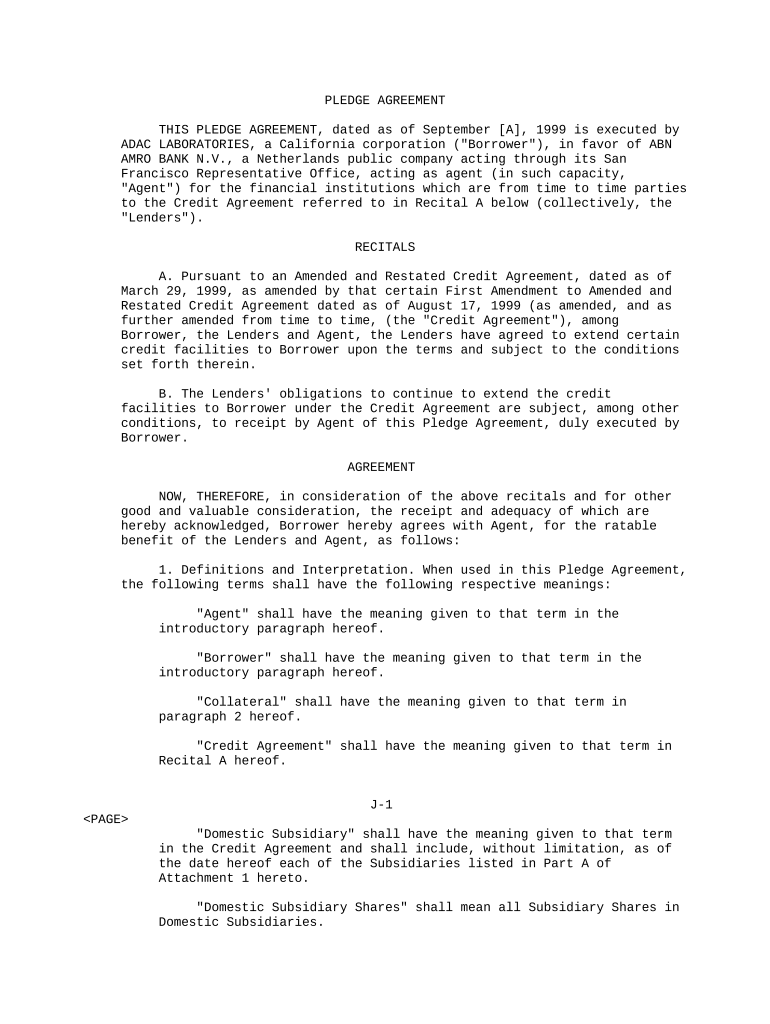
A Pledge Agreement is a security contract under which a debtor (the pledgor) grants a creditor (the pledgee) a security interest in specified collateral to secure repayment of an obligation. It documents the parties, the secured obligations, a precise collateral description, and remedies on default. Pledge Agreements are used in commercial lending, secured lines of credit, equipment financing, and some sale-leaseback arrangements. Perfection of the security interest typically requires additional steps (for example, UCC-1 filing) depending on the collateral and governing law.

Why a Clear Pledge Agreement Matters

A well-drafted Pledge Agreement clarifies rights, priority, and remedies, reduces litigation risk, and improves enforceability if the debtor defaults.

Why a Clear Pledge Agreement Matters

Who Commonly Prepares or Signs a Pledge Agreement

Typical participants include secured lenders, corporate borrowers, guarantors, trustees, and legal or compliance teams reviewing priority and collateral.

  • Banks and credit unions providing secured loans or lines of credit to businesses.
  • Corporate borrowers and subsidiaries granting collateral for financing or supplier credit.
  • In-house counsel or outside attorneys who prepare perfection and enforcement language.

Core Elements to Include in a Professional Pledge Agreement

A comprehensive Pledge Agreement combines identity, scope, notice, perfection steps, and remedies. Use precise descriptions and unambiguous triggering events to reduce enforcement friction and preserve priority against third parties.

Parties

Full legal names, entity types, and signing authority for pledgor and pledgee; include EINs for corporate parties when available.
Secured Obligations

Define the debts, obligations, or contingent liabilities being secured, including principal, interest, fees, and indemnities.

Collateral Description

Describe collateral with specificity (serial numbers, account numbers, inventory descriptions, or general after-acquired property clauses) to avoid ambiguity.

Perfection Steps

State any required filings (UCC-1, control agreements, possession, or RON-notarization) and which party will file and pay fees.

Events of Default

List concrete default events and the cure periods, acceleration rights, and notice procedures before enforcement.

Remedies and Governing Law

Specify permitted enforcement methods, deficiency handling, waiver provisions, and the controlling state law for interpretation.

Step-by-Step: Completing and Perfecting a Pledge Agreement

Follow a clear sequence from drafting to perfection to reduce risk and maintain priority against competing creditors.

  • 01
    Draft: Collect party details and collateral descriptions before drafting.
  • 02
    Review: Legal review for enforceability and priority concerns.
  • 03
    Execute: All authorized signers sign and date the agreement.
  • 04
    Perfect: File UCC-1, control agreement, or take possession as required.

How to Configure an Online Workflow for a Pledge Agreement

Set up a simple digital workflow that secures signatures, records identity, and automates filing reminders for perfection steps.

Field Configuration
Upload Document Import final PDF or DOCX and verify pagination
Assign Roles Add signers and specify signing order and authentication level
Set Authentication Enable SMS code or ID check for higher assurance
Reminders and Storage Schedule reminders for UCC filings and route signed copy to secure storage

Typical eSigning Flow for a Pledge Agreement

A best-practice eSigning flow captures intent, authenticates signers, preserves an audit trail, and delivers a completed record for filing and retention.

  • Upload: Sender uploads the final agreement
  • Place Fields: Add signature, date, and initials fields
  • Authenticate: Signer verifies identity by chosen method
  • Complete: Signed document and audit trail are generated

Platform Requirements and File Formats for eSubmission

Choose a platform that supports PDF and DOCX uploads, audit trails, and secure storage compatible with your compliance needs.

  • Integrations: Salesforce, NetSuite, Microsoft 365
  • File Formats: PDF, DOCX, XLSX
  • Authentication: Email, SMS, KBA

Ensure the vendor supports export of a tamper-evident PDF and retains a timestamped audit trail for filing, storage, and any required legal review.

Key Deadlines and Timing Considerations

Observe execution, filing, and preservation timelines: delayed perfection can reduce priority and expose the pledgee to competing claims.

Effective Date Entry:

Matches the executed signature date unless otherwise specified

UCC-1 Filing:

File promptly after execution to perfect a security interest

Notarization Window:

Complete notarization steps as required by state law before filing

Record Delivery:

Deliver executed originals to pledgee or filing agent promptly

Monitoring:

Set calendar reminders for renewals and continuation deadlines

Milestones from Negotiation to Enforcement

Track discrete milestones so each party knows responsibilities and timing for perfection and enforcement.

01

Negotiation

Agree collateral scope, obligations, and default conditions

02

Execution

All parties sign and date the pledge agreement

03

Perfection

Complete UCC-1, control agreement, or possession steps

04

Enforcement

Trigger remedies according to agreed default procedures

How a Pledge Agreement Compares to Other Security Instruments

Pledge Agreements are one form of security instrument; their mechanics, typical collateral, and filing needs differ from other instruments.

Document Type Pledge Agreement Security Agreement Mortgage Deed of Trust
Typical Collateral tangible goods tangible/intangible real property real property
Perfection Method possession/ucc-1 ucc-1 land records land records
Common Use short-term finance broader lending home financing home financing
Priority Issues depends on possession filing date recording date recording date

eSignature Vendor Pricing and Capability Snapshot

Compare core plan starting prices and basic capabilities relevant to signing and storing Pledge Agreements. signNow is listed first per the comparison framework.

signNow DocuSign Adobe Sign PandaDoc HelloSign
Starting Price $8/user/mo $15/user/mo $14/user/mo $19/user/mo $15/user/mo
Free Trial 7-day free trial Varies Varies Varies Varies
Bulk Send Yes Yes Yes Yes Varies
Audit Trail Yes Yes Yes Yes Yes
HIPAA Compliant Yes Yes Yes No No

Real-World Examples of Digital Execution for Secured Documents

These condensed case stories show how organizations applied eSignature workflows to secured and finance-related agreements.

Martin Properties (Tim Martin)

Tim Martin shifted leasing and collateral agreements to digital workflows to avoid in-person signings and delays.

  • He reported faster turnaround on executed documents.
  • By using an integrated eSignature process across agents and tenants, the company reduced physical handling, ensured consistent signed copies, and stored tamper-evident PDFs for later perfection and enforcement needs.

Fertility Centers of Illinois (John Butler)

John Butler noted the platform’s responsiveness and API integration for document handling.

  • Integration simplified routing.
  • The system allowed staff to route signed agreements to legal and records teams automatically, preserved audit trails for regulatory review, and reduced manual tracking errors across multiple clinic locations.

Practical Tips to Reduce Risk When Preparing a Pledge Agreement

Adopt consistent drafting, authentication, and filing practices to preserve enforceability and priority.

Use Precise Collateral Language
Describe collateral with serial numbers, account identifiers, or unambiguous categories. Avoid vague catchall phrases. Accurate descriptions make UCC searches reliable and reduce challenges to the security interest during enforcement or bankruptcy.
Confirm Signing Authority
Obtain corporate resolutions or proof of authority when entities sign. A documented chain of authority prevents later claims that signatures were unauthorized and preserves the pledgee’s rights to enforce collateral remedies.
Coordinate Perfection Steps
Plan UCC-1 filings, possession arrangements, or control agreements before or immediately after execution. Delays in perfection can result in lower priority versus previously filed creditors or trustees.
Keep an Audit Trail
Retain time-stamped signed PDFs, authentication logs, and delivery receipts. An audit trail supports attribution, intent, and retention requirements under ESIGN and related state laws in case of litigation.

Common Mistakes to Avoid When Preparing a Pledge Agreement

  • Using imprecise collateral descriptions that leave open whether after‑acquired property was intended, which can defeat perfection.
  • Failing to obtain or document signatory authority; unsigned or unauthorized signatures can render enforcement claims voidable.
  • Delaying UCC-1 or control agreement filings until after other creditors have filed, reducing priority and recovery prospects.
  • Relying on email consent alone without proper consumer-facing disclosures where ESIGN requires explicit consent for electronic records.

Security and Compliance Considerations for Electronic Pledge Agreements

Encryption: TLS 1.2/1.3 in transit; AES‑256 at rest
Audit Trail: Detailed timestamped event log
HIPAA Support: BAA available where required
21 CFR Part 11: Capabilities for FDA-regulated records
SOC 2: SOC 2 Type II report available
Access Controls: Role-based permissions and SSO

Penalties and Risks from Incorrect or Incomplete Pledge Agreements

Unenforceability: Security interest may be voidable
Priority Loss: Other creditors may take precedence
Filing Errors: Incorrect UCC indexation risks rejection
Notary Defect: Missing notary can hamper enforcement
Fraud Exposure: Undisclosed liens increase litigation risk
Tax Consequences: Mischaracterized transfers may trigger reporting

Frequently Asked Questions About Pledge Agreements

Answers to common legal and procedural questions about drafting, executing, perfecting, and revoking Pledge Agreements.


Need help? Contact support

be ready to get more
Join over 28 million airSlate SignNow users