Establishing secure connection…Loading editor…Preparing document…

Private Annuity Agreement

This template is fully customizable. Edit the text, fill out the fields, and send it for signature. Give it a try!
Private Annuity Agreement

What a Private Annuity Agreement Is and when it's used

A Private Annuity Agreement is a contract where an owner (the seller/annuitant) transfers property or assets to a buyer (the transferee) in exchange for a lifetime or term-specific stream of payments. It reallocates ownership and spreads gain recognition over the annuity period, and it is commonly used for estate planning, intra-family transfers, and tax deferral planning in the United States.

Key reasons to consider a Private Annuity Agreement

The agreement can convert a lump-sum transfer into predictable payments, potentially deferring capital gains recognition and providing steady income. It also formalizes payment timing, interest assumptions, and remedies if the transferee defaults.

Key reasons to consider a Private Annuity Agreement

Who commonly prepares and signs these agreements

Typical parties include sellers seeking income or estate liquidity and buyers who accept future payment obligations in exchange for immediate asset ownership.

  • Family transfer participants arranging intergenerational wealth transfers with tax and cash-flow considerations
  • Estate planners and attorneys preparing documents to meet fiduciary and tax objectives
  • Private buyers or entities acquiring assets and agreeing to long-term payment schedules

Use professional tax and legal advice when drafting terms that affect tax reporting, creditor exposure, and enforceability across jurisdictions.

Primary signer roles

Seller / Annuitant

The asset owner transferring property who will receive annuity payments. Must verify identity, tax status, and sign with clear acknowledgment of payment schedule and tax consequences; legal counsel usually advisable.

Buyer / Transferee

The party receiving title to the asset and promising periodic payments. Responsible for funding the annuity, maintaining payment records, and accepting liability if payments lapse; should confirm solvency and security terms.

Security, compliance, and data protections to consider

Encryption: TLS 1.2/1.3 in transit; AES-256 at rest
Audit Trail: Tamper-evident logs and timestamps
Certifications: SOC 2 Type II; ISO 27001
HIPAA: BAA available for protected health data
U.S. eSignature Law: ESIGN and UETA compliant
Accessibility: WCAG 2.0 Level AA support

Common legal and tax risks to watch for

Tax recharacterization: IRS may reclassify transaction
Gift tax exposure: Potential IRC gift consequences
Fraudulent conveyance: Creditor challenge risk
Payment ambiguity: Uncertain payment schedule
Missing formalities: Unsigned or unnotarized documents
Ineffective security: No collateral or enforcement plan

Common drafting and execution pitfalls

  • Vague payment formulas or interest assumptions that create disputes over amount due and tax treatment
  • Failing to document transfer consideration clearly, leaving room for IRS or creditor challenge
  • Neglecting to specify contingencies for early death, insolvency, or payment acceleration events
  • Assuming oral assurances replace written amendment procedures or enforcement mechanisms

Essential clauses and elements in a professional Private Annuity Agreement

A complete agreement clarifies parties, assets, payment mechanics, tax allocation, security, and remedies to reduce ambiguity and legal risk.

Parties

Full legal names and entity types of annuitant and transferee; include EINs or SSNs for tax reporting purposes.
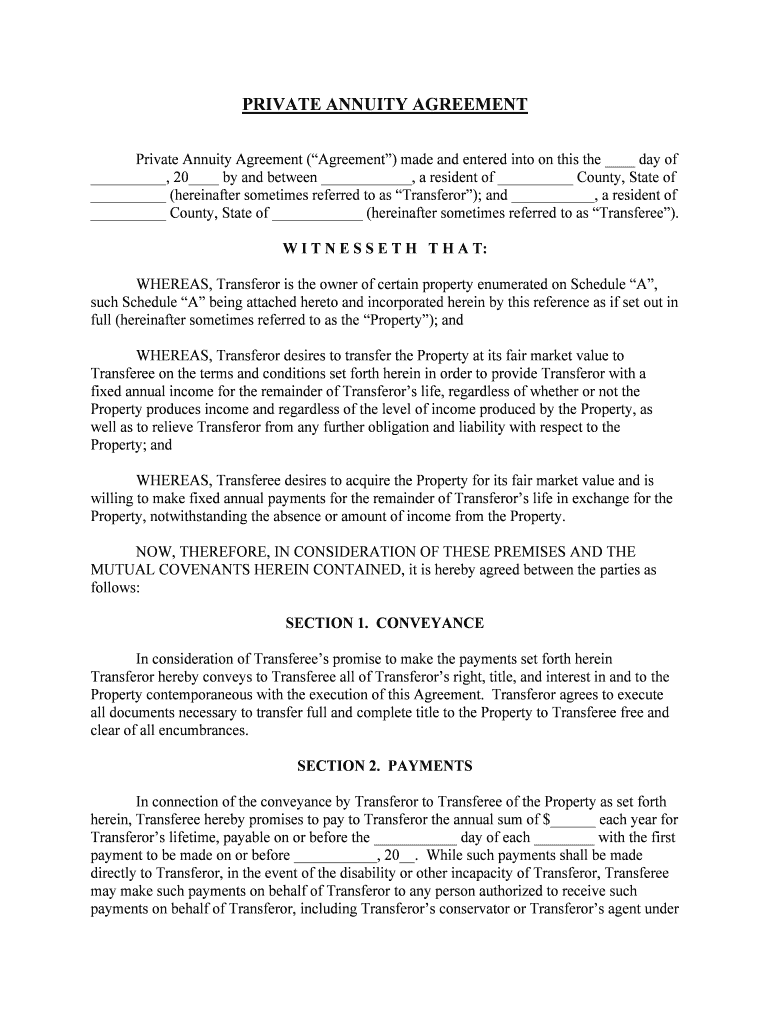
Transferred Property

Clear legal description of assets or title, including deed references for real property or serial numbers for tangible goods.

Annuity Schedule

Payment frequency, amount calculation, start date, term or lifetime provision, and treatment on death or assignment.

Consideration

Specify cash or other consideration exchanged and how it affects basis and gain allocation.

Security & Remedies

Any collateral, escrow arrangements, or default remedies and acceleration clauses to protect the seller.

Tax & Reporting

Allocation of principal versus income, withholding responsibilities, and obligations for information reporting.

Step-by-step: completing a Private Annuity Agreement

Follow these sequential steps to prepare, review, and finalize the agreement with clear evidence of intent and consent.

  • 01
    Draft terms: Define parties, asset, payment schedule, and defaults.
  • 02
    Tax review: Confirm tax allocation with advisor before signing.
  • 03
    Execute document: All parties sign; notarize if required.
  • 04
    Record transfer: Record deeds or file UCC where applicable.

How execution, delivery, and enforcement typically flow

These four stages summarize the document lifecycle from preparation through enforcement.

  • Preparation: Draft with legal and tax counsel; attach exhibits.
  • Signing: Parties sign; consider notarization or RON.
  • Recording: Record deeds or file security instruments as applicable.
  • Ongoing compliance: Track payments and issue tax forms each year.

Technical workflow settings for digital completion

Configure a secure signing workflow that supports identity checks, notarization, and document retention to maintain legal defensibility.

Field Configuration
Authentication Email link plus optional SMS code for signer verification
Notarization Support for RON sessions or in-person notary workflows
Templates Reusable templates with conditional fields and merge data
Retention Audit trail plus secure PDF export and long-term storage

Delivery channels, integrations, and technical considerations

Choose delivery and integration options that preserve audit trails, support authentication, and meet recordkeeping obligations.

  • E-sign delivery: Email links or embedded signing sessions
  • System integrations: CRM and document storage connectors
  • File formats: PDF, DOCX, and secure exports

Use platforms that integrate with CRM, ERP, and cloud storage. Verify support for PDF/A exports, audit logs, and any required notarization integrations before deploying at scale.

Key dates and timing considerations

Track these critical dates to protect rights and meet reporting obligations tied to the agreement.

Effective date entry:

Establishes when payments and transfer obligations begin

First payment due:

Date when the annuity payer must make the initial payment

Recording deadline:

Record deed or UCC promptly after transfer where required

Annual tax reporting:

Report payments on appropriate information returns each tax year

Amendment timing:

Specify notice period and effective date for amendments

Real-world implementation examples

These customer examples show how organizations used digital signing and recordkeeping to complete complex transfer agreements.

Optica Ventures — Brian Fitzgibbons

Optica used digital workflows to circulate the agreement quickly and securely

  • Executed signatures via structured signing links to multiple parties
  • The result reduced turnaround time and preserved a detailed audit trail for tax and title records.

Fertility Centers of Illinois — John Butler

Fertility Centers implemented eSigning with integrated templates for recurring transactions

  • Templates ensured consistent clauses and fields across agreements
  • This standardized approach reduced review time and improved record consistency for compliance purposes.

Selected eSignature vendor comparison for signing and managing agreements

Compare typical pricing and core capabilities across major eSignature vendors; signNow appears first in the vendor column per listing conventions.

signNow DocuSign Adobe Sign PandaDoc HelloSign
Starting Price $8/user/mo $15/user/mo $14/user/mo $19/user/mo $15/user/mo
Free Trial 7-day free trial Varies by plan Varies by plan Varies by plan Varies by plan
Bulk Send Yes Yes Yes Yes No
Audit Trail Yes Yes Yes Yes Yes
HIPAA Compliant Yes Yes Yes No No

Frequently asked questions and practical clarifications

Answers to common legal, tax, and execution questions about Private Annuity Agreements, with attention to U.S. rules and electronic execution.


Need help? Contact support

be ready to get more
Join over 28 million airSlate SignNow users