Establishing secure connection…Loading editor…Preparing document…

California Employee's Proprietary Information and Inventions Agreement

This template is fully customizable. Edit the text, fill out the fields, and send it for signature. Give it a try!
California Employee's Proprietary Information and Inventions Agreement

What the California Employee's Proprietary Information and Inventions Agreement Is

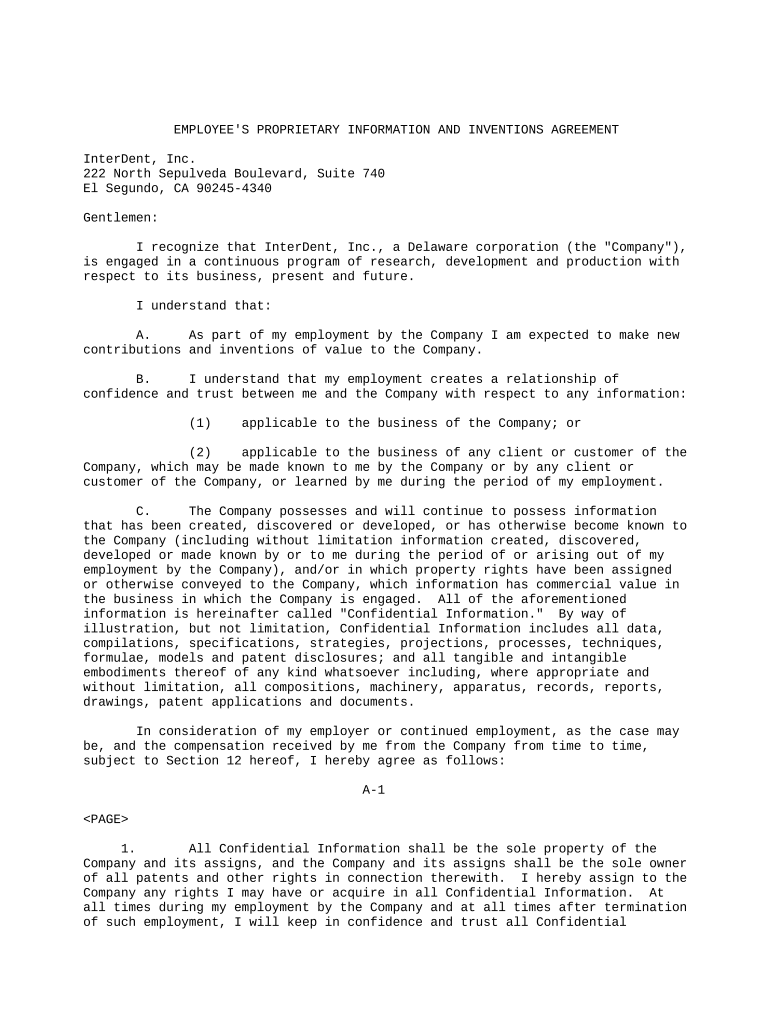
The California Employee's Proprietary Information and Inventions Agreement (PIIA) is an employment document that defines employer confidential information, assigns certain invention rights, and sets expectations for handling proprietary materials. In California the agreement must be drafted and applied with statutory limits in mind, including Labor Code provisions that limit assignment of inventions created on an employee's own time without employer resources. This page explains structure, legal constraints, completion steps, and retention best practices for employers and employees.

Why this Agreement Matters for Employers and Employees

A well-drafted PIIA clarifies ownership of inventions, protects trade secrets, and reduces post-employment disputes while respecting California statutory protections such as Labor Code §2870 and federal e-signature law where applicable.

Why this Agreement Matters for Employers and Employees

Who Typically Uses the California Employee's PIIA

Employers and employees across technology, life sciences, professional services, and other innovation-driven sectors commonly use this agreement before or at hiring.

  • Early-stage employers onboarding engineers, product designers, or developers with direct access to source code and prototypes.
  • Established companies hiring research staff, inventors, or contractors whose work may produce patentable inventions.
  • Human resources and legal teams standardizing templates to balance protection with California statutory limits.

Primary Signatories and Their Roles

Employee

The individual under hire who must disclose prior inventions, agree to confidentiality, and assign defined invention rights consistent with California law. The employee should read assignment scope, invention disclosure obligations, and any carve-outs before signing.

Employer Representative

An authorized company officer or HR representative signs for the employer and ensures the agreement's terms align with company IP policy, job description, and applicable state statutes; consult counsel for role-specific language.

Essential Data Elements Included in the Agreement

Parties: Employee and employer legal names
Effective Date: MM/DD/YYYY format
Definition: Scope of confidential information
Assignments: Inventions covered and assignment terms
Exclusions: Employer resource and outside-time carve-outs
Term: Duration of confidentiality obligations

Key Risks and Consequences of an Incorrect Agreement

Unenforceable Assignment: Overbroad clauses may be void under Cal. law
Trade Secret Loss: Weak definitions can jeopardize protection
Litigation Costs: Disputes can lead to expensive lawsuits
Patent Claim Issues: Ambiguity may impact patent ownership
Regulatory Exposure: HIPAA or other rules may apply in healthcare
Operational Delay: Onboarding may be slowed by unclear terms

Common Mistakes to Avoid When Preparing a PIIA

  • Using template assignment language without checking California Labor Code §2870 and relevant carve-outs can render key parts unenforceable.
  • Failing to define 'Company Resources' leads to disputes about whether an invention used employer tools or time.
  • Not recording inventor disclosures or failing to require timely reporting increases the risk of ownership challenges later.
  • Combining overly broad noncompete language with assignment clauses; noncompetes are generally unenforceable in California.

Real-World Scenarios Where a PIIA Is Used

Two short examples show practical differences in PIIA use for startup hires and enterprise research staff.

Startup Engineer

A lead engineer signs at hiring and discloses prior side projects

  • Agreement includes narrow assignment tied to company projects
  • The company limits assignment language to inventions developed using company resources and conducts inventor disclosures to avoid future disputes.

Enterprise Researcher

A scientist with lab access signs as a condition of employment

  • Agreement includes clear IP assignment and data-handling rules
  • The employer attaches lab data protocols and requires periodic invention disclosures to preserve patent rights and trade secret protection.

Step-by-Step: How to Complete the Agreement

Follow these steps to complete, review, and store a California PIIA correctly.

  • 01
    Read Carefully: Review definitions and assignment scope before signing.
  • 02
    Disclose Prior Inventions: List prior inventions to avoid future ownership disputes.
  • 03
    Confirm Effective Date: Enter the start date as MM/DD/YYYY before signing.
  • 04
    Sign and Store: Sign with required witnesses or e-signature and retain a copy.

Typical Workflow for Issuing and Executing a PIIA

This workflow outlines the common sequence from template selection to final retention.

  • Prepare Template: Customize assignment and confidentiality language for role.
  • Send to Candidate: Provide agreement before start date for review and signature.
  • Collect Signatures: Use e-signature or in-person signing with verification.
  • Archive Record: Store signed agreement with HR and legal files.

Core Clauses Every Professional PIIA Should Contain

A compliant PIIA balances employer protection with statutory carve-outs and clear employee obligations; include precise clauses for each core area below.

Confidentiality

Define what constitutes confidential information, permitted disclosures, and handling procedures, including electronic storage and access controls to protect trade secrets.

Assignment of Inventions

Identify inventions subject to assignment, specify employer resources, and include exceptions for employee-created inventions outside work time.

Disclosure Duty

Require timely, written disclosure of inventions created during employment and describe the format and recipient within the company.

Return of Materials

Obligate return of company property and clarify retention or deletion of copied electronic files upon termination.

Practical Tips for Accurate and Efficient Completion

Adopt standard practices that reduce disputes and speed onboarding while complying with California law.

Use Role-Specific Templates
Maintain separate templates for engineers, executives, and contractors to ensure assignment language matches job duties and exposure to IP.
Require Prior-Invention Lists
Collect a signed schedule of prior inventions at hire to avoid later challenges and to document clear attribution.
Limit Assignment Scope
Draft narrow assignment provisions tied to employer resources or projects to improve enforceability under California Labor Code norms.
Coordinate With Patent Counsel
Involve IP counsel when drafting assignment language for R&D roles to align with patent prosecution needs and inventor obligations.

Key Milestones from Offer to Post-Termination

The typical milestone timeline shows when to issue, sign, and retain the agreement during the employee lifecycle.

01

Offer Issued

Provide the PIIA with the offer letter before acceptance.

02

Signing Deadline

Require signature prior to start date or on day one.

03

Periodic Disclosures

Request invention disclosures during employment as needed.

04

Post-Term Retention

Retain the signed agreement for the legally recommended period.

Time-Sensitive Items to Track

Track these deadlines to protect rights and maintain compliance during and after employment.

Effective Date Entry:

Enter MM/DD/YYYY before signatures to fix start of obligations.

Prior-Invention Disclosure:

Obtain list at hiring to avoid future ownership disputes.

Invention Reporting:

Request written notification when employee believes an invention was made.

Patent Filing Coordination:

Coordinate disclosures with patent counsel before filings.

Record Retention Start:

Begin retention clock on effective date or signing date.

Detailed Components to Review Before Finalizing the Agreement

These six components frequently determine enforceability and operational clarity; review each for scope, timing, and legal compliance.

Definitions

Precise definitions for 'Confidential Information', 'Invention', and 'Company Resources' reduce ambiguity and support enforcement.
Assignment Clause

Specify what inventions are assigned, how assignment occurs, and exceptions for inventions developed without company resources.

Prior Inventions Schedule

Attach or require a completed schedule of prior inventions that the employee represents as their own prior work.

Confidentiality Duration

State how long confidentiality survives termination and any exceptions for public domain information.

Return and Destruction

Require return of physical property and define obligations for deletion or retention of electronic copies.

Governing Law

Identify applicable state law, mindful that California public policy can affect certain assignment provisions.

How to Configure an Online PIIA Workflow

Recommended digital workflow settings for secure distribution, signing, and recordkeeping.

Field Configuration
Authentication Email link with optional SMS code or KBA for higher assurance
Signature Type Allow typed or drawn e-signature; capture audit trail
Retention Store PDF with audit trail and exportable metadata
Notarization Enable RON where lawful; otherwise record in-person notarization steps

Digital Signing and Integration Considerations

Ensure the chosen provider supports record retention, optional RON, and a HIPAA BAA if the document is used with protected health information.

  • Integrations: Salesforce, NetSuite, Google Workspace, Microsoft 365
  • File Types: PDF, DOCX, HTML, Excel
  • Authentication: Email, SMS, multi-factor options

How a PIIA Differs from an NDA or Invention Assignment Only

Compare common document types to choose the right instrument for protecting confidential information and invention ownership.

Document Type PIIA NDA
Scope confidentiality + assignment confidentiality only
Invention Assignment
Prior Invention Schedule typical less common
Employment Integration often required often separate

eSignature Platform Pricing Comparison When Managing PIIAs

Platform pricing and feature availability affect cost and compliance. signNow appears first; compare starting prices and enterprise features relevant to PIIA workflows.

signNow DocuSign Adobe Sign PandaDoc HelloSign
Starting Price $8/user/mo $15/user/mo $14/user/mo $19/user/mo $15/user/mo
Free Trial 7-day free trial Varies by vendor Varies by vendor Varies by vendor Varies by vendor
Bulk Send Yes (Premium) Yes Yes Yes No
Audit Trail Yes Yes Yes Yes Yes
HIPAA Compliant Yes Yes Yes No No
Envelope Cap No cap 100 envelopes/user/year Varies by plan Varies by plan Varies by plan

Frequently Asked Questions About the California Employee's PIIA

Answers to common legal and practical questions about enforceability, electronic signatures, and special California rules.


Need help? Contact support

be ready to get more
Join over 28 million airSlate SignNow users