Establishing secure connection…Loading editor…Preparing document…

Protective Quash Order

This template is fully customizable. Edit the text, fill out the fields, and send it for signature. Give it a try!
Protective Quash Order

What a Protective Quash Order Is and When It Applies

A Protective Quash Order is a court-issued directive that limits or terminates compelled disclosure in response to subpoenas, discovery requests, or other compelled production. It typically seeks to protect privileged communications, trade secrets, personal data, or other sensitive material from disclosure or public filing. Practitioners use this motion to prevent premature production, require a protective protocol (redaction, sealed filing, in camera review), or to quash an overbroad or burdensome demand. The order can be sought in federal and state litigation; local rules and judge-specific practices affect form, timing, and supporting affidavits.

Why a Protective Quash Order Matters in Litigation

A Protective Quash Order preserves privileged or confidential material, narrows discovery scope, and reduces litigation risk by preventing inappropriate disclosures. Courts use these orders to balance relevance with privacy, business confidentiality, and statutory protections.

Why a Protective Quash Order Matters in Litigation

Who Typically Prepares and Requests a Protective Quash Order

Courts, opposing counsel, and third parties receive copies per local rules; counsel should follow procedural and service requirements for the jurisdiction.

  • Defense counsel seeking to protect client communications and litigation strategy.
  • Corporate privacy or compliance teams guarding trade secrets or proprietary data.
  • Individual parties defending personal privacy interests or regulated health/education data.

Typical Signatories and Their Roles

Lead Counsel

A licensed attorney for the moving party who signs the motion and verifies factual assertions. Lead Counsel prepares legal argument, files the motion with the court clerk, and certifies compliance with local meet-and-confer rules.

Corporate Representative

An authorized company officer or custodian may execute certifications or declarations supporting confidentiality claims. Their declaration should explain why documents are sensitive and identify privilege bases or trade secret elements.

Filing a Protective Quash Order: Step-by-Step

Follow local rules and meet-and-confer obligations before filing; include declarations and proposed order.

  • 01
    Prepare motion: Draft legal argument, cite case law, and attach supporting declarations.
  • 02
    Meet and confer: Attempt resolution with opposing counsel per local rules and certificate of meet-and-confer.
  • 03
    File motion: Submit via court e-filing system with proposed order and redacted exhibits if necessary.
  • 04
    Serve parties: Serve all parties and interested nonparties according to local service rules.

How a Protective Quash Order Moves Through the Court Process

A Protective Quash Order follows a predictable flow from filing to judicial decision and implementation.

  • Filing: Motion filed electronically with supporting exhibits and proposed order.
  • Opposition: Opposing party files response and any counter-declarations.
  • Hearing: Court may schedule oral argument or decide on the papers.
  • Order: Judge issues order granting, denying, or modifying protective relief.

Setting Up an Electronic Workflow for a Protective Quash Order

Configure your e-filing and signing workflow to protect confidential exhibits and track chain of custody.

Field Configuration
Document Access Controls Restrict downloads and set view-only where supported.
Signer Authentication Use email plus ID review or two-factor authentication for counsel signatures.
Redaction Workflow Apply redaction layers before sharing exhibits; preserve originals offline.
Audit Trail Enable full audit records: timestamps, IPs, and signer identity logs.

Technical Requirements for Secure eSubmission

Verify the court's e-filing requirements and retain an unredacted copy offline under attorney-client privilege protocols.

  • File Formats: PDF/A or PDF preferred for court compatibility.
  • Authentication: Multi-factor authentication recommended for signers.
  • Integrations: Integrates with court e-filing portals and secure storage.

Typical Timing and Deadlines to Observe

Deadlines vary by court and local rules; calendar each step to avoid waiver or sanctions.

Meet-and-Confer Window:

Many jurisdictions expect conferment before filing; timing varies by local rule.

Response Deadline:

Opposition often due 14–21 days after service; check local rules.

Reply Deadline:

Reply briefs commonly due 7–14 days after opposition is filed.

Hearing Notice:

Court sets hearing dates per calendar availability, often 3–8 weeks out.

Compliance Stay:

Requesting a stay or sealing may be necessary pending the judge's decision.

Key Milestones from Filing to Order

Track these sequential milestones to ensure timely filings and preservation of privileged material.

01

Prepare Motion

Complete draft, attach declarations, and propose protective procedures.

02

Meet and Confer

Document attempts to resolve disputes before filing with the court.

03

File and Serve

E-file and serve all parties, noting any sealing or redaction needs.

04

Court Decision

Implement judge's order and inform custodians and third parties of any restrictions.

Common Pitfalls to Avoid When Preparing a Protective Quash Order

  • Failing to meet-and-confer before filing, which can lead to sanctions or denial of relief.
  • Submitting unredacted privileged exhibits to the public record instead of sealed or in camera review.
  • Using vague descriptions of materials that leave the court unable to assess privilege claims.
  • Omitting a proposed order or specific protective procedures for how disclosure should be handled.

Risks and Consequences of an Incorrect or Untimely Motion

Sanctions: Monetary or evidentiary sanctions may follow improper filings.
Waiver: Privilege may be deemed waived by improper disclosure.
Contempt: Court may hold parties in contempt for failing to comply.
Public Disclosure: Sensitive data could become part of the public record.
Case Delay: Motions can lengthen litigation timelines and increase costs.
Professional Discipline: Repeated procedural failures may trigger professional review.

Essential Components to Include in a Professional Protective Quash Order

A complete motion includes a clear statement of facts, legal authority, declaration of privilege, proposed protective procedures, and a proposed order the judge can sign.

Caption

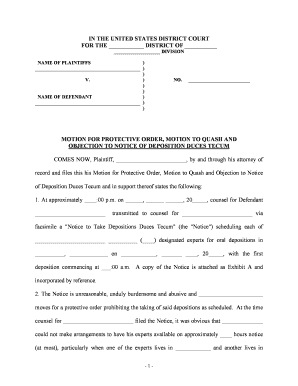
Full court name, case caption, and docket number. Accurate captioning directs the clerk and ties the motion to the correct matter; clerical errors can misroute filings.
Statement of Facts

Concise factual background explaining how documents were requested, who seeks them, and the context of the litigation; factual clarity helps the court resolve disputed privilege or relevance issues.

Legal Argument

Cite controlling authority and standards for quash or protective orders; explain why requested materials are privileged, overbroad, or unduly burdensome under applicable rules.

Declarations

Attach sworn declarations from custodians, privacy officers, or counsel describing the documents, privilege bases, or trade secret elements supporting non-disclosure.

Proposed Relief

Specify the exact relief sought—quash, partial redaction, in camera review, sealing order, or protective protocol with handling instructions.

Proposed Order

Include a ready-to-sign proposed order with precise operative language and any deadlines for compliance or return of materials to the producing party.

How a Protective Quash Order Differs from Similar Motions

Compare typical objectives, parties, and outcomes to distinguish proper usage from other discovery motions.

Criteria Protective Quash Order Motion to Quash
Primary Purpose limit/secure disclosure eliminate compliance with subpoena
Typical Author responding party or custodian recipient of subpoena
Relief Sought protective conditions or sealing complete nullification of demand
Where Filed pending case court court with jurisdiction over subpoena

eSignature Pricing Comparison for Preparing and Submitting Protective Quash Orders

This table presents starting price and key capability differences among common eSignature vendors; signNow is first per vendor-ordering rules.

signNow DocuSign Adobe Sign PandaDoc HelloSign
Starting Price $8/user/mo $15/user/mo $14/user/mo $19/user/mo $15/user/mo
Free Trial 7-day free trial, no credit card required Varies by vendor Varies by vendor Varies by vendor Varies by vendor
Bulk Send Depends on plan Yes Yes Yes No
Audit Trail Yes Yes Yes Yes Yes
HIPAA Compliant Yes Yes Yes No No

Practical Examples of Protective Quash Order Use

These short examples illustrate common scenarios where a Protective Quash Order is appropriate.

Corporate Litigation

A company receives a broad subpoena for internal communications about a merger.

  • The company moves to quash and requests in camera review.
  • The court limits disclosure, orders redaction of privileged segments, and requires a privilege log to justify withheld material.

Healthcare Privacy

A party seeks patient records beyond relevance.

  • Hospital moves for protective order citing HIPAA and patient privacy.
  • Judge allows limited production under sealed conditions and orders strict handling procedures for disclosed documents.

Practical Tips for Accurate and Efficient Completion

Adopt a consistent checklist to reduce errors and speed judicial consideration.

Prepare a Privilege Log
Provide a clear, itemized privilege log describing withheld materials without disclosing privileged content; specificity strengthens the motion and reduces in camera review scope.
Use a Proposed Order
Include a concise, ready-to-sign proposed order with specific protective measures and deadlines to aid the judge and clerk.
Redact Carefully
When redaction is proposed, preserve an unredacted master under attorney control and clearly mark redactions in the public filing copy.
Document Conferences
Keep written records of meet-and-confer efforts and include a certificate of compliance to satisfy local procedural rules.

Frequently Asked Questions About Protective Quash Orders

Answers to common procedural and practical questions when preparing, filing, or contesting a Protective Quash Order.


Need help? Contact support

be ready to get more
Join over 28 million airSlate SignNow users