Scope of Services
Describe specific investment authority, discretionary limits, approved instruments, and any prohibited transactions to align subadviser actions with client mandates.
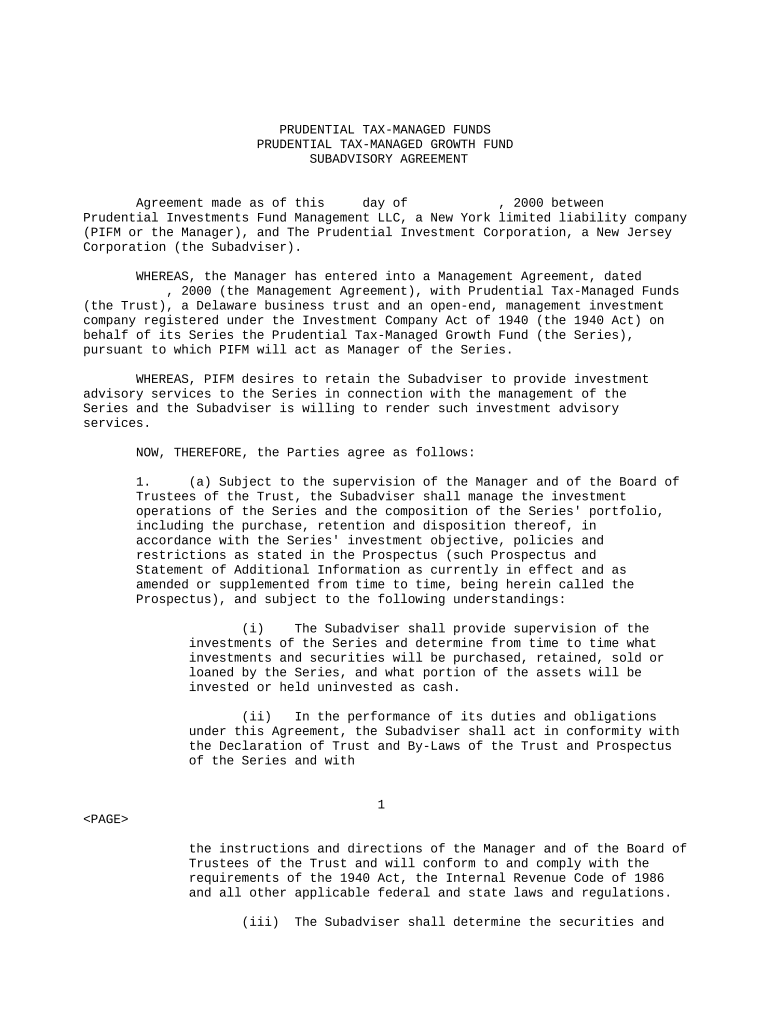
A well-drafted Subadvisory Agreement allocates responsibilities, protects client interests, reduces regulatory risk, and clarifies fees and reporting between adviser and subadviser.

Common users include primary investment advisers arranging delegated management, asset managers, and fund sponsors.
The agreement should be tailored to the parties’ regulatory status, client disclosures, and operational needs.
Describe specific investment authority, discretionary limits, approved instruments, and any prohibited transactions to align subadviser actions with client mandates.
State objective, benchmarks, concentration limits, risk tolerances, ESG filters, leverage rules, and rebalancing triggers to guide portfolio decisions.
Specify fee structure, invoicing intervals, expense reimbursements, and how gross or net performance fees are calculated and allocated between parties.
Set regular reporting cadence, required performance reports, position-level statements, access for audits, and delivery format and recipients.
Include firm-level representations, regulatory compliance obligations, disclosures to clients, insider trading controls, and supervisory responsibilities.
Define notice periods, transition assistance, custody handoff, data return, and post-termination trading restrictions to avoid disruption to clients.
| Field | Configuration |
|---|---|
| Signer Order | Set primary adviser then subadviser sequential signing. |
| Authentication | Use email plus SMS code or stronger methods for high-value accounts. |
| Reminders | Enable automated reminders every 3–7 days until execution. |
| Retention | Store signed PDF plus audit trail for the required retention period. |
Choose an eSignature provider that supports audit trails, secure storage, and applicable compliance addenda.
Ensure the platform can deliver tamper-evident signed PDFs, export signing certificates, and integrate with your document repository or CRM for automated recordkeeping and audits.
Defines when authority and fees begin.
Commonly 30–90 days written notice required.
Set delivery timing for performance and holdings.
Schedule compliance and performance reviews annually.
Define days for custody transfer and trading halt.
All commercial terms agreed and documented.
Counsel and compliance approval obtained.
Signed by authorized representatives of both parties.
Custodian receives instructions and assets transfer completes.
The CCO typically reviews and certifies that the arrangement meets regulatory obligations and internal policies; their approval is required in many firms for delegations of discretionary authority.
An officer or person with board-authorized signature authority signs on behalf of the entity; provide corporate resolution or power-of-attorney documentation when requested.
A pension plan hires a specialist subadviser for emerging-market bonds
A mutual fund sponsor engages a boutique manager for small-cap equities
| signNow | DocuSign | Adobe Sign | PandaDoc | HelloSign | |
|---|---|---|---|---|---|
| Starting Price | $8/user/mo | $15/user/mo | $14/user/mo | $19/user/mo | $15/user/mo |
| Free Trial | 7-day free trial | Varies by vendor | Varies by vendor | Varies by vendor | Varies by vendor |
| Bulk Send | Yes | Yes | Yes | Yes | No |
| Audit Trail | Yes | Yes | Yes | Yes | Yes |
| HIPAA Compliant | Yes | Yes | Yes | No | No |
| Envelope Cap | No cap | 100 envelopes/user/year | Varies by plan | Varies by plan | Varies by plan |