Establishing secure connection…Loading editor…Preparing document…

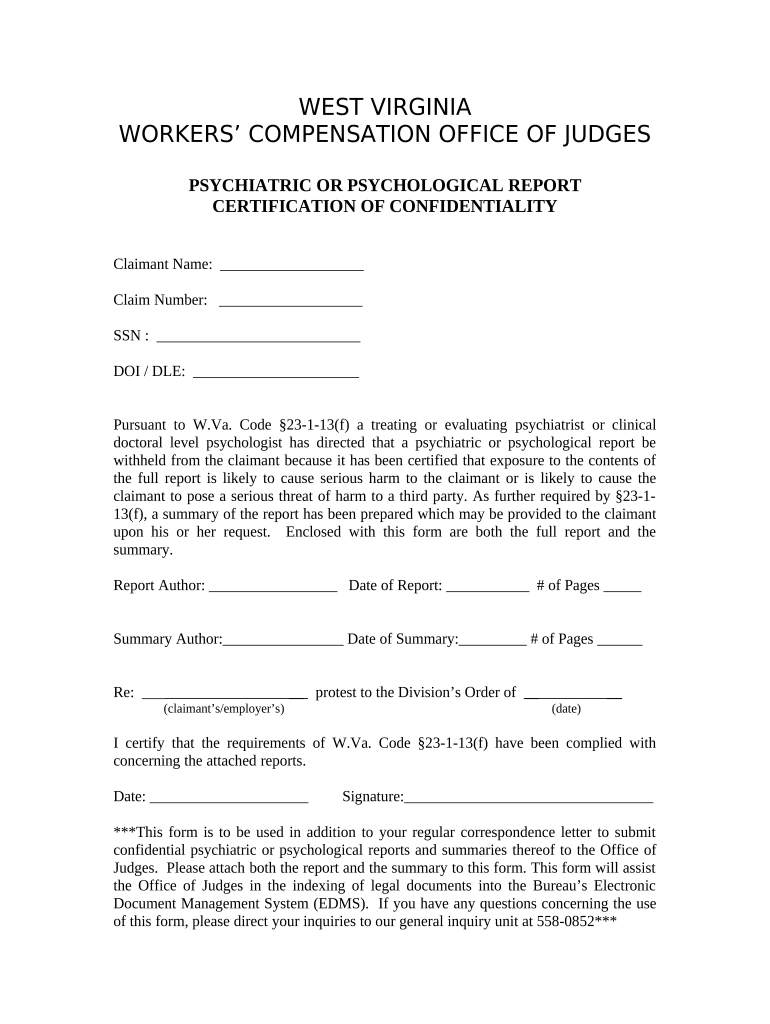
Psychiatric or Psychological Report Certification of Confidentiality

This template is fully customizable. Edit the text, fill out the fields, and send it for signature. Give it a try!
Psychiatric or Psychological Report Certification of Confidentiality

What this Psychiatric or Psychological Report Certification of Confidentiality is

The Psychiatric or Psychological Report Certification of Confidentiality is a formal statement attached to a clinical evaluation that documents the confidential status of diagnostic findings, treatment notes, and narrative opinions. It identifies the report author, the patient or subject, the scope of information protected, and any limits to confidentiality. The certification clarifies intended recipients, required court or agency disclosures, and whether the report is subject to additional statutory protections such as HIPAA. Use this certification when sharing evaluative material with third parties to establish handling expectations and legal protections.

Why a formal confidentiality certification matters for psychiatric and psychological reports

A clear certification protects patient privacy, documents consent or legal exceptions, and reduces risk when records are shared with courts, insurers, or third parties. It creates an auditable record that supports compliance with HIPAA and applicable state privacy statutes while clarifying permitted disclosures.

Why a formal confidentiality certification matters for psychiatric and psychological reports

Who typically completes or relies on this certification

Clinicians, forensic evaluators, disability examiners, and legal counsel commonly prepare or review the Psychiatric or Psychological Report Certification of Confidentiality before disclosure.

  • Treating clinicians and practice managers who control release of clinical records for continuity of care or third-party requests.
  • Forensic evaluators preparing court-bound or independent examination reports where confidentiality exceptions and limits must be stated explicitly.
  • Legal teams and caseworkers who receive reports and must document handling, storage, and permissible reuse.

In multi-party contexts the certification helps recipients understand permitted uses and document retention expectations while supporting defensible disclosure decisions.

Key signers and their roles

Treating Provider

Licensed clinician who authored the report; certifies accuracy, scope, and confidentiality. The provider documents patient identity verification, clinical credentials, and any patient consents or limitations relevant to disclosure.

Authorized Recipient

Entity or individual authorized to receive the report (e.g., insurer, attorney, court). This signer acknowledges receipt conditions, agrees to confidentiality limits, and confirms authorized use and secure handling.

Security and compliance data to include

Encryption: TLS 1.2/1.3 in transit
Data at rest: AES-256 encrypted storage
Compliance: HIPAA (BAA required)
Audit trail: Timestamped signing events
Access controls: Role-based permissions
Retention export: PDF with certificate

Potential legal and practical risks of incorrect certification

HIPAA violations: Civil and criminal penalties
Unauthorized disclosure: Patient privacy breaches
Evidentiary challenges: Report admissibility questioned
Professional liability: Malpractice exposure
Regulatory fines: Agency sanctions possible
Reputational harm: Loss of trust

Common mistakes to avoid when preparing the certification

  • Failing to clearly state limits of confidentiality and specific authorized recipients, which creates downstream confusion and risk.
  • Using inconsistent names or dates between the report and certification, leading to mismatched records and potential invalidation.
  • Neglecting to document patient consent or legally required notices when disclosures exceed routine care or involve third-party requests.
  • Sending reports over unsecured channels or omitting an audit trail, reducing legal defensibility of the disclosure.

Step-by-step: completing a Psychiatric or Psychological Report Certification of Confidentiality

Follow these steps to prepare, certify, and share the report while preserving confidentiality and compliance.

  • 01
    Prepare report: Finalize clinical findings and confirm patient identifiers.
  • 02
    Draft certification: State scope, recipients, and exceptions to confidentiality.
  • 03
    Obtain signatures: Have provider and authorized recipient sign and date.
  • 04
    Record audit: Capture signing metadata and retention instructions.

Typical disclosure workflow and routing for certified reports

This sequence describes how a certified psychiatric or psychological report moves from creation to authorized recipients.

  • Create and attach: Author prepares the evaluation and appends the confidentiality certification.
  • Authenticate signer: Verify clinician identity and obtain signature with an audit trail.
  • Deliver securely: Send to authorized recipient using encrypted transfer or secure portal.
  • Log and retain: Store signed report per retention policy and document disclosures.

Essential elements included in a professional certification

A complete certification contains core factual and procedural elements that make the confidentiality status explicit and actionable.

Author identification

Full clinician name, license number, professional affiliation, and contact details to establish authorship and accountability in case of later inquiries.
Subject details

Patient name, date of birth, and record identifiers to ensure the certification is uniquely associated with the correct clinical file.

Scope of information

Clear description of which sections or exhibits are covered (e.g., diagnostic narrative, psychometric results, therapy notes) to avoid overbroad or ambiguous protections.

Permitted recipients

List of named individuals or organizations authorized to receive the report, and any restrictions on onward disclosure or redisclosure.

Exceptions and disclosures

Explicitly state legal or ethical exceptions (e.g., risk of harm, court order) and outline the process for compelled disclosure.

Signatures and date

Dated signatures of the author and any accepting parties, plus a reference to the audit trail or electronic certificate proving execution.

Supporting documentation and format options to include

Attach or reference additional documents and specify file formats to maintain integrity and accessibility across systems.

Patient consent form

Attach the patient authorization or refusal form that documents consent to release and any specified limits on distribution or duration.

Court orders or subpoenas

Include any relevant legal process that compels disclosure and note whether the certification is modified by the order’s scope.

Redaction log

Provide a redaction summary that lists removed items and the legal basis for redaction to preserve transparency for authorized recipients.

File formats

Provide the final signed report in PDF (with embedded audit certificate) and retain an editable source copy (DOCX) for internal records.

Practical tips for accurate, efficient completion

Apply these recommendations to reduce errors and simplify compliance when preparing certified reports.

Verify identities before release
Confirm recipient identity using institutional email or two-factor methods; document verification steps in the audit trail to show due diligence.
Use explicit language
Avoid vague terms; state exact recipients, duration, and exceptions to prevent misinterpretation and unsupported redisclosure.
Maintain an audit trail
Record timestamps, signer IPs, and method of delivery for every release to preserve evidence of authorization and handling.
Coordinate with counsel
When a court process affects confidentiality, consult legal counsel to align the certification language with the order’s requirements.

Key milestones from request to archived record

Track milestones to meet legal response windows and ensure defensible handling from production through retention.

01

Request received

Begin tracking when a disclosure or records request is received.

02

Preparation completed

Finalize report, attach certification, and prepare redactions if applicable.

03

Execution and delivery

Obtain required signatures and transmit via secure channel.

04

Archive and retention

Store the certified report and audit trail according to retention policy.

Typical timeframes and regulatory response expectations

Anticipate these common deadlines when receiving or responding to record requests or legal process.

HIPAA response:

Respond to patient access requests within 30 days per 45 CFR §164.524.

Expedited requests:

Allow for a single 30‑day extension when duly documented under HIPAA rules.

Court subpoenas:

Comply with the subpoena’s timeline or seek protective order as necessary.

Internal review:

Complete internal clinician review and redaction within business days to meet disclosure deadlines.

Retention trigger:

Retention period begins on creation or last effective date of the record.

How organizations apply certified psychiatric and psychological reports

Real-world examples show how certifications clarify handling and protect privacy while enabling lawful disclosure.

Optica Ventures LLC

Brian Fitzgibbons describes streamlined delivery for partner reviews

  • Signed certifications clarified permitted recipients
  • The certification reduced follow-up requests and established an auditable handling process that simplified legal review and protected patient confidentiality.

Fertility Centers of Illinois

John Butler highlights clinical record control

  • Certification attached to each evaluation
  • Standardized confidentiality language ensured consistent disclosure practices across clinicians, improving compliance and reducing administrative burden when records were requested by insurers and legal counsel.

How to configure an online workflow for certification and secure delivery

Set up fields, authentication, and retention options to match the clinical and legal requirements for confidential reports.

Field Configuration
Upload document PDF or DOCX source with embedded metadata
Signature fields Signature, printed name, date fields
Authentication Email link, SMS code, or multi-factor
Audit & retention Enable audit trail and export signed PDF

Platform capabilities to support secure certifications and e-signing

Choose a platform that provides strong authentication, detailed audit trails, HIPAA support, and integrations with clinical systems.

  • Integrations: Salesforce, NetSuite, Google Workspace support
  • File formats: PDF, DOCX, HTML accepted
  • Security features: Role-based access and encryption

These capabilities reduce manual handling, preserve evidence of consent and receipt, and support compliance with health privacy rules while enabling controlled sharing.

Common questions about Psychiatric or Psychological Report Certification of Confidentiality

Answers to frequently encountered issues when preparing, signing, and sharing certified clinical reports.


Need help? Contact support

Comparison of eSignature vendor pricing and core capabilities for secure certifications

Cost and capability comparisons help determine which vendor aligns with security, compliance, and volume needs for certified psychiatric and psychological reports.

signNow DocuSign Adobe Sign PandaDoc HelloSign
Starting Price $8/user/mo $15/user/mo $14/user/mo $19/user/mo $15/user/mo
Free Trial 7-day free trial No No Yes, limited Yes, limited
Bulk Send Yes Yes Yes Yes No
Audit Trail Yes Yes Yes Yes Yes
HIPAA Compliant Yes Yes Yes No No
be ready to get more
Join over 28 million airSlate SignNow users