Header
Date, tenant name, landlord name, and property address so the notice is clearly tied to the correct lease and unit.
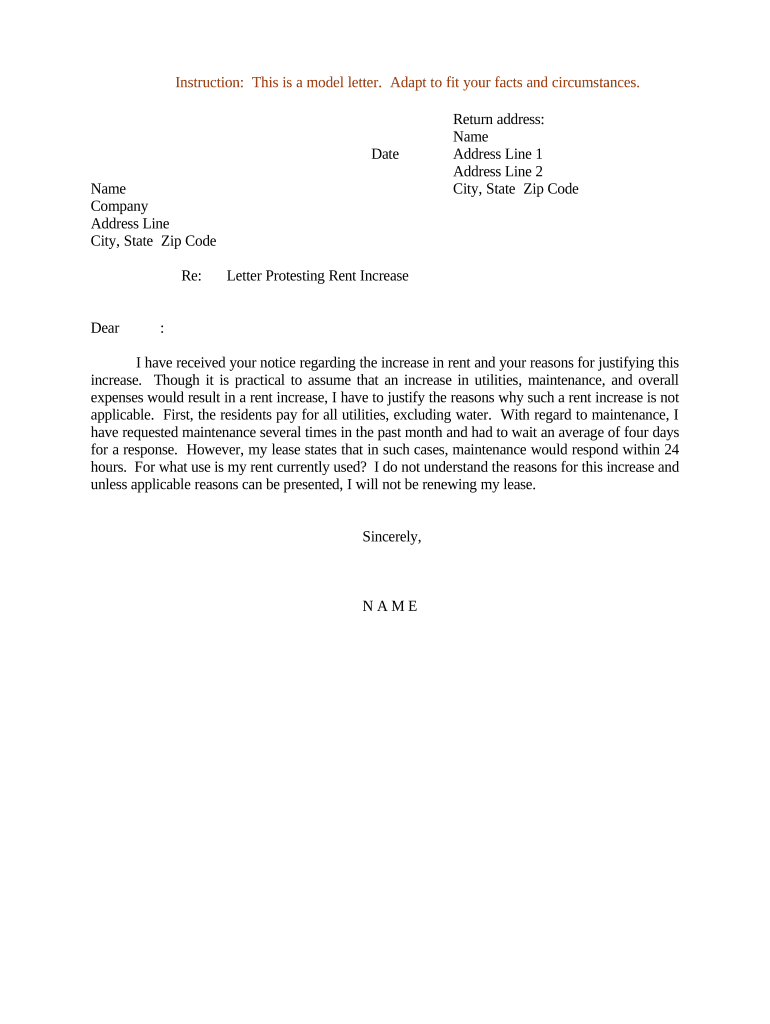
A clear written protest documents your objections, preserves legal defenses, and signals readiness to resolve the issue formally; electronic delivery supported under ESIGN and UETA makes the record admissible in many jurisdictions.

The letter is most often used by individual tenants, tenant advocacy groups, property managers, and attorneys who represent renters.
Choose the sender profile that matches your situation; legal counsel can add statutory citations and filing strategy when necessary.
A tenant who receives a rent increase notice and wants to preserve objections. The tenant includes lease ID, proposed increase amount, and a clear statement of dispute to avoid waiving defenses; retain proof of delivery.
An attorney or legal aid representative filing on the tenant's behalf. Counsel typically cites lease provisions, local rent-control statutes, and administrative rules, and requests a formal response or hearing date.
Date, tenant name, landlord name, and property address so the notice is clearly tied to the correct lease and unit.
Cite the lease start date, section or clause challenged, and any prior amendments to show contractual context for the protest.
Quote the rent increase notice date and the new proposed rent amount to avoid ambiguity about what is being contested.
Explain facts supporting the protest: insufficient notice, breach of covenant, miscalculation, local rent-control conflicts, or failure to maintain habitability.
State what you want—withdrawal of increase, corrected calculation, set hearing date, or mediation—and any deadline for a response.
Typed and signed tenant name with date, contact information, and statement of intent to pursue administrative or legal remedies if unresolved.
Check format, authentication, and storage options before sending to ensure admissibility and retrievability.
Retain the signed file and audit trail in a secure location and include delivery receipts when submitting to tribunals or housing agencies.
| Field | Configuration |
|---|---|
| Signature Field | Required; timestamp enabled |
| Date Field | MM/DD/YYYY format |
| Attachment | Allow PDF/DOCX supporting docs |
| Authentication | Email verification or SMS OTP |
Send protest as soon as possible after receiving increase notice.
Some rent-control areas impose statutory response or filing windows.
Check notice periods in your lease (often 30–60 days).
Administrative hearings may have short filing deadlines—verify locally.
Keep records until dispute fully resolves and beyond statute of limitations.
Confirm the landlord received the letter within 7–14 days where possible.
Allow a reasonable response period; check lease or local rules for specific deadlines.
If no agreement, file with local housing agency or court per local procedures.
Attend scheduled hearings or mediation with all supporting documents.
| signNow | DocuSign | Adobe Sign | PandaDoc | HelloSign | |
|---|---|---|---|---|---|
| Starting Price | $8/user/mo | $15/user/mo | $14/user/mo | $19/user/mo | $15/user/mo |
| Free Trial | 7-day free trial | Varies by plan | Varies by plan | Varies by plan | Varies by plan |
| Bulk Send | Yes (Premium) | Yes | Yes | Yes | No |
| Audit Trail | Yes | Yes | Yes | Yes | Yes |
| Envelope Cap | No cap | 100 envelopes/user/year | Varies | Varies | Varies |