Establishing secure connection…Loading editor…Preparing document…

Letter Requesting Patience During Renovations

This template is fully customizable. Edit the text, fill out the fields, and send it for signature. Give it a try!
Letter Requesting Patience During Renovations

What this Letter Is and When to Use It

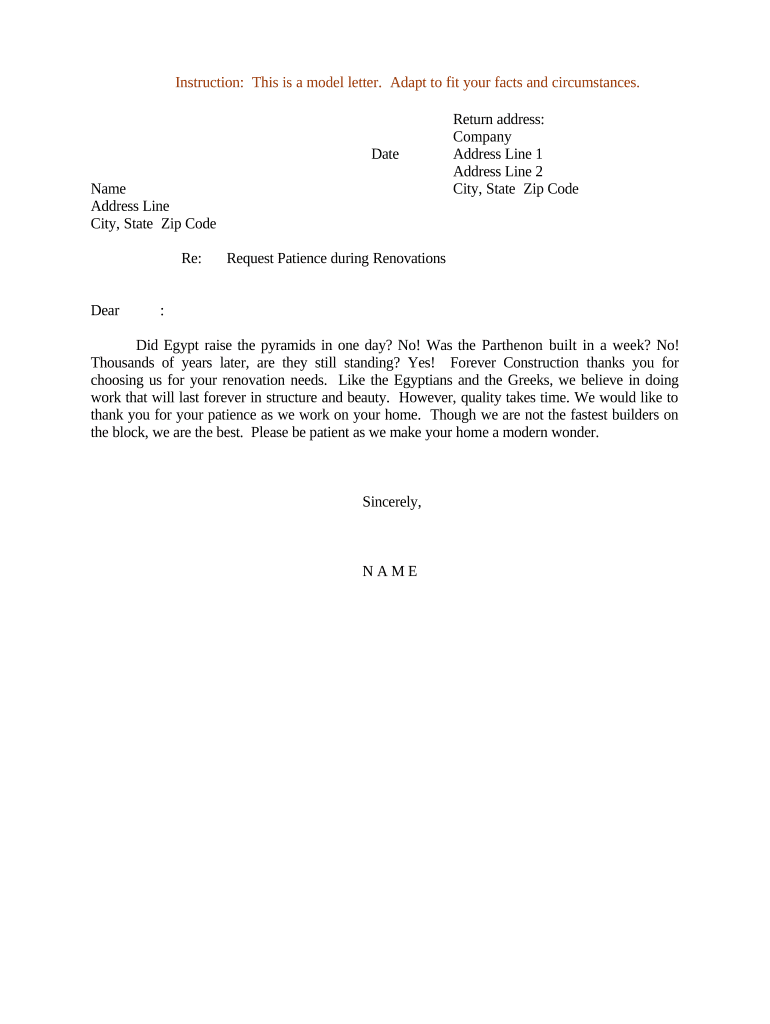
A Letter Requesting Patience During Renovations is a brief written notice used by property managers, landlords, business owners, or building contractors to inform occupants, customers, or neighbors about planned or ongoing renovation work. It explains expected impacts (noise, temporary closures, limited access), provides a projected timeline, and sets expectations for communications and safety precautions while reminding recipients of any temporary service changes or alternate arrangements.

Why a Clear Patience Letter Helps Your Project

A concise, factual letter reduces confusion, lowers complaint volume, and documents notice to affected parties. It protects the sender by demonstrating advance communication, supports tenant relations, and provides a record useful for dispute resolution or regulatory compliance.

Why a Clear Patience Letter Helps Your Project

Who Typically Sends and Receives This Notice

The letter is appropriate for multi-tenant buildings, single-family rental properties, commercial premises, and school facilities when renovations affect access, noise levels, or services.

  • Property managers notifying tenants and owners of building or unit work
  • Retail or hospitality operators informing customers of temporary closures or altered access
  • Contractors and construction managers advising neighboring units and occupants

Typical Author and Recipient Examples

Property Manager

A property manager drafts and distributes the notice to tenants and owners to document disclosure of work scope, noise windows, and temporary access restrictions; the notice helps meet lease notice obligations and reduces tenant complaints.

Business Owner

A retail or restaurant owner informs customers and staff of hours changes, service interruptions, and safety paths; the letter supports continuity planning and provides evidence of proactive communication if service expectations change.

Essential Elements to Include in the Letter

A professional Letter Requesting Patience During Renovations should be concise and factual while covering legal, logistical, and contact information so recipients understand impacts and follow-up channels.

Headline

Clear title such as 'Notice of Renovation Work' to set expectations immediately and ensure recipients treat the message as an operational notice.
Dates & Hours

Exact start and expected end dates plus daily hours when disruptive work will occur; include contingency language if timelines may shift.

Work Description

Brief description of the renovation tasks (e.g., plumbing, flooring, painting), scope, and areas affected so recipients can assess impact.

Impacts & Access

List likely impacts such as noise levels, dust precautions, temporary closures, and alternate access routes to minimize surprise and safety risks.

Contact Information

Provide primary contact name, phone, email, and expected response hours so recipients know how to report urgent issues or request accommodations.

Safety & Compliance

Note safety measures in place (barriers, signage, restricted zones) and any required recipient actions to comply with lease or building rules.

How to Prepare and Send the Notice — Step by Step

Follow a short, consistent process to create, approve, and distribute the letter so recipients receive timely and accurate information.

  • 01
    Draft: Fill in purpose, dates, impacts, and contact details.
  • 02
    Review: Have legal or property management review for lease compliance.
  • 03
    Distribute: Send via chosen channels (email, posted notice, in-person handout).
  • 04
    Record: Save signed copy and distribution log for documentation.

Digital Workflow Settings to Use for Notices

Configure a simple workflow to automate distribution, reminders, and recordkeeping when issuing multiple notices or repeated updates.

Field Configuration
Sender Account Business or property manager email address
Authentication Email link or SMS code for recipient verification
Template Reusable notice template with merge fields
Notifications Auto-reminders at set intervals

Where to Send or File the Completed Letter

Choose distribution channels and internal filing destinations that meet lease terms, regulatory notice requirements, and recordkeeping practices.

  • Email Recipients: Tenants, owners, HOA board
  • Physical Posting: Building lobby or unit door
  • Hand Delivery: In-person with dated acknowledgment
  • Internal Filing: Tenant file, property management system

Digital Delivery Options and Basic Technical Needs

Ensure the chosen system preserves a copy of the final signed or acknowledged letter and logs delivery timestamps for future reference.

  • File Formats: PDF or DOCX
  • Authentication: Email link or SMS code
  • Storage: Encrypted cloud storage

Timing Considerations and Recommended Notice Periods

Provide clear timing so recipients can plan. Use longer notice for major disruptions and shorter updates for minor or emergency work.

Standard Notice:

At least 7–14 calendar days for planned renovations

Short Notice Work:

48–72 hours for small, low-impact tasks

Emergency Repairs:

Immediate notice with follow-up documentation

Schedule Changes:

Notify as soon as a change is confirmed

Record Retention:

Keep copies for the document retention period

Key Milestones from Draft to Record

Track clear milestones from initial draft through final archiving so the project team and recipients share the same timeline and responsibilities.

01

Draft Creation

Prepare notice draft with scope and dates

02

Internal Approval

Legal or management review and sign-off

03

Distribution

Send via chosen channels and confirm receipt

04

Archiving

Store final copy and delivery log

Common Mistakes to Avoid

  • Using vague dates or 'sometime in spring' instead of exact MM/DD/YYYY ranges leads to confusion and disputes.
  • Failing to provide a clear contact person and response hours increases complaint volume and delays issue resolution.
  • Omitting expected noise windows or safety measures can produce tenant safety risks and breach lease terms.
  • Not keeping a distribution log or signed acknowledgements undermines proof of notice during disputes or inspections.

Potential Consequences of Poor or Missing Notice

Lease Violation: Breach of lease
Tenant Complaints: Increased disputes
Regulatory Risk: Local code fines
Safety Incidents: Liability exposure
Reputational Harm: Customer dissatisfaction
Contract Delay: Work interruptions

eSignature Provider Comparison for Sending Notices

Common provider features and starting prices for electronic signing and delivery. signNow is listed first in the comparison per platform guidance.

signNow DocuSign Adobe Sign PandaDoc HelloSign
Starting Price $8/user/mo $15/user/mo $14/user/mo $19/user/mo $15/user/mo
Free Trial 7-day free trial Varies Varies Varies Varies
Bulk Send Yes Yes Yes Yes No
Audit Trail Yes Yes Yes Yes Yes
HIPAA Compliant Yes Yes Yes No No
Envelope Cap No cap 100 envelopes/user/year Varies Varies Varies

Real-World Examples of Notice Use

Actual user stories show how clear notices reduced confusion and sped project timelines.

Martin Properties

A small property owner prepared templated notices for unit work to reduce tenant questions.

  • The template standardized timing and contacts.
  • Result: fewer service calls and faster tenant coordination; Tim Martin reported that managing notices online helped his team close out projects with fewer schedule conflicts and improved tenant satisfaction during multi-unit renovations.

Fertility Center

A medical facility informed patients of phased HVAC replacement and exam room closures.

  • The letter included alternate visit instructions.
  • Outcome: appointments were rescheduled with minimal disruption; John Butler described improved patient communication and a documented audit trail for scheduling changes and patient notifications.

Practical Tips for Clear, Effective Notices

Small changes in wording and process significantly improve recipient understanding and reduce administrative overhead.

Be Specific
Use exact dates, hours, and clear descriptions of impacted areas; specificity prevents misunderstandings and limits disputes.
Use a Template
Create a reusable template with merge fields to ensure consistency and speed distribution for repeated or multi-site projects.
Log Delivery
Record distribution method, recipients, and timestamps to create evidence of notice in case of later disputes.
Coordinate Safety
List safety precautions and responsibility lines so occupants know what to avoid and who enforces safety protocols.

Frequently Asked Questions About These Notices

Answers to common questions about drafting, delivery, legal effect, and recordkeeping for renovation notices.


Need help? Contact support

be ready to get more
Join over 28 million airSlate SignNow users