Establishing secure connection…Loading editor…Preparing document…

Notice or Demand for Retraction Regarding Libelous Publication

This template is fully customizable. Edit the text, fill out the fields, and send it for signature. Give it a try!
Notice or Demand for Retraction Regarding Libelous Publication

What a Notice or Demand for Retraction Is and When It Applies

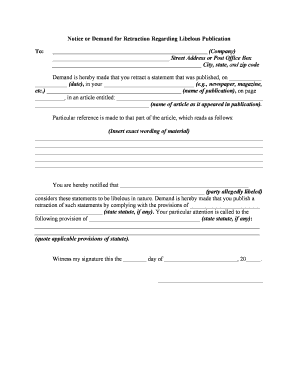
A Notice or Demand for Retraction Regarding Libelous Publication is a formal written request sent to a publisher, author, or platform asking for removal or correction of published statements that the sender alleges are false and defamatory. The document identifies the specific statements, explains why they are false, requests a clear retraction or correction, and sets a reasonable deadline for response. It preserves evidentiary and contractual positions should the matter proceed to litigation, and it can sometimes resolve disputes without filing a lawsuit by prompting voluntary correction or mitigation of damages.

Why a Clear, Professional Retraction Demand Matters

A well‑drafted notice can stop ongoing harm, preserve legal rights, and create a record demonstrating that the publisher had the opportunity to correct alleged falsehoods prior to any lawsuit.

Why a Clear, Professional Retraction Demand Matters

Who Typically Prepares or Receives This Notice

Individuals and organizations use this notice when they believe published material is false and harming reputation; it is often prepared with legal input.

  • Private individuals and public figures seeking correction or retraction from media or social platforms.
  • Attorneys and in‑house counsel sending formal demands to publishers or authors on behalf of clients.
  • Public relations or compliance teams coordinating factual corrections with legal oversight.

Use legal counsel when potential liability, complex jurisdictional issues, or statutory defamation limitations arise.

Stepwise Procedure to Complete and Send the Demand

Follow these steps in order to prepare a clear, defensible demand and document delivery.

  • 01
    Gather Evidence: Collect screenshots, links, and context for each statement.
  • 02
    Draft Notice: Identify statements, state the requested correction, and set a deadline.
  • 03
    Review Legal Issues: Check statute of limitations and consult counsel as needed.
  • 04
    Serve Notice: Deliver via certified mail, email with delivery receipt, or process service.

Core Components Every Professional Retraction Demand Should Include

A complete notice combines clear identification, factual explanation, a precise remedy, and a record of service so recipients understand the issue and the consequences of noncompliance.

Identification

Full sender details and the recipient's legal identity, including corporate or platform account identifiers, to avoid ambiguity about who is involved.
Offending Statements

Exact quotations, publication URLs, dates, and screenshots that demonstrate the content claimed to be false or defamatory.

Factual Basis

Concise explanation of why each statement is false, including objective facts or documentary proof supporting correction.

Requested Remedy

Specific language for the retraction or correction requested, and whether a published apology or removal is sought.

Deadline

A clear MM/DD/YYYY deadline for response and action; specify how compliance should be communicated.

Service and Signature

Method of delivery, proof of service, and a dated signature block for the sender to establish the record.

How the Notice Moves from Draft to Delivery

A typical administrative workflow moves the notice through preparation, review, delivery, and follow up.

  • Drafting: Prepare the demand text and attach supporting evidence.
  • Internal Review: Legal or PR review to confirm factual and legal footing.
  • Delivery: Send via tracked mail, verified email, or process server.
  • Record Keeping: Retain proof of delivery and all correspondence.

Suggested Digital Workflow Settings for eDelivery and Tracking

Configure these settings when using an electronic document platform to send and track the notice reliably.

Field Configuration
Sender Address Verified corporate or personal email; enable reply tracking.
Signer Authentication Use email link plus optional SMS code for added attribution.
Retention Policy Enable automatic archive and export of audit trail.
Delivery Receipt Require download confirmation or certified mail proof.

Technical Considerations for Electronic Completion and Proof

Ensure the chosen platform supports reliable audit trails, common file types, and proof of delivery for legal continuity.

  • File Formats: Support for PDF and DOCX preserves layout and metadata.
  • Audit Trail: Capture timestamps, IP addresses, and actions for admissibility.
  • Integrations: Connectors to cloud storage and case management systems reduce manual handling.

Platforms that provide secure storage, tamper-evident audit logs, and multiple delivery options reduce disputes about whether the notice was sent or received.

Timing Considerations and Common Deadlines

Time matters: choose a reasonable response period, preserve evidence promptly, and review applicable state limitation periods before sending.

Preservation Immediately:

Preserve screenshots, URLs, and download copies as soon as possible.

Response Window:

Commonly provide 7–14 days for acknowledgment and correction.

Follow‑Up Timing:

If no response, send a second demand within 7 days of the deadline.

Statute of Limitations:

State defamation limits commonly range from 1–3 years; verify applicable state law.

Escalation To Court:

If unresolved, litigation or court filing timelines vary by jurisdiction and case.

Key Milestones from Notice to Possible Litigation

Track these sequential milestones so evidence, deadlines, and decisions are documented at each stage.

01

Preserve Evidence

Capture and store all relevant material and metadata before it changes.

02

Send Demand

Deliver the notice with proof of service and clear corrective request.

03

Await Response

Monitor the response window and record any communications or remedial actions.

04

Decide Next Steps

If unresolved, consider court filing, injunctive relief, or further negotiation.

Common Pitfalls to Avoid When Preparing a Notice

  • Vague allegations without specific quotes or links increase dispute risk and reduce credibility.
  • Failing to preserve evidence promptly can prevent reconstruction of the original publication.
  • Using inflammatory or threatening language may foreclose settlement and escalate costs.
  • Sending to incorrect or unofficial recipient addresses can lead to failed service and delays.

Risks of an Inaccurate or Improperly Served Demand

Waived Claims: Poor documentation can weaken later litigation claims.
Increased Damages: Overstated or unproven assertions may result in countersuits or sanctions.
Lost Evidence: Delayed preservation reduces admissible proof and discovery leverage.
Procedural Delay: Incorrect service methods can extend timelines and costs.
Ethical Exposure: Unethical or harassing demands may trigger professional discipline.
Missed Limitations: Failing to check statute of limitations may bar relief.

How a Retraction Demand Differs from Similar Letters

Compare the demand for retraction with a cease‑and‑desist letter; both can overlap but serve different primary purposes and remedies.

Criteria Retraction Demand Cease-and-Desist Letter
Primary Purpose correct public record stop conduct immediately
Typical Timing before litigation often pre‑litigation or during dispute
Legal Force persuasive, not binding threat of enforcement or injunction
Usual Remedy correction or apology cease activity and possible damages

Representative eSignature Vendor Pricing and Capabilities for Sending Notices

Compare basic pricing and capabilities when choosing an eSignature provider to create, sign, and archive a retraction demand.

signNow DocuSign Adobe Sign PandaDoc HelloSign
Starting Price $8/user/mo $15/user/mo $14/user/mo $19/user/mo $15/user/mo
Free Trial Yes, 7-day trial Varies by plan Varies by plan Varies by plan Varies by plan
Bulk Send Yes (Business Premium) Yes Yes Yes Limited
Audit Trail Yes Yes Yes Yes Yes
HIPAA Compliant Yes (BAA available) Yes Yes No No

Illustrative Use Cases for a Retraction Demand

Realistic scenarios show how concise demands can resolve disputes or support later legal action.

Case Study 1

A small business disputed false online reviews that named staff and revenue loss evidence.

  • Business presented precise quotes and screenshots to the publisher.
  • The publisher issued a correction and removed defamatory content after receiving the well‑documented demand and proof of harm.

Case Study 2

An individual found a social post falsely alleging criminal conduct and shared private records.

  • Counsel requested removal and a public retraction with proposed language.
  • The platform removed the post and the author posted an apology, avoiding further litigation after formal demand delivery.

Frequently Asked Questions About Retraction Demands and Electronic Delivery

Answers to common questions about validity, delivery methods, and next steps when a retraction demand is contested or ignored.


Need help? Contact support

be ready to get more
Join over 28 million airSlate SignNow users