Establishing secure connection…Loading editor…Preparing document…

Complaint Court Form

This template is fully customizable. Edit the text, fill out the fields, and send it for signature. Give it a try!
Complaint Court Form

What the Complaint Court Form Is and When It’s Used

A Complaint Court Form is the initiating pleading a plaintiff files to start a civil lawsuit, stating jurisdiction, parties, factual allegations, legal claims, and requested relief. It establishes the case caption, case number (assigned by the clerk), and service instructions for defendants. Complaints vary by court and case type (e.g., contract, tort, civil rights) and must meet procedural rules for format, signature, and filing to avoid rejection or dismissal.

Why the Complaint Court Form Matters

A correctly prepared complaint defines claims, preserves deadlines such as the statute of limitations, and begins the court’s jurisdiction over the dispute; errors at filing can cause delay, extra cost, or loss of rights.

Why the Complaint Court Form Matters

Who Typically Prepares and Files Complaints

The filer must ensure procedural compliance for the specific jurisdiction and case type to protect substantive rights and avoid administrative rejection.

  • Plaintiffs or claimants initiating litigation, often through counsel.
  • Defense counsel or clerks who respond or note procedural issues.
  • Court clerks who accept, docket, and provide filing receipts.

Representative Signers and Preparers

Pro Se Plaintiff

An individual representing themselves who completes the complaint, signs under penalty of perjury when required, and is responsible for service and meeting court rules without counsel.

Attorney / Firm

Licensed counsel prepares and signs the complaint, certifies factual and legal allegations under professional rules, and typically files via electronic court filing systems on behalf of the client.

Core Elements Found in a Professional Complaint

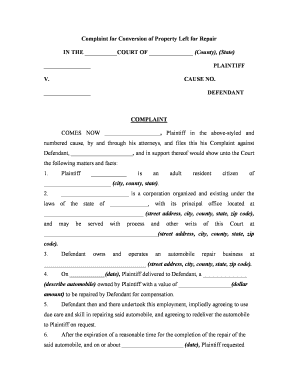
A complete complaint combines identification, jurisdictional statements, factual narrative, legal causes of action, relief requested, and signature blocks to comply with court rules and enable service on defendants.

Caption

Court name, parties, case number placeholder, and styled cause that identifies the action and parties.
Jurisdiction

Statement of subject-matter and personal jurisdiction and basis for venue to justify the court’s authority.

Factual Allegations

Chronological facts supporting each claim, specific dates, and relevant contract or statute references.

Causes of Action

Numbered legal claims (e.g., breach of contract, negligence) tied to the factual allegations and elements.

Prayer for Relief

Clear statement of remedies sought: damages, injunctive relief, declaratory relief, attorney fees when applicable.

Signature Block

Signature, printed name, bar number if attorney, address, contact, and date required for filing and service.

Privacy and Security Considerations for Complaint Data

Personal Data: Limit SSNs and sensitive data in filings
Protected Health Info: Redact PHI when health details are unnecessary
Encryption In Transit: TLS 1.2/1.3
Encryption At Rest: AES-256
Audit Trail: Timestamps and signer attribution
Access Controls: Role-based access and two-factor options

Step-by-Step: Preparing and Filing a Complaint

Follow these sequential steps to draft, verify, sign, and file a complaint in most U.S. courts while preserving procedural and substantive rights.

  • 01
    Draft the Complaint: Compose caption, facts, claims, and relief clearly.
  • 02
    Verify Parties & Venue: Confirm correct defendant names and proper venue.
  • 03
    Sign and Verify: Signer signs; attorney includes bar number and certificate.
  • 04
    File and Serve: Submit to clerk, obtain docket number, and serve defendants.

How Filing and Service Typically Flow

A complaint moves from drafter to court clerk, then to defendants via service; each step creates deadlines and triggers defendant responses.

  • Document Preparation: Draft and proof the complaint for accuracy.
  • Court Filing: File with clerk and receive docket number.
  • Service of Process: Serve defendants per state civil procedure rules.
  • Defendant Response: Defendant files answer, motion, or other response.

Configuring an Online Workflow for Complaint Filing

Set up a digital workflow to prepare, collect signatures, and archive complaints while meeting court and confidentiality requirements.

Field Configuration
Document Template Prepopulate caption and party fields for reuse.
Signature Authentication Enable email or SMS codes for signer verification.
Redaction Workflow Add steps to redact sensitive data prior to filing.
Archive and Audit Retain signed PDF and audit trail for compliance.

Technical Options for Digital Completion and Submission

Verify the court’s e-filing requirements before submitting electronically to ensure compatibility and acceptance.

  • Supported Formats: PDF and DOCX
  • Integrations: Connect to cloud storage and case management
  • Authentication: Email, SMS, or advanced KBA options

Common Preparation and Filing Mistakes

  • Using incorrect defendant names or corporate entities causes service defects and possible dismissal.
  • Omitting jurisdictional or venue allegations can lead to administrative rejection or early motion practice.
  • Failing to attach required exhibits or supporting documents delays case progression and discovery timelines.
  • Not tracking statute of limitations dates risks permanent loss of the right to sue.

Consequences of an Incorrect Complaint

Dismissal: Case may be dismissed
Sanctions: Court penalties or fines
Default Judgment: If service errors persist
Statute Bar: Claim precluded by limitations
Fee Forfeiture: Costs or fee judgment risk
Malpractice Risk: Attorney exposure for errors

Practical Tips to Reduce Rework and Risk

Adopt consistent drafting, verification, and filing steps to avoid common errors and protect procedural rights.

Use Verified Party Names
Confirm corporate registrations or government IDs before filing; mismatches can invalidate service and lead to dismissal.
Document Proof of Service
Keep signed return-of-service or affidavit and docket receipts to prove timely service and meet response deadlines.
Redact Sensitive Data
Remove unnecessary SSNs and medical details; file redacted public versions and retain unredacted originals under secure access control.
Track Deadlines
Log statute of limitations, service deadlines, and response periods immediately after filing to preserve rights.

Real-World Complaint Use Cases

Two concise scenarios illustrate how complaint forms are used in practice and the outcomes that follow accurate filing.

Small Business Contract Dispute

A local vendor files a breach-of-contract complaint with itemized damages and exhibits

  • Complaint included invoices and delivery records
  • Proper drafting and prompt service led to early settlement and avoided extended discovery costs.

Personal Injury Claim

An individual files a negligence complaint after an accident with medical records and liability allegations

  • The complaint preserved the statute of limitations date
  • Accurate exhibits and verified plaintiff identity enabled timely defendant response and mediation.

Frequently Asked Questions About Complaint Court Forms

Answers to common questions about e-signatures, filing, service, and deadlines when preparing a complaint.


Need help? Contact support

be ready to get more
Join over 28 million airSlate SignNow users