Establishing secure connection…Loading editor…Preparing document…

Request for Admissions Louisiana

This template is fully customizable. Edit the text, fill out the fields, and send it for signature. Give it a try!
Request for Admissions Louisiana

What a Request for Admissions (Louisiana) Is and when it applies

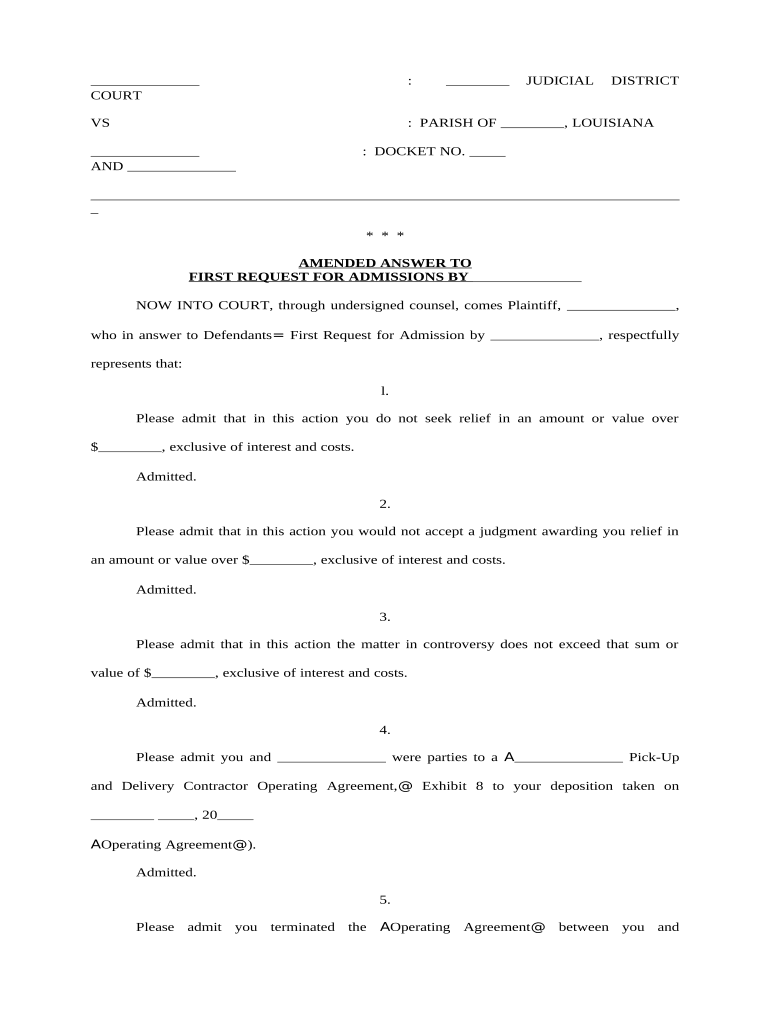
A Request for Admissions in Louisiana is a written discovery device used in civil litigation to ask another party to admit the truth of specific facts, the application of law to facts, or the authenticity of documents. Each request is numbered and served so the responding party may admit, deny, or explain. Properly drafted admissions narrow issues, reduce evidence at trial, and can make summary judgment or trial preparation more efficient. This guide covers components, timing, filing and service considerations, and practical drafting tips for Louisiana matters.

Why Requests for Admissions matter in Louisiana disputes

Requests for Admissions focus litigation by converting contested facts into admitted facts, trimming the scope of trial proof, and reducing costs. In many courts an unanswered request may be deemed admitted, so careful drafting and timely response are important to preserve issues for trial.

Why Requests for Admissions matter in Louisiana disputes

Who typically prepares and responds to Requests for Admissions

Requests are used by attorneys, litigants represented pro se, and litigation support staff to narrow disputed facts and streamline case preparation.

  • Plaintiff counsel seeking admissions to limit contested elements of liability and damages during trial preparation
  • Defense counsel crafting targeted denials or qualified responses to preserve trial strategy and factual defenses
  • Litigation paralegals assembling exhibits, numbering requests, and ensuring proper service and proof of delivery

Anatomy of a professional Request for Admissions (Louisiana)

A standard Request for Admissions contains a caption, definitions, numbered admission requests, instructions on responses, a signature and verification, and a certificate of service to document delivery.

Caption

Court name, party names, docket number, and case style; mirror the complaint to ensure proper identification for filing and service.
Definitions

Define recurring terms and time frames so each numbered request is clear and not ambiguous to avoid objections for vagueness.

Numbered Requests

Each entry should assert a single fact, legal application, or document authenticity; avoid compound or multi-part requests that invite objections.

Response Instructions

State the required form of response (admit, deny, explain), cite the deadline, and note any verification or signature requirements under local rules.

Signature and Verification

Attorney or party signature, printed name and contact, and verification language if state rules require sworn answers or verification.

Certificate of Service

Document how and when the requests were served, listing recipients and method to create a record for the court.

Essential information to include on every Request for Admissions

Court Caption: Case name, court, docket number
Party Names: Full legal names of parties
Requests List: Sequentially numbered statements
Response Deadline: Deadline for admitting or denying
Signature Block: Signer name, bar number, date
Service Info: Method and date of service

Step-by-step: drafting and serving a Request for Admissions in Louisiana

Follow these sequential steps to prepare, serve, and preserve evidence when using Requests for Admissions in Louisiana civil litigation.

  • 01
    Draft requests: Write numbered, single-fact admissions with clear definitions.
  • 02
    Confirm timing: Check applicable court rule or order for response deadlines.
  • 03
    Serve opposing party: Deliver requests using allowed methods and retain proof of service.
  • 04
    File proof: File or retain the certificate of service or proof per local procedure.

Where to send, file, and record a Request for Admissions

A Request for Admissions must be served on opposing counsel or an unrepresented party and a service record should be created for filing or proof if required by court rules.

  • Serve counsel: Send the request by agreed or permitted service method to opposing counsel.
  • File with clerk: File the certificate of service if your jurisdiction requires it.
  • Retain copies: Keep signed originals and proof of delivery for the client file.
  • Use eDelivery: Where allowed, use certified e-filing or e-service platforms to document transmission.

Digital signing and platform compatibility for Requests for Admissions

Electronic delivery and signatures are generally acceptable where the court and local rules permit electronic service or filing and the method meets legal validity tests.

  • Accepted formats: PDF, DOCX files
  • Integrations: Salesforce, Microsoft 365, NetSuite
  • Audit trail: Timestamp, IP, signer info

Typical deadlines and timing expectations

Deadlines for responding to Requests for Admissions vary by forum. Observe federal and local rules and seek extensions before the deadline when necessary.

Federal court response deadline:

30 days | FRCP 36(a)(3)

State court variations:

Deadlines may differ; check local rules

Extension practice:

Request extensions with opposing counsel or court approval

Motion to determine sufficiency:

File a motion if answers are evasive or non-responsive

Consequences of no response:

Requests may be deemed admitted if unanswered

Common drafting and service mistakes to avoid

  • Using compound requests that combine multiple facts, creating grounds for partial responses or objections
  • Failing to define key terms and time frames, which invites vagueness objections or inconsistent answers
  • Serving requests without proper proof or via unsupported methods, undermining the certificate of service
  • Missing local rule deadlines or failing to seek extensions, resulting in admissions being deemed admitted

Risks and adverse consequences of incorrect or untimely responses

Deemed Admitted: Requests treated as admissions
Evidentiary Loss: Facts may be binding at trial
Sanctions: Court may impose monetary sanctions
Waiver: Objections may be waived
Verification Defect: Invalid signature or verification
Service Issue: Improper service can void effect

Selected eSignature vendor comparison for handling Requests for Admissions

Common eSignature vendors vary by price, enterprise features, and compliance options. The table below provides a concise comparison focused on cost, bulk send and HIPAA compliance.

signNow DocuSign Adobe Sign PandaDoc HelloSign
Starting Price $8/user/mo $15/user/mo $14/user/mo $19/user/mo $15/user/mo
Free Trial 7-day free trial Varies by plan Varies by plan Varies by plan Varies by plan
Bulk Send Yes Yes Yes Yes No
Audit Trail Yes Yes Yes Yes Yes
HIPAA Compliant Yes Yes Yes No No

Practical examples and real-world context

Two brief examples illustrate how organizations use e-signature and strong process controls to manage discovery documents including admissions.

BIS (example)

A mid-size services firm standardized discovery templates to reduce drafting time and errors.

  • They centralized version control and service proof.
  • "We felt most comfortable with airSlate SignNow given their SOC 2 certification and strict focus on ESIGN and UETA act compliance."

Optica Ventures (example)

A boutique firm moved to electronic discovery workflows to serve and archive admissions reliably.

  • They tracked audit trails and retention automatically.
  • "The interface is simple and easy-to-use for our team; more importantly, it is just as easy for our customers."

Practical drafting and service tips for accurate Requests for Admissions

Adopt clear drafting conventions and a documented service process to reduce objections, avoid waiver, and maintain evidentiary value.

Write one fact per request
Draft each numbered item to state a single, verifiable fact or the authenticity of a discrete document. Single-issue requests reduce partial admissions and objections and make judicial rulings cleaner.
Use defined terms consistently
Create a definitions section to control meaning of recurring terms and time ranges. Consistency prevents vagueness objections and helps opposing counsel give precise answers.
Serve with documented proof
Choose a service method that creates a durable record — certified mail, permitted e-service, or filing a certificate of service — to avoid disputes about timeliness.
Preserve audit trails and originals
Keep signed originals, electronic audit logs, and metadata for all served documents to establish authenticity and chain of custody at trial or on motion.

Frequently asked questions — common issues and remedies

Answers to common questions about drafting, serving, responding to, and contesting Requests for Admissions in Louisiana and federal practice.


Need help? Contact support

be ready to get more
Join over 28 million airSlate SignNow users