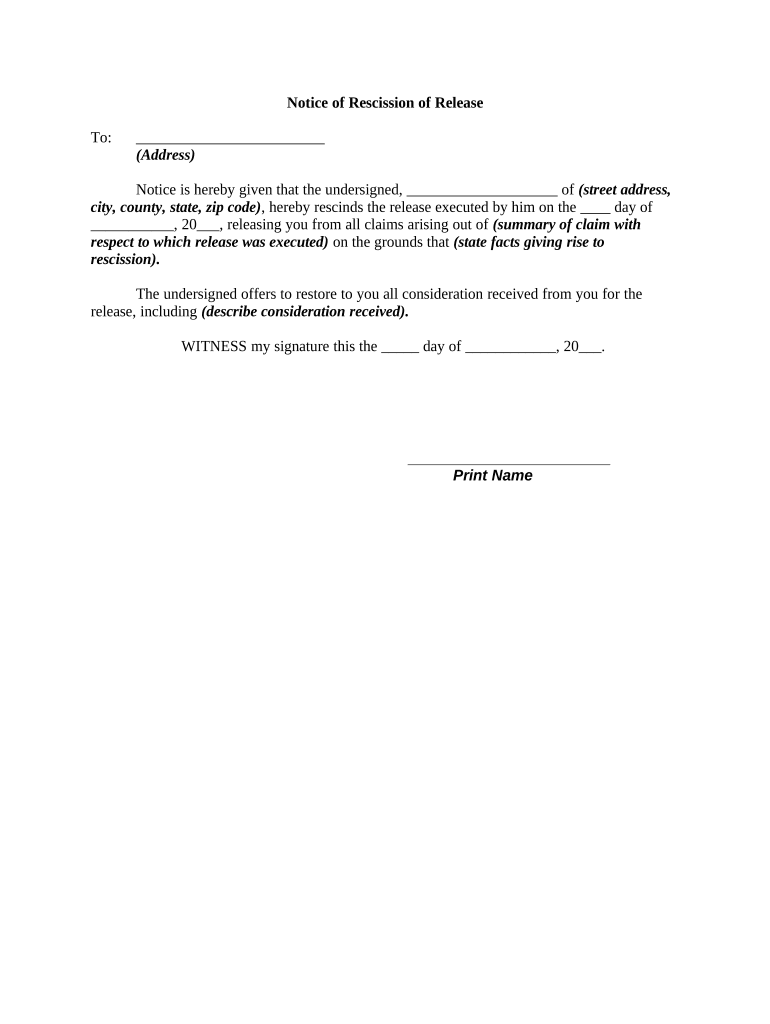
Notice of Rescission of Release
What a Notice of Rescission of Release Is and When it Applies
Why a Formal Notice Matters
A formal notice creates a clear, dated record of your intent to withdraw the release, reduces ambiguity about the parties’ positions, and preserves evidence for litigation or negotiation. It also triggers any contractual or statutory response windows and informs third parties who rely on the original release.
Who Typically Prepares or Receives This Notice
The receiving party should evaluate contractual clauses, applicable statutes, and any required response or cure periods before accepting or contesting rescission.
- Individual claimants or plaintiffs seeking to undo a signed release after discovering misrepresentation or newly discovered evidence.
- Legal counsel or claims adjusters issuing rescission on behalf of clients to protect legal rights.
- Employers, insurers, or payors who receive rescission notices and must assess contractual and regulatory effects.
Step-by-Step: Preparing the Notice of Rescission of Release
-
01Identify the release: Cite the original agreement, date, and parties precisely.
-
02Explain grounds: Describe reasons for rescission—fraud, duress, mistake, or new evidence.
-
03State rescission: Declare that the release is rescinded as of a specific effective date.
-
04Serve parties: Deliver by required methods and retain proof of service.
How to Configure an Online Rescission Workflow
| Field | Configuration |
|---|---|
| Signature Field | Required for primary signer; capture timestamp and IP. |
| Date Field | Auto-fill MM/DD/YYYY upon signature. |
| Attachment Field | Allow evidence upload (PDF, DOCX). |
| Authentication | Email link, SMS code, or stronger methods as required. |
Where to File, Send, and Maintain the Notice
-
Primary Recipient: Send to the party that received the original release; address must match contract contact.
-
Counsel and Representatives: Copy attorneys, claims representatives, and insurers for awareness and response coordination.
-
Court or Agency: File with court or administrative agency if the release was part of a filed matter.
-
Recordkeeping: Retain signed notice and proof of service per retention rules.
Digital Signing and eSubmission Requirements
Store signed copies and the audit record to support enforceability and future evidentiary needs.
- Authentication: Email links, SMS codes, or multi-factor authentication as needed.
- Audit Trail: Record timestamps, IPs, and signer actions.
- File Formats: PDF and DOCX preferred for long-term retention.
Common Legal Risks and Consequences
Frequent Preparation Errors to Avoid
- Failing to precisely identify the original release, which creates confusion about which obligations are being rescinded and invites disputes.
- Omitting proof of service or using an unapproved delivery method, leaving no evidence that the other party received the notice.
- Relying on an informal email or text without a proper signature or audit trail, risking challenges to the notice's validity.
- Neglecting to attach or reference supporting facts and exhibits that establish grounds for rescission, weakening your legal position.
Key Timeframes and Statutory Deadlines to Watch
TILA Consumer Rescission:
Three business days for certain credit transactions (15 U.S.C. §1635).
Response Window:
Contract may set a cure or response period; follow the contract's deadlines.
Statute of Limitations:
Underlying claim limitations vary by state; commonly 2–6 years.
Proof of Service:
Retain delivery evidence immediately; delays can forfeit claims.
Administrative Filings:
Agency or court filings may have separate scheduling and service rules.
Key Components to Include in a Professional Notice
Identification
Full party names, original release title, and exact date—precision avoids disputes over which instrument is at issue.
Statement of Rescission
A clear, unambiguous sentence stating the release is rescinded as of the effective date; avoid conditional or tentative phrasing.
Grounds and Evidence
Concise factual basis and list of attached exhibits (correspondence, photos, sworn statements) that substantiate rescission.
Service and Signatures
Signed and dated by authorized signer; include notarization or witness details if required by jurisdiction or contract.
Real-World Examples of Rescission Notices
Optica Ventures — Portfolio Dispute
The company discovered material misrepresentation in a release used during an asset transfer
- Team attached original contract excerpts and financial records to support rescission
- The recorded notice and certified delivery preserved Optica’s position while negotiations continued.
Martin Properties — Tenant Release
A landlord rescinded a tenant release after finding fraudulent signatures on supporting paperwork
- Staff retained audit logs and notarized affidavits
- Clear documentation reduced litigation risk and supported recovery of disputed funds.
Pricing and Feature Comparison for eSignature Platforms
| signNow | DocuSign | Adobe Sign | PandaDoc | HelloSign | |
|---|---|---|---|---|---|
| Starting Price | $8/user/mo | $15/user/mo | $14/user/mo | $19/user/mo | $15/user/mo |
| Free Trial | 7-day trial | Varies by plan | Varies by plan | Varies by plan | Varies by plan |
| Bulk Send | Available by plan | Available by plan | Available by plan | Available by plan | Varies |
| Audit Trail | Yes | Yes | Yes | Yes | Yes |
| HIPAA Compliant | Yes | Varies by plan | Varies by plan | Varies by plan | Varies by plan |
Frequently Asked Questions About Notice of Rescission of Release
-
Is an electronic rescission notice valid under federal law?
Yes. An electronic notice that demonstrates intent, consent, signer attribution, and record retention meets the ESIGN Act standards (15 U.S.C. §7001) and is generally enforceable when those elements are present.
-
Do I always need a notary to rescind a release?
Not necessarily. Notarization depends on the original release, state law, or contract clause. If the original instrument required notarization, having a notarized rescission supports enforceability.
-
What happens if the other party refuses the rescission?
If refused, preserve evidence and pursue judicial or administrative remedies as appropriate. Courts will evaluate the factual basis for rescission—fraud, duress, or mutual mistake are common grounds.
-
How should I serve the notice to prove delivery?
Use methods specified in the contract (certified mail, personal service) or provide proof of electronic delivery with an audit trail; retain delivery receipts and timestamps.
-
Can I rescind a release after a third party relied on it?
Third-party reliance complicates rescission and can limit available remedies; obtain legal advice because equitable considerations and lender or creditor rights may apply.
-
How do I correct errors in a rescission notice?
Prepare an amended rescission stating the correction, cite the original rescission, and re-serve all parties with evidence of the amendment and explain the reason for the change.