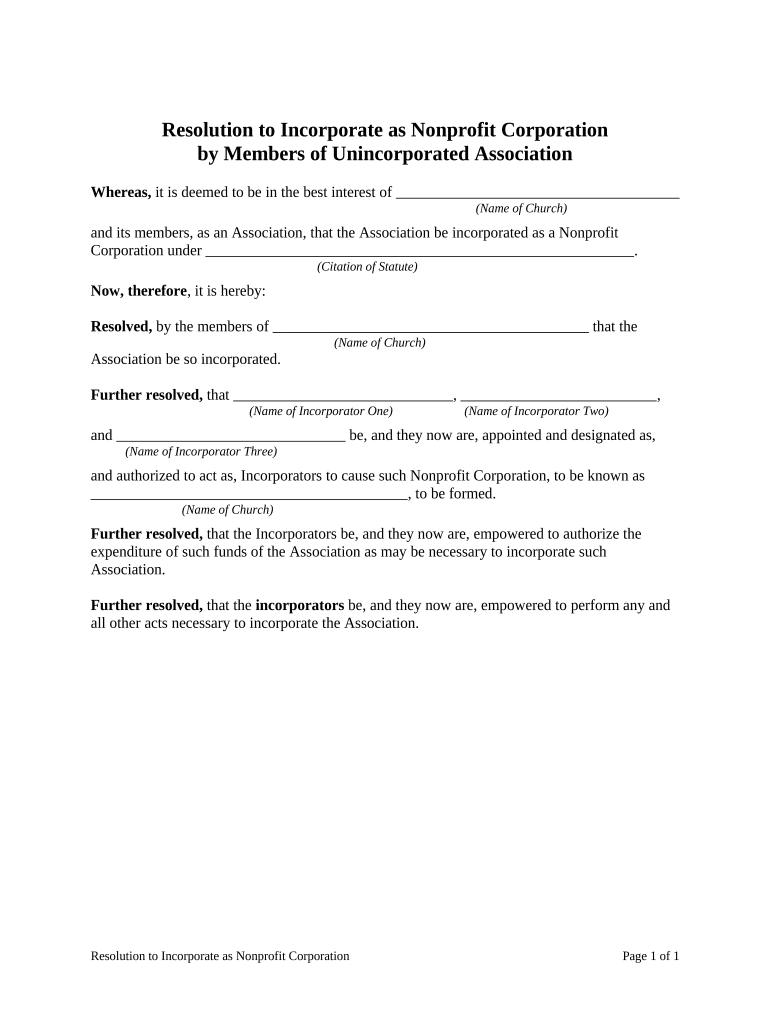
Resolution to Incorporate as Nonprofit Corporation
What the Resolution to Incorporate as Nonprofit Corporation Is
Why a Clear Resolution Matters for Incorporation
A written resolution creates a transparent internal record that the board authorized incorporation, avoids later disputes about authority, and supports filings with the state and third parties such as banks and grantors.
Who Typically Prepares and Signs This Resolution
The resolution is prepared by the incorporator, corporate counsel, or the board secretary and is adopted by the board or incorporator before filing incorporation papers.
- Incorporators and founders who will file the articles and set initial governance.
- Board members who must authorize formation, initial bylaws, and officer appointments.
- Corporate counsel or nonprofit advisors preparing compliant formation documentation.
Keep a signed copy in the corporate minute book and attach it to initial corporate records, bank account applications, and tax-exemption filings.
Step-by-Step: Adopting and Using the Resolution
-
01Draft: Prepare resolution language consistent with articles of incorporation and bylaws.
-
02Board Action: Hold a board or incorporator meeting and record the vote in minutes.
-
03Signatures: Collect required signatures and dates; notarize when state rules require.
-
04Attach: File or keep a signed copy with the articles, bylaws, EIN paperwork, and corporate minute book.
Where the Resolution Fits in the Incorporation Flow
-
Board Approval: Documented authorization to form the nonprofit and to file articles.
-
File Articles: Submit certificate or articles of incorporation to the state secretary of state or equivalent office.
-
Obtain EIN: Use approved resolution language when requesting an Employer Identification Number from the IRS.
-
Open Accounts: Provide signed resolution to banks and grantors as evidence of authority.
Configuring an Online Workflow for the Resolution
| Field | Configuration |
|---|---|
| Signer Order | Sequential signing: incorporator then board chair then secretary |
| Authentication | Email plus SMS code for added signer attribution |
| Attachments | Attach articles, bylaws, and minutes as supporting documents |
| Retention | Store executed copy in secure document repository with audit trail |
Technical Requirements for Electronic Adoption and Storage
Use an e-signature platform that provides an audit trail, secure storage, and exportable signed PDF copies for regulators and banks.
- Integrations: Salesforce, Google Workspace, Microsoft 365, NetSuite
- Formats: PDF and DOCX with embedded audit trails
- Authentication: Email, SMS, or advanced signer authentication available
Ensure the chosen platform supports ESIGN/UETA compliance, secure encryption (TLS/AES), and retention exports for audits and tax-exempt applications.
Typical Timelines and Deadlines After Adopting the Resolution
File Articles:
File articles of incorporation with the state shortly after adoption to establish legal existence
Obtain EIN:
Apply to the IRS for an EIN soon after filing to enable banking and payroll setup
Apply for 501(c)(3):
File Form 1023 or 1023-EZ for federal tax exemption; filing within 27 months can secure retroactive exemption
State Tax & Registrations:
Register for state tax exemption and charitable solicitation as required by state law
Minutes and Recordkeeping:
Record the resolution and attach signed copies to the corporate minute book immediately
Key Milestones from Resolution to Operational Nonprofit
Adopt Resolution
Board or incorporator votes and signs the resolution authorizing formation and initial governance
File Incorporation Papers
Submit articles or certificate to the state secretary of state and pay required fees
Federal Registrations
Obtain EIN and submit tax-exempt application if applicable
Operational Setup
Open bank accounts, adopt bylaws, and commence authorized activities
Common Pitfalls When Preparing the Resolution
- Using an informal or unsigned resolution that lacks a clear effective date, which can create ambiguity for banks and regulators and delay account openings.
- Mismatched entity name between resolution and articles of incorporation, causing filing rejections or confusion with state records.
- Failing to specify who has authority to sign checks or contracts, requiring a supplemental resolution and additional administrative steps.
- Assuming electronic signatures are valid without confirming state RON or notarization rules when a notary or witnesses are required.
Consequences of an Incorrect or Missing Resolution
eSignature Pricing and Feature Comparison for Incorporation Workflows
| signNow | DocuSign | Adobe Sign | PandaDoc | HelloSign | |
|---|---|---|---|---|---|
| Starting Price | $8/user/mo | $15/user/mo | $14/user/mo | $19/user/mo | $15/user/mo |
| Free Trial | 7-day free trial | Varies by plan | Varies by plan | Varies by plan | Varies by plan |
| Bulk Send | Yes | Yes | Yes | Yes | No |
| Audit Trail | Yes | Yes | Yes | Yes | Yes |
| HIPAA Compliant | Yes | Yes | Yes | No | No |
| Envelope Cap | No cap | 100 envelopes/user/year | Varies by plan | Varies by plan | Varies by plan |
Frequently Asked Questions About the Resolution and Electronic Execution
-
Is an electronic signature valid?
Yes, electronic signatures are legally binding in the United States under the ESIGN Act (15 U.S.C. §7001) and UETA where adopted, provided the signature shows intent, consent, attribution, and reliable record retention.
-
Do I need notarization for the resolution?
Most states do not require notarization of a board resolution to incorporate, but some filings or bank account openings may request notarized signatures; verify the bank and state filing requirements in advance.
-
Can I use Remote Online Notarization (RON)?
RON is permitted in many states with specific identity-proofing and recording rules; check your state's notary commission or NCSL updates to confirm RON availability and any retention obligations.
-
Who should sign the resolution?
The incorporator or the board chair and secretary typically sign; ensure signers are authorized by the board minutes and that the resolution expressly names authorized officers or agents.
-
What supporting documents are needed?
Attach the articles of incorporation, initial bylaws or bylaws approval, and minutes reflecting adoption; banks and grantors commonly require the resolution plus an EIN confirmation.
-
How should I store the executed resolution?
Store the signed resolution in the corporate minute book and a secure electronic repository that preserves an audit trail and allows reproduction for audits and regulator requests.