Identification
List the trust name, original date of execution, grantor's full legal name, and any unique file or docket numbers so the revocation cannot be confused with another instrument.
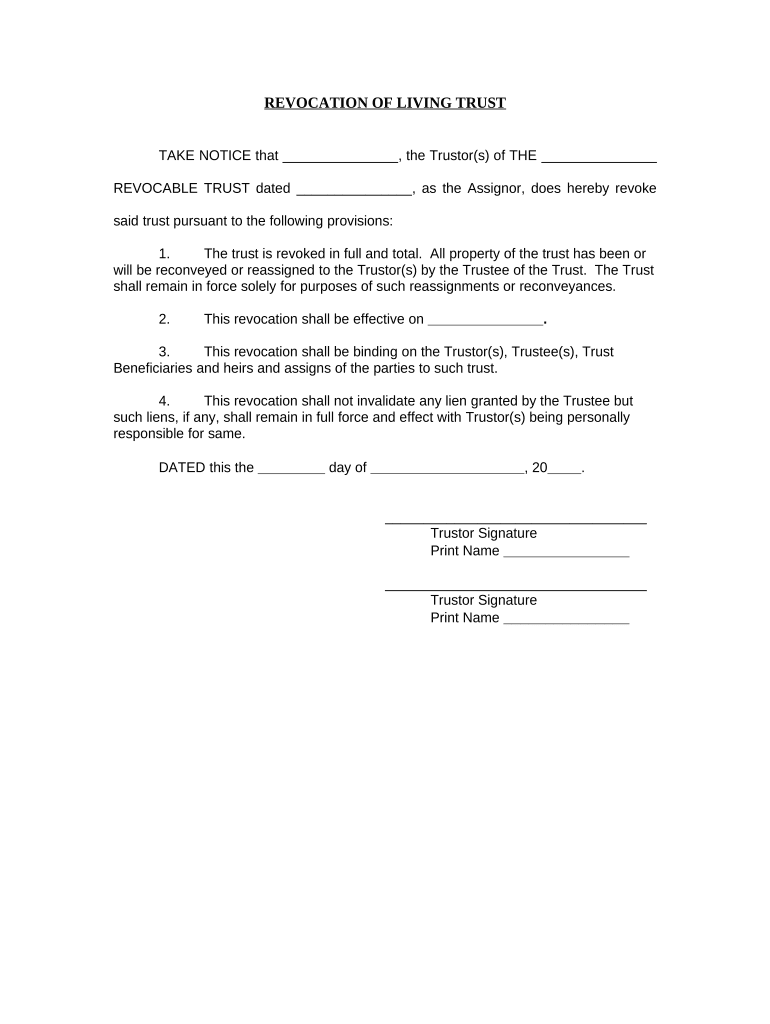
Revocation of Living Trusts clarifies control over assets, prevents unintended distributions, and updates estate plans to reflect changed circumstances. A clear, properly executed revocation reduces disputes, eases asset transfer for successors, and preserves the settlor’s intent under applicable state trust law.

Typical users include settlors updating their estate plans, estate attorneys preparing documents, and trustee offices processing trust changes.
List the trust name, original date of execution, grantor's full legal name, and any unique file or docket numbers so the revocation cannot be confused with another instrument.
A clear declarative sentence stating that the settlor revokes the trust, whether in whole or in part, and describing the scope of revocation to avoid ambiguity in administration.
If only certain assets are revoked, include an itemized list or exhibit referencing account numbers, property descriptions, and parcel IDs to precisely identify assets removed from the trust.
Signature lines for the settlor and, if required by state law, witness and notary sections with jurat or acknowledgement language consistent with local statutes and notarization instructions.
Specify the date the revocation becomes effective; if retroactive action is intended, state that explicitly and cite any supporting instrument or clause.
Instructions for delivering executed revocation copies to trustees, successor trustees, financial institutions, and any registry that holds trust assets; note required recording if real property is affected.
| Field | Configuration |
|---|---|
| Document Upload | PDF or DOCX; set signer fields |
| Signer Authentication | Email link, SMS code, or ID verification |
| Notary Integration | Enable RON if state permits; record session |
| Save & Archive | Automatic retention with audit trail and timestamp |
Digital signing and eSubmission require platforms that support authentication, audit trails, secure storage, and file formats compatible with legal recording.
Effective on the signed date unless the document specifies a later date.
Send executed copies immediately; allow institutions up to 30 days for administrative changes.
Record as soon as possible to clear title; county processing times vary.
Report changes for tax purposes at year-end; consult tax counsel for timing.
Some banks require notarized originals within 30–60 days; verify each institution's policy.
A settlor revises personal plans after remarriage and needs to remove specific beneficiaries from a previously drafted living trust to reflect new family dynamics.
A corporate trustee received a signed revocation and required a notarized acknowledgement before updating account registrations and releasing assets back to the former settlor.