Establishing secure connection…Loading editor…Preparing document…

Revocation of Premarital Agreement North Carolina

This template is fully customizable. Edit the text, fill out the fields, and send it for signature. Give it a try!
Revocation of Premarital Agreement North Carolina

What a Revocation of Premarital Agreement in North Carolina Does

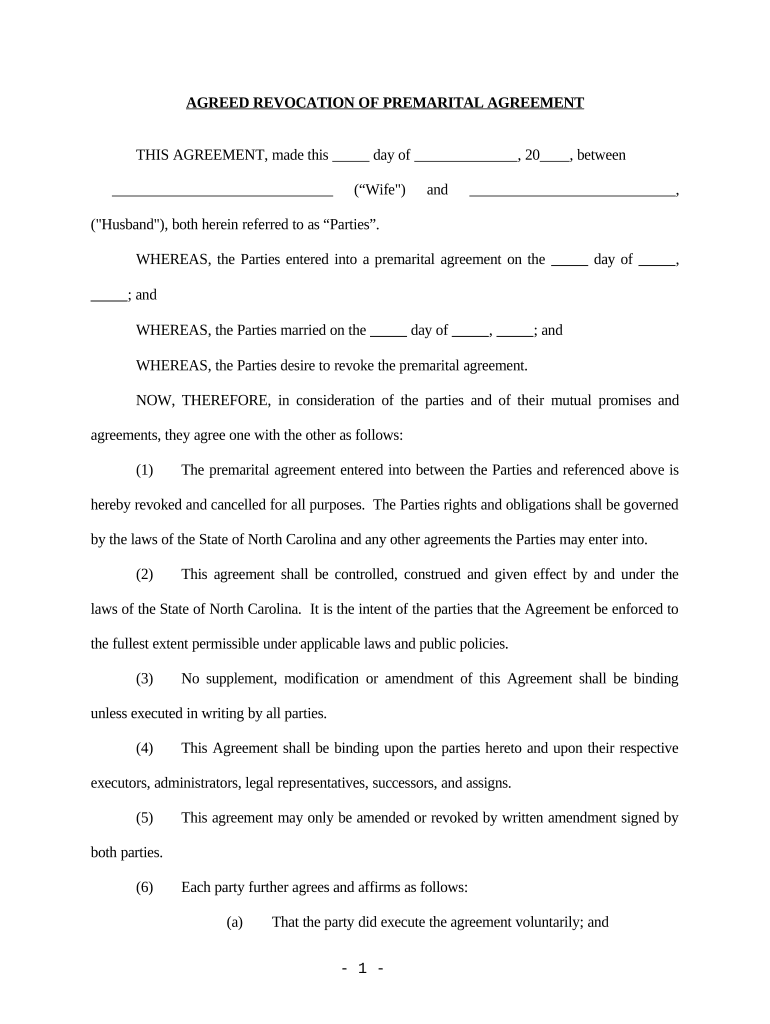
A Revocation of Premarital Agreement (North Carolina) is a written statement used by the parties to cancel or terminate a previously executed premarital (prenuptial) agreement. The revocation identifies the original agreement, states the parties' mutual intent to revoke, sets an effective date, and documents signatures and dates. A clear revocation reduces later ambiguity about property, spousal support, or estate issues. Parties typically retain signed copies and may follow state formalities for notarization, recordkeeping, or court filing when required or recommended.

Why a Formal Written Revocation Matters

A signed revocation provides an unambiguous record that the original premarital agreement is no longer in force, lowering litigation risk and helping accountants, trustees, and courts determine current rights. It creates a traceable chain of intent and can prevent disputes about whether prior terms still apply.

Why a Formal Written Revocation Matters

Who Typically Prepares or Signs This Revocation

Typical users include the spouses themselves, family law counsel, and advisors documenting termination of premarital protections.

  • Married or engaged couples who mutually agree to revoke a premarital agreement.
  • Family law attorneys preparing recorded or notarized revocation documents for clients.
  • Estate planners and tax advisors documenting changed asset allocation after revocation.

Core Parts of a Professional Revocation Document

A focused revocation clearly identifies the original agreement, states the revocation language, records the effective date, and captures signatures and notarizations where appropriate.

Identification

Cite the original premarital agreement by date and parties so the document unmistakably references the instrument being revoked.
Revocation Clause

A short declarative clause stating the parties' mutual intent to revoke and nullify the specified premarital agreement in whole or in part.

Effective Date

Specify the exact MM/DD/YYYY effective date for the revocation so third parties can determine which terms still apply.

Signatures

Signature blocks for both parties with printed names and dates; mutual signatures commonly required to avoid unilateral cancellation disputes.

Notary Block

Notary acknowledgment or remote online notarization record when state formalities or evidentiary needs make notarization advisable.

Distribution Log

A brief record of who received copies and when, useful for estate, tax, and court inquiries.

Step-by-Step: Preparing and Finalizing the Revocation

Follow these principal steps to create a clear, enforceable revocation and to preserve proof of termination.

  • 01
    Locate Original: Review the original premarital agreement to confirm references and any required revocation method.
  • 02
    Draft Revocation: Prepare a concise written revocation that references the dated agreement and states mutual cancellation.
  • 03
    Sign and Notarize: Both parties sign in presence of a notary or via approved RON procedure, if desired or required.
  • 04
    Distribute & Retain: Provide signed copies to counsel, retain originals, and update estate or financial files accordingly.

Where a Completed Revocation Typically Goes

After execution, send or lodge the signed revocation with the parties, counsel, and any third parties who rely on the original agreement.

  • To the Other Party: Deliver a signed copy and obtain acknowledgment of receipt.
  • To Attorneys: Give copies to both parties' counsel for file updates and advice.
  • Court or Registry: File only if a filing is required or court involvement is anticipated.
  • Record Retention: Store the original signed revocation with estate and tax records.

How to Complete the Revocation Online and Maintain Audit Evidence

Set up an online workflow that captures signer intent, identity, and a tamper-evident audit trail for later proof.

Field Configuration
Signature Fields Place signature, printed name, and date fields for both parties.
Authentication Require email link plus SMS or knowledge-based verification for stronger attribution.
Notary/RON Option Enable remote notarization session or add notary acknowledgment fields when needed.
Audit Trail Capture IP, timestamp, and action log for each signer.

Technical Considerations for Digital Execution

Choose a platform that supports legal e-signatures, required file formats, and reliable audit trails before sending the revocation for signature.

  • File Formats: PDF and DOCX supported
  • Integrations: Google Workspace, Microsoft 365
  • Authentication: Email, SMS, ID verification

Ensure the chosen workflow allows export of a certificate of completion and long-term storage in a tamper-evident format for evidentiary needs.

Timing, Effective Dates, and Practical Deadlines

There is no universal filing deadline for revoking a premarital agreement; observe effective-date precision and immediate distribution to relevant parties.

Effective Date:

Revocation takes effect on the MM/DD/YYYY listed or on mutual signature date.

Immediate Notice:

Provide signed copy to the other party promptly after execution.

Notarization Window:

If notarized, complete notarization at signing or within the timeframe required by local notary law.

Court Filing:

File only when a court order or recordation is necessary for enforcement.

Record Update:

Update estate and financial records within 30 days of execution.

Common Preparation Mistakes to Avoid

  • Failing to reference the original agreement precisely, causing ambiguity about which instrument is revoked.
  • Using vague language like 'amend' when the parties intend full revocation, producing litigation risk.
  • Allowing only one party to sign or failing to notarize when state or third-party requirements exist.
  • Not distributing signed copies to counsel, financial institutions, or estate administrators who rely on prior terms.

Legal Risks and Consequences of an Incorrect Revocation

Invalid Revocation: Missing mutual signature
Estate Disputes: Claims about asset ownership
Tax Complications: Potential IRS reporting ambiguity
Court Challenges: Costly litigation risk
Third-Party Reliance: Banks may refuse changes
Evidentiary Gaps: Missing audit trail weakens proof

Practical Examples of Electronic Revocation and Recordkeeping

Two brief examples illustrate how organizations and individuals execute and store revocations while preserving evidentiary trails.

Optica Ventures

Optica used an eSignature workflow to collect mutual signatures on a revocation and preserve an audit trail for estate planning.

  • Faster execution without in-person meetings.
  • Brian Fitzgibbons, COO, said: "The interface is simple and easy-to-use for our team; more importantly, it is just as easy for our customers." They kept secure copies for client records and counsel.

Fertility Centers of Illinois

A legal team used digital signatures to execute a revocation and distribute copies to multiple advisors quickly.

  • Improved coordination across advisors and counsel.
  • John Butler, Founder, noted reliable compliance and API integration benefits; the organization retained signed copies and a certificate of completion for audit purposes.

Security and Compliance Considerations for Electronic Revocation

Encryption: TLS 1.2/1.3; AES-256 at rest
Certifications: SOC 2 Type II and ISO 27001
Legal Compliance: ESIGN and UETA compliant
HIPAA Support: HIPAA-compliant with BAA
Audit Trail: Detailed timestamp and IP logs
Accessibility: WCAG 2.0 Level AA support

Comparing eSignature Options for Executing a Revocation

This comparison shows common commercial options and starting prices for eSignature vendors; signNow appears first per platform selection conventions.

signNow DocuSign Adobe Sign PandaDoc HelloSign
Starting Price $8/user/mo $15/user/mo $14/user/mo $19/user/mo $15/user/mo
Free Trial 7-day free trial Varies Varies Varies Varies
Bulk Send Yes Yes Yes Yes No
Audit Trail Yes Yes Yes Yes Yes
HIPAA Compliant Yes Yes Yes No No

Frequently Asked Questions About Revoking a Prenuptial Agreement in North Carolina

Answers to common questions about execution, electronic signatures, notarization, and implications for estate and tax planning.


Need help? Contact support

be ready to get more
Join over 28 million airSlate SignNow users