Caption and Case Data
Court name, case number, parties, and judge designation in the statutory or local form required by the court; this ensures correct routing and docketing.
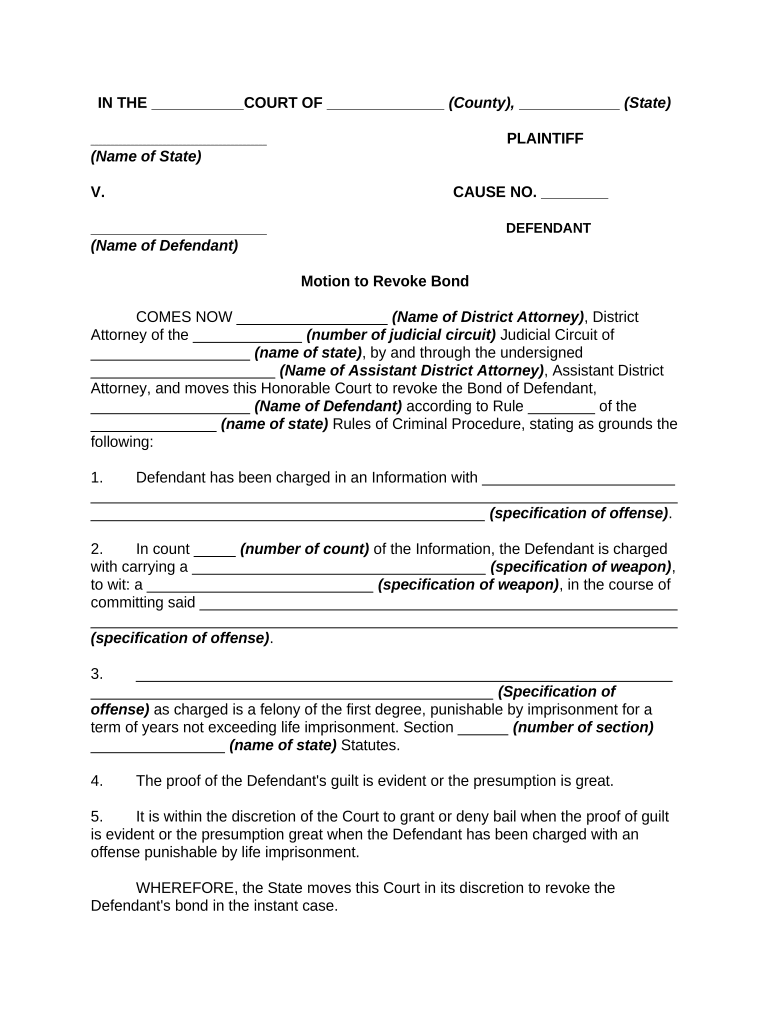
Filing a Motion to Revoke Bond enables an interested party to prompt court review when circumstances change, help protect public safety, and ensure judicial oversight of release conditions. The motion begins a formal process that can result in modification, revocation, or enforcement of the underlying bond.

Several parties may prepare or request a Motion to Revoke Bond depending on the case context.
The court, not the filer, decides whether to revoke a bond after considering evidence and argument from all parties.
A prosecutor or state attorney files motions when public safety or compliance issues arise; they must attach factual statements and may request an evidentiary hearing to support revocation. The motion typically cites charged offenses and any violations of release terms.
Defense counsel prepares responsive filings, motions to continue, or proposed alternatives (e.g., modified conditions). Counsel focuses on due process, potential undue prejudice, and remediation measures that avoid unnecessary detention.
Court name, case number, parties, and judge designation in the statutory or local form required by the court; this ensures correct routing and docketing.
Concise factual narrative describing new conduct, noncompliance, or fraud that justifies revocation; include dates, witnesses, and sources of information.
Cite controlling statutes, rules, and case law supporting revocation or modification; address standards the court uses to assess bond conditions.
Attach affidavits, police reports, certified records, communications, or surveillance logs with exhibit labels and authenticated copies where required.
Clearly state the requested order (full revocation, modification, arrest, or forfeiture) and any interim measures like emergency detention or surety security.
Include proof of service showing who received the motion, how it was served, and the date to comply with procedural rules.
| Field | Configuration |
|---|---|
| Platform | Choose e-filing-compatible PDF platform |
| Authentication | Require signer identity validation |
| Template Fields | Lock caption, case number, signature blocks |
| Filing Destination | Court clerk e-file or physical filing |
Many courts accept electronically signed motions and e-filed documents, but local rules and e-filing provider requirements vary.
Confirm the court's e-filing rules and any consumer-disclosure requirements when using electronic signatures under ESIGN and state law.
File immediately; court may hear same day
File with at least 7–14 days' notice before hearing
Opposing party usually has 7–14 days to respond
Judge sets hearing based on calendar and urgency
Ruling may be immediate or issued in writing later
Prepare motion, exhibits, and proposed order for filing
Clerk assigns a filing date and docket number
Serve all interested parties and file proof of service
Judge hears argument and issues decision or order
Intro: A prosecutor files after the defendant is arrested on a new charge within days of release.
Intro: A bail company petitions when a defendant willfully breaches supervision terms and cannot be located.
| signNow | DocuSign | Adobe Sign | PandaDoc | HelloSign | |
|---|---|---|---|---|---|
| Starting Price | $8/user/mo | $15/user/mo | $14/user/mo | $19/user/mo | $15/user/mo |
| Free Trial | 7-day free trial | Free trial available | Free trial available | Free trial available | Free trial available |
| Bulk Send | Yes | Yes | Yes | Yes | No |
| Audit Trail | Yes | Yes | Yes | Yes | Yes |
| HIPAA Compliant | Yes | Yes | Yes | No | No |