Establishing secure connection…Loading editor…Preparing document…

Membership Share Purchase Agreement

This template is fully customizable. Edit the text, fill out the fields, and send it for signature. Give it a try!
Membership Share Purchase Agreement

What a Membership Share Purchase Agreement Does

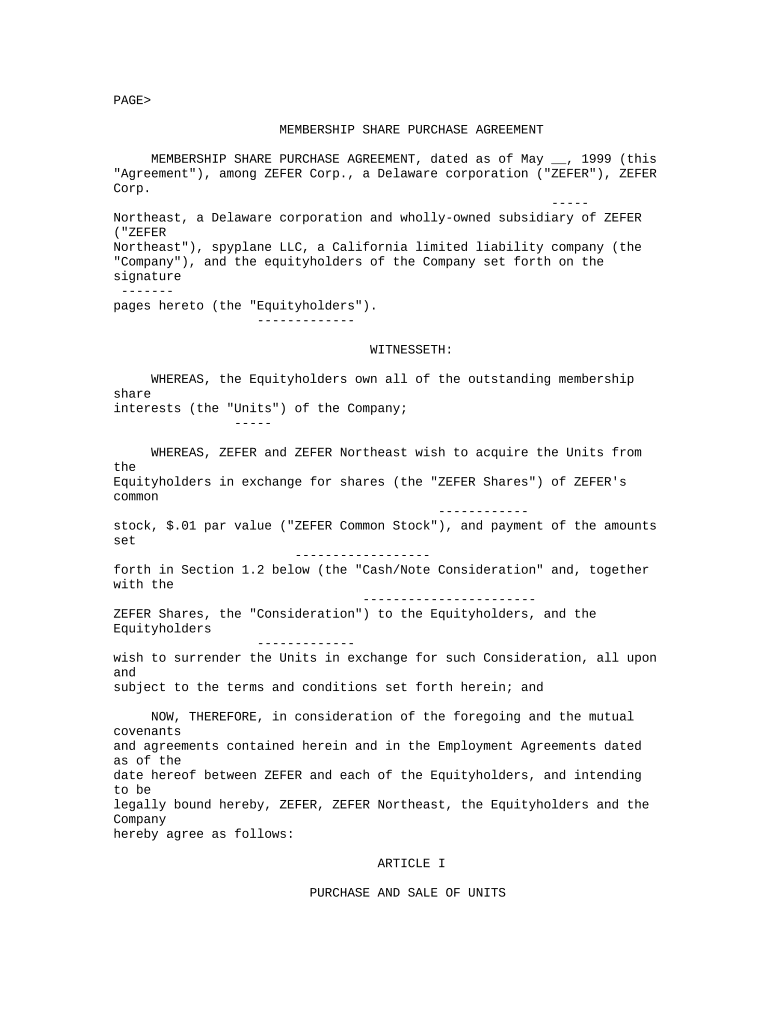
A Membership Share Purchase Agreement is a legally binding contract that records the sale and transfer of membership interests or shares in a private company, cooperative, or limited liability company. It identifies buyer and seller, specifies the exact units or shares transferred, sets the purchase price and payment terms, allocates representations and warranties, and defines indemnities. The agreement lists closing conditions, any rights of first refusal or transfer restrictions, and the deliverables required at closing, and typically attaches schedules for cap table detail, liabilities, and required consents.

Why this agreement matters for buyers and sellers

A clear Membership Share Purchase Agreement allocates risk, documents title transfer mechanics, and reduces post-closing disputes. It ensures tax treatment, protects parties through express warranties and indemnities, and records conditions needed for financing or regulatory approvals.

Why this agreement matters for buyers and sellers

Who typically prepares and executes this agreement

Typical users include company founders, private investors, in-house and outside counsel, and members managing transfers under an operating agreement.

  • Buyers and investors completing a purchase of membership interests in LLCs or cooperatives.
  • Sellers documenting sale terms, purchase price allocation, and post-closing obligations.
  • Corporate counsel preparing closing deliverables, consents, and updates to company ledgers.

Step-by-step: completing and executing the agreement

Follow these sequential steps to complete, approve, and execute the Membership Share Purchase Agreement correctly for a clean transfer.

  • 01
    Prepare Draft: Assemble terms, exhibits, and cap table schedules for review.
  • 02
    Obtain Approvals: Secure member or board consents required by operating agreement.
  • 03
    Complete Signatures: Have buyer and seller sign; include notarization if required.
  • 04
    Record & Update: Deliver certificates, update company ledger, and file any notices.

Essential clauses to review before closing

Core components determine enforceability and allocate obligations between buyer and seller; review these clauses carefully and seek legal input for high-value or contested terms prior to closing.

Purchase Terms

Defines purchase price, payment mechanisms, escrow arrangements, prorations, and post-closing adjustments. Specify currency, allocation among share classes, and mechanics for installment or promissory note payments.
Representations

Seller and buyer make statements about authority, title, capitalization, tax status, absence of undisclosed liabilities, and compliance. Accurate reps underpin indemnity obligations and closing approval.

Warranties

Contractual promises about condition, solvency, and corporate records that survive closing for an agreed period. Include discovery and limitation carve-outs for known exceptions.

Indemnities

Describe procedures for claim notice, defense control, indemnity caps and baskets, remedy hierarchy, and survival term. Clarify responsibility for attorneys' fees and settlement approvals.

Closing Conditions

List conditions precedent: required member approvals, regulatory filings, third-party consents, certificate deliveries, and any financing or escrow releases necessary for closing to occur.

Transfer Mechanics

Detail delivery of certificates, company ledger updates, tax forms, assignment language, and any required filings; include post-closing cooperation and procedures for share registration.

Security and compliance considerations

Encryption: AES-256 at rest; TLS 1.2/1.3 in transit
Certifications: SOC 2 Type II, ISO 27001
HIPAA: BAA required for PHI workflows
Audit Trail: Timestamps, IP address, and action history
Access Controls: Role-based access and SSO support
Retention: Policy-based retention and e-discovery exports

Common preparation mistakes to avoid

  • Failing to obtain required member or board approvals before closing can void transfers or expose parties to breach claims and rescission.
  • Using vague consideration terms like 'fair value' without an agreed formula risks disputes and complicates tax allocation and reporting.
  • Not reconciling pre-existing liabilities or contingent obligations may leave buyers unexpectedly liable for claims, taxes, or undisclosed obligations.
  • Mismatched names, incorrect TINs, or unsigned exhibits frequently delay closings and can trigger backup withholding or regulatory penalties.

Key risks and penalties from incorrect documentation

Transfer May Be Void: Transfer may be void
Tax Penalties: Backup withholding 24% risk
Contract Claims: Breach damages and fees
Regulatory Exposure: IRS or agency audits possible
Escrow Loss: Forfeiture of escrowed amounts
Reputational Harm: Investor confidence impaired

Setting up a compliant digital signing workflow

Configure online signing workflow to match company policies, approvals, and authentication before issuing the agreement to signers.

Field Configuration
Signature Fields Add signature, initial, and date fields for each signer.
Signer Order Set sequential order or parallel signing per approval requirements.
Authentication Use email, SMS code, or KBA for higher assurance.
Conditional Fields Show payment or escrow fields only after conditions met.

How digital execution typically proceeds

Typical e-signing flow moves a document from upload through authentication, signing, and final delivery with an audit trail for records.

  • Upload: Sender uploads agreement and attachments.
  • Place Fields: Add signer roles and required fields.
  • Authenticate: Signers verify identity (email, SMS, or KBA).
  • Complete: Signed copies and audit trail archived and distributed.

Platform features to verify before eSigning

Select an eSignature platform that supports required authentication, notarization, and integrations with your accounting and corporate record systems.

  • File Formats: PDF and Word (DOCX) supported
  • Integrations: Salesforce, NetSuite, Google Workspace
  • Authentication: Email, SMS, SSO options

Typical deadlines and timing expectations

Identify timing for approvals, due diligence, closing, ledger updates, and tax reporting to coordinate parties and reduce the chance of delay.

Request and Consent Deadlines:

Allow 7–21 days for member consents depending on operating agreement

Due Diligence Period:

Typical 7–14 day window for document review and seller disclosures

Closing Date:

Set a fixed closing date and contingency plan for delayed approvals

Ledger Update:

Record transfer in company books immediately upon receiving executed documents

Tax Reporting:

File any required tax forms and issue corrected documents within 30 days

How real organizations use eSigning for ownership transfers

Organizations use secure electronic signing to accelerate transfers, collect consents remotely, and keep auditable records that simplify governance and tax compliance.

Optica Ventures — COO

Optica Ventures uses electronic signatures to streamline ownership transfers and capture member consents without in-person meetings, reducing closing delays and manual recording.

  • Resulted in faster closings and cleaner records.
  • "The interface is simple and easy-to-use for our team; more importantly, it is just as easy for our customers." — Brian Fitzgibbons, COO, Optica Ventures LLC.

Martin Properties — Founder

A real-estate owner used eSignature workflows to execute multiple transfer documents while working remotely, ensuring compliance and speedy record updates.

  • Achieved consistent execution across devices.
  • "I can process and execute all of these documents online with 100% compliance and built-in security. Whether on mobile or working offline, I can get forms back to their necessary parties efficiently." — Tim Martin, Founder, Martin Properties.

Baseline pricing and feature comparison for common eSignature vendors

Compare starting prices and key feature availability across common eSignature vendors to assess fit for Membership Share Purchase Agreement workflows.

signNow DocuSign Adobe Sign PandaDoc HelloSign
Starting Price $8/user/mo $15/user/mo $14/user/mo $19/user/mo $15/user/mo
Free Trial 7-day free trial No No Yes, limited Yes, limited
Bulk Send Yes Yes Yes Yes No
Audit Trail Yes Yes Yes Yes Yes
HIPAA Compliant Yes Yes Yes No No
Envelope Cap No cap 100 envelopes/user/year Varies by plan Varies by plan Varies by plan

Frequently asked questions and troubleshooting

Answers to common execution and enforceability questions when preparing or eSigning a Membership Share Purchase Agreement.


Need help? Contact support

be ready to get more
Join over 28 million airSlate SignNow users