Establishing secure connection…Loading editor…Preparing document…

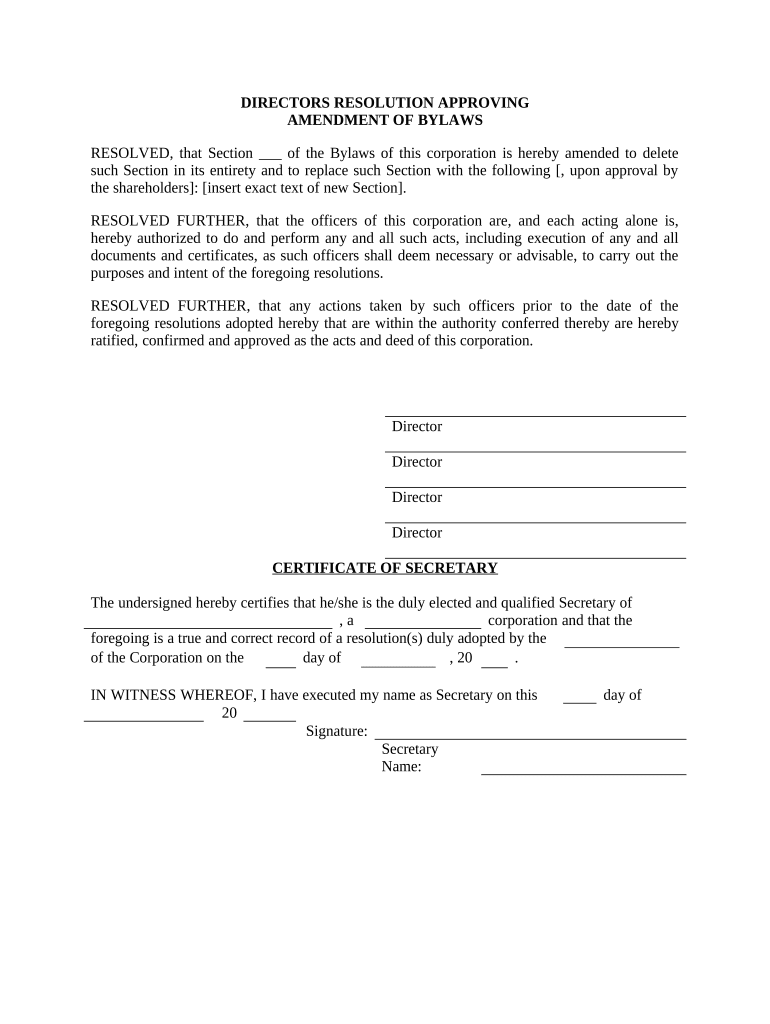
Sample Amendment to Bylaws

This template is fully customizable. Edit the text, fill out the fields, and send it for signature. Give it a try!
Sample Amendment to Bylaws

What a Sample Amendment to Bylaws Is and When It Applies

A Sample Amendment to Bylaws is a formal written change to an organization’s bylaws that records a modification to governance rules, officer powers, meeting procedures, or membership provisions. It typically identifies the bylaw section being amended, provides the new or replacement text, states the effective date, and documents the board or membership approval required under corporate law and the existing bylaws. In the United States, amendments executed electronically meet legal standards when they satisfy ESIGN (15 U.S.C. ch. 96) and applicable state UETA or state electronic-records laws, and when required notices and vote thresholds are observed.

Why Use a Standardized Sample Amendment to Bylaws

A clear template reduces drafting errors, ensures required elements are present, and documents corporate authority and timing. Using a sample helps maintain consistent language across amendments and simplifies internal review and minute-book updates, while supporting reproducible electronic signing and audit trails under ESIGN and state law.

Why Use a Standardized Sample Amendment to Bylaws

Typical Users and Stakeholders

Organizations of all sizes use amendments to align governance with operational needs, legal requirements, or shareholder directions.

  • Board members who must approve changes per the bylaws and state corporation statute.
  • Corporate secretaries responsible for recording the amendment in the minute book and maintaining official records.
  • In-house or external counsel who review language for legal risk and statutory compliance.

Essential Parts of a Professional Amendment Document

A professional amendment includes consistent headings, the exact bylaw citation, replacement language or deletions, approval attestations, an effective date, and an executed signature block. Clear structure reduces interpretive disputes and supports enforceability under corporate and electronic signature law.

Title

A concise title that identifies the document as an amendment to the bylaws and lists the organization’s legal name and amendment number where applicable.
Recitals

Short background statements describing why the amendment is proposed, including references to the authorizing bylaw provisions or corporate resolutions prompting the change.

Amendment Clause

A clear clause stating which Article, Section, and paragraph of the bylaws is amended, revoked, or replaced, with exact text to be inserted or deleted.

Approval Statement

A record of the approving body (board or members), the date of approval, and the vote tally or required quorum showing compliance with bylaws and state law.

Effective Date

A specific MM/DD/YYYY effective date or triggering event that establishes when the amendment takes legal effect for governance and operational actions.

Signature Block

Execution lines for authorized signers (e.g., corporate secretary, board chair) with printed names, titles, dates, and any witness or notary blocks if required by jurisdiction or internal policy.

Required Information and Fields to Include

Company Legal Name: Full entity name
Bylaw Citation: Article/Section
Amendment Text: Exact replacement
Approval Date: MM/DD/YYYY
Vote Record: Quorum and tally
Signatory Details: Name, title, signature

Step-by-Step: Preparing and Executing the Amendment

Follow a standard sequence to draft, approve, execute, and record the amendment to ensure legal effect and internal traceability.

  • 01
    Draft: Identify section and draft precise replacement language.
  • 02
    Review: Obtain counsel review and verify vote thresholds.
  • 03
    Approve: Hold board or member vote and record the tally.
  • 04
    Record: File in minute book and distribute certified copies.

How to Customize and Complete the Amendment Online

When using an electronic workflow, map each document element to a field, configure signer order and authentication, and enable an audit trail and retention controls.

Field Configuration
Title Field Fixed text; read-only
Amendment Text Field Multi-line; tracked changes
Approval Vote Field Numeric entry; required
Signature Block Signer order and authentication

Where to File, Send, or Submit the Executed Amendment

Amendments to bylaws are primarily internal corporate records; follow internal filing rules and any statutory notice or filing obligations relevant to your entity type.

  • Minute Book: Store executed amendment as part of corporate minutes.
  • Board Records: Attach resolution and vote record to the amendment.
  • Shareholder Notices: Send certified copies if bylaws or state law require member notice.
  • State Filings: Generally not required unless charter/articles are amended.

Digital Signing and Distribution Considerations

Choose a platform that provides an auditable signature record, secure storage, and configurable signer authentication for governance documents.

  • File Formats: PDF and DOCX supported
  • Integrations: CRM and cloud storage
  • Authentication: Email, SMS, or stronger

Common Timelines and Notice Periods to Watch

Amendments often require advance notice and specific meeting timing to satisfy notice, quorum, and voting rules; verify deadlines under your bylaws and state corporation statute.

Notice Periods:

Follow bylaws for meeting notice timing, commonly 10–30 days.

Quorum Rules:

Quorum thresholds set in bylaws determine valid voting.

Voting Deadlines:

Record vote on the documented approval date.

Effective Date:

Use explicit MM/DD/YYYY or triggering condition.

Distribution Timing:

Provide executed copies promptly after approval.

Key Milestones for an Amendment (Sequential)

Track each milestone from drafting through recording to ensure the amendment satisfies procedural and statutory requirements and to maintain a clear audit trail.

01

Drafting Complete

Final text prepared and reviewed by counsel.

02

Board Approval

Meeting held and vote recorded in minutes.

03

Member Ratification

If bylaws require, obtain member vote and certify results.

04

Record and Distribute

Place in minute book and share certified copies.

Common Preparation and Execution Errors to Avoid

  • Failing to cite the exact Article and Section to be amended, which creates ambiguity about the intended change and may cause disputes.
  • Not documenting the vote tally or quorum properly, risking a challenge to the amendment’s validity under state corporate law.
  • Using vague replacement language like 'amend as necessary' instead of providing the precise new text to be inserted or deleted.
  • Assuming an amendment to bylaws requires Secretary of State filing; in most jurisdictions bylaws are internal records and do not need state filing.

Consequences of an Incorrect or Improper Amendment

Invalid Amendment: May be void
Legal Challenge: Member or creditor suit
Operational Risk: Conflicting governance actions
Regulatory Exposure: Industry-specific penalties
Contractual Breach: Third-party agreement impacts
Recordkeeping Failure: Discovery complications

Who Typically Signs an Amendment

Board Chair

The board chair or president often signs to attest that the board approved the amendment; their signature confirms the vote and records the decision for corporate governance purposes.

Corporate Secretary

The corporate secretary certifies the amendment, attaches minutes and vote records, and preserves the executed document in the minute book as the official custodian of corporate records.

Real-World Examples of Using an Amendment

Organizations frequently amend bylaws to update signing authority, remote meeting procedures, or officer roles; these brief case notes show typical scenarios where a sample amendment is used.

Martin Properties — Remote Meetings

Martin Properties updated bylaws to allow virtual board meetings after COVID-19 restrictions.

  • The board adopted specific remote quorum rules.
  • Tim Martin reported that executing the amendment online preserved compliance while enabling continued property operations and faster distribution of certified minutes.

BIS — Authority Clarification

BIS amended officer signing thresholds to streamline vendor payments.

  • The amendment lowered approval limits for the COO.
  • Dan Rotelli noted the change reduced processing delays, required a clear vote record, and was recorded immediately in the corporate minute book.

Comparison: eSignature Options for Executing Bylaw Amendments

Key pricing and capability differences among common eSignature vendors; signNow is listed first per comparison conventions and platform data.

signNow DocuSign Adobe Sign PandaDoc HelloSign
Starting Price $8/user/mo $15/user/mo $14/user/mo $19/user/mo $15/user/mo
Free Trial 7-day free trial Verify Verify Verify Verify
Bulk Send Yes (Business Premium) Verify Verify Verify Verify
Audit Trail Yes Yes Yes Yes Yes
HIPAA Compliant Yes Yes Yes No No

FAQs: Common Questions About Amendments and eSigning

Answers to frequent questions on legal validity, signatures, notarization, and recordkeeping for bylaw amendments executed electronically.


Need help? Contact support

be ready to get more
Join over 28 million airSlate SignNow users