Establishing secure connection…Loading editor…Preparing document…

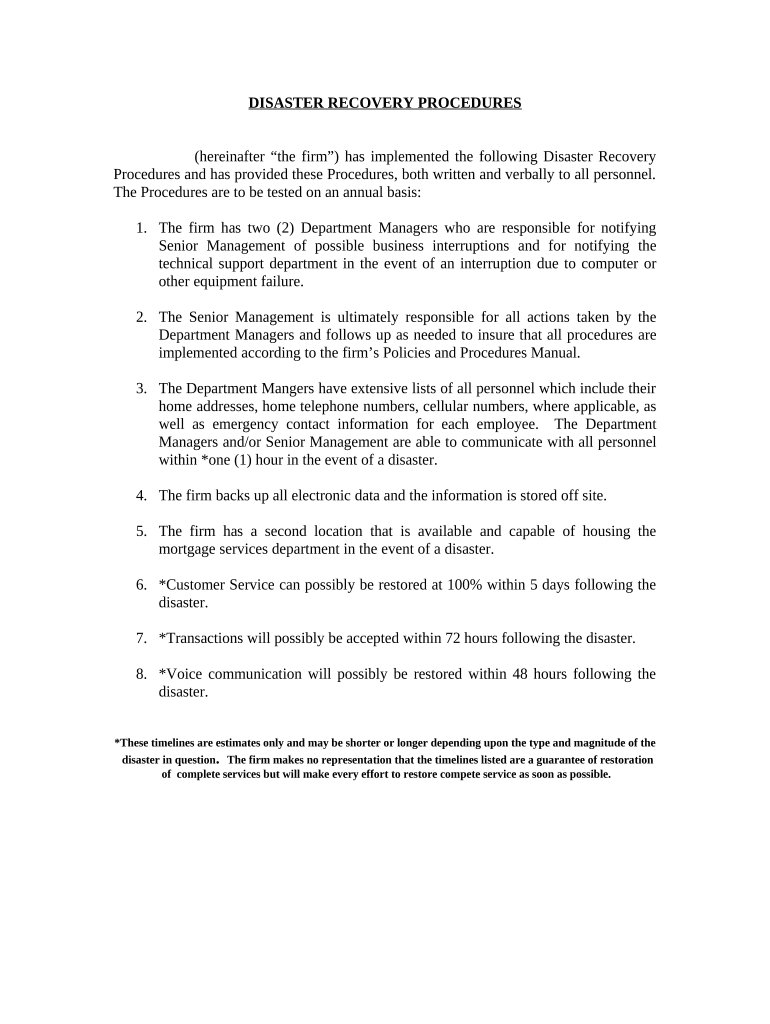
Disaster Recovery Procedures

This template is fully customizable. Edit the text, fill out the fields, and send it for signature. Give it a try!
Disaster Recovery Procedures

What Disaster Recovery Procedures Are and why they matter

Disaster Recovery Procedures are a documented set of policies and stepwise actions that an organization follows to restore operations, data, and critical services after an incident such as a natural disaster, cyberattack, system failure, or other business interruption. The procedures define roles, communication plans, recovery priorities, backup verification, alternate facilities, and measurable recovery time objectives. They link to technical runbooks and business continuity plans, and include escalation paths, tested restore procedures, and criteria for declaring the recovery complete. Clear procedures reduce downtime and support regulatory compliance.
Why maintain formal Disaster Recovery Procedures

Maintaining Disaster Recovery Procedures safeguards operational continuity, reduces recovery time, and helps meet regulatory obligations such as HIPAA, SEC, or IRS recordkeeping. Well-defined procedures clarify responsibilities, enable repeatable restores, and limit financial and legal exposure after an outage.

Why maintain formal Disaster Recovery Procedures

Who prepares and relies on these procedures

Organizations across industries adopt Disaster Recovery Procedures to protect systems, data, staff, and customers during disruptions.

  • IT and security teams managing backups, restore testing, and infrastructure failover.
  • Compliance, legal, and risk officers maintaining audit trails and regulatory evidence.
  • Operations and business unit leaders coordinating recovery priorities and alternate workspace.

Core sections to include in professional procedures

Professional Disaster Recovery Procedures include clear scopes, roles, recovery priorities, documentation standards, testing plans, and post-incident review processes to ensure measurable readiness.

Scope

Define systems, facilities, personnel, and services covered by the procedures, including dependencies, third-party vendors, and critical data flows; a precise scope limits ambiguity during activation and informs resource allocation during recovery.

Roles

Assign specific responsibilities with backup designees: recovery manager, communications lead, technical restore lead, and vendor liaison; include contact methods, escalation thresholds, and authority limits for decision-making under incident conditions.

Recovery Objectives

Document Recovery Time Objectives (RTOs), Recovery Point Objectives (RPOs), and acceptable data loss for each critical service; tie objectives to business impact analysis and measurable restoration targets.

Runbooks

Provide step-by-step technical runbooks per service with prerequisites, exact commands or procedures, expected results, rollback steps, validation checks, and links to backup artifacts or snapshots.

Testing

Schedule regular tabletop exercises, partial restores, and full failover drills; capture metrics, time-to-recover, and lessons learned to validate procedures and improve future responses.

Post-Incident Review

Require root cause analysis, documentation of decisions, remediation plans, and an approval cycle for updates; maintain version history and evidence for audits and regulators.

Step-by-step checklist to create and maintain procedures

Follow this sequential checklist to document, test, and execute Disaster Recovery Procedures for predictable response and recovery.

  • 01
    Identify Assets: List critical systems, data, and dependencies with recovery priorities.
  • 02
    Assign Roles: Designate owners, recovery coordinators, and escalation contacts.
  • 03
    Document Procedures: Create step-by-step recovery runbooks and checklist for each service.
  • 04
    Test & Revise: Perform tabletop and full restores; update based on findings.

Configure digital workflows for approvals and signoffs

Configure online workflows to assign tasks, enforce signer order, and automate notifications for Disaster Recovery Procedures.

Field Configuration
Signer Order Sequential order enforced to ensure approvals occur in correct sequence.
Authentication Use email link, SMS code, or KBA based on document sensitivity.
Timeouts Set session timeouts and link expiration to reduce risk of stale access.
Notifications Automated reminders and completion notices for owners and auditors.

How procedures flow from planning to verification

This flow shows how Disaster Recovery Procedures move from planning to execution and verification across stakeholders.

  • Create Plan: Draft objectives, inventories, roles, and communication protocols.
  • Approve: Leadership reviews, risk signs off, and version is finalized.
  • Distribute: Share runbooks to teams, cloud storage, and external vendors as needed.
  • Exercise: Run tabletop and full-restore tests; capture issues for remediation.

Platform capabilities to support Disaster Recovery Procedures

Ensure the chosen platform supports secure e-signing, access controls, and tamper-evident audit logs for Disaster Recovery Procedures.

  • Formats: PDF and DOCX file formats supported
  • Integrations: Connectors to enterprise systems
  • Authentication: Multi-factor authentication options available

Security, encryption, and compliance elements to include

Encryption: AES-256 encryption at rest
TLS: TLS 1.2/1.3 in transit
Audit Trail: Tamper-evident logs and timestamps
Access Controls: Role-based access and MFA
Certifications: SOC 2 Type II and ISO 27001
HIPAA: BAA available for covered entities

Consequences of incomplete or incorrect procedures

Operational Downtime: Extended outages increase costs
Regulatory Noncompliance: Fines and audit findings possible
Data Loss: Irreversible loss if backups invalid
Reputational Damage: Customer trust and revenue harm
Legal Liability: Breach-related lawsuits or penalties
Recovery Delays: Unclear roles slow response

Common preparation and maintenance mistakes to avoid

  • Failing to update procedures after infrastructure changes leaves runbooks outdated and leads to failed restores when teams follow obsolete steps, increasing downtime and recovery cost.
  • Not testing backups regularly can mask corruption and restore failures; organizations should perform periodic full restores to verify data integrity and recovery timelines under realistic conditions.
  • Ambiguous ownership or missing contact information for vendors and staff causes coordination delays during incidents; clearly designated alternates and reachable contact methods are essential.
  • Relying solely on single-region cloud backups without offsite snapshots or immutable copies risks simultaneous data loss during regional outages or ransomware events.

Recommended testing and review cadence

Set recurring deadlines for testing, review, and backups to keep Disaster Recovery Procedures current and verifiable for audits.

Annual Full Test:

Complete end-to-end restore once per year.

Quarterly Tabletop:

Conduct tabletop exercises every three months.

Monthly Backup Check:

Verify backup integrity and size weekly or monthly schedule.

Version Review:

Review and approve updates annually or after major incidents.

Retention Audit:

Confirm retention aligns with IRS, HIPAA, or SEC rules.

Key milestones from creation to post-incident review

Use the following milestone sequence to plan creation, testing, activation, and post-incident review of Disaster Recovery Procedures.

01

Plan Creation

Draft inventory, roles, and initial runbooks.

02

Approval

Leadership signs off and sets effective date.

03

Testing Cycle

Execute tabletop then partial and full restores.

04

Post-Incident Review

Capture lessons, update documents, and reissue versions.

Electronic signature versus digital (PKI) signature: practical differences

Key differences between electronic signatures and cryptographic digital signatures affect verification, non-repudiation, and use in regulated workflows.

Criteria Electronic Signature Digital Signature
Definition any electronic mark pki cryptographic signature
Technology email link or image overlay x.509 certificate and pki
Non-repudiation audit trail evidence strong cryptographic proof
Implementation simple, fast setup complex certificate management

Pricing and basic feature comparison for eSignature platforms

Compare common pricing and feature criteria to evaluate eSignature platforms for executing Disaster Recovery Procedures.

signNow DocuSign Adobe Sign PandaDoc HelloSign
Starting Price $8/user/mo $15/user/mo $14/user/mo $19/user/mo $15/user/mo
Free Trial 7-day free trial Varies by plan Varies by plan Varies by plan Varies by plan
Bulk Send Yes Yes Yes Yes No
Audit Trail Yes Yes Yes Yes Yes
HIPAA Compliant Yes Yes Yes No No
Envelope Cap No cap 100 envelopes/user/year Varies Varies Varies

Real-world examples of Disaster Recovery Procedures in action

Two real-world examples show how organizations use Disaster Recovery Procedures to reduce downtime, maintain compliance, and streamline post-incident recovery.

Optica Ventures

Optica Ventures documented procedures and integrated eSign workflows to ensure remote teams could execute recovery tasks without phone-based approvals.

  • Resulted in faster incident response and fewer manual handoffs.
  • After scheduled drills, Optica reduced average recovery time, improved communication among technical and operations staff, and maintained a clear audit trail for compliance reviews, enabling quicker regulatory reporting and evidence collection when required.

Tech Data

Tech Data formalized recovery roles and used cloud-hosted runbooks so on-call engineers could follow tested steps during cross-region outages.

  • This eliminated confusion and reduced time to restore services.
  • The company documented vendor contacts, automated failover triggers, and captured post-test findings; auditors cited the thorough documentation during compliance reviews, and internal stakeholders gained confidence in repeatable recovery capabilities.

Practical practices to keep procedures effective and reliable

Adopt these practices to keep Disaster Recovery Procedures practical, testable, and aligned with business continuity objectives and regulatory requirements.

Keep runbooks concise and actionable
Write steps in plain language, include exact commands and file paths, state required credentials, expected outcomes, and clear escalation points; concise runbooks reduce operator error during high-pressure restores.
Test against real scenarios regularly
Design tests that simulate realistic failures, measure time-to-recover and data integrity, involve cross-functional teams, and document remediation; use findings to update procedures and verify assumptions.
Use automation where safe
Automate repetitive restore tasks and verifications while retaining manual overrides; automated checks shorten recovery time but must include fallback instructions and periodic manual validation to avoid false confidence.
Maintain clear version history
Record every change, reviewer, and approval with timestamps; archive previous versions, denote superseded procedures, and ensure auditors can reconstruct the sequence of updates and rationale after an incident.

Who typically signs or approves the procedures

CIO / IT Director

CIOs and IT directors use Disaster Recovery Procedures to coordinate technical restorations, prioritize infrastructure, justify investments in redundancy, and demonstrate to executives and regulators that recovery objectives are defined and tested; they own approval cycles and resource allocation during incidents.

Compliance Officer

Compliance and risk officers verify that procedures meet legal and regulatory obligations, ensure retention policies match IRS, HIPAA, or SEC rules, review audit trails after incidents, and maintain evidence for external audits and internal governance processes.

Frequently asked questions about Disaster Recovery Procedures

Answers to common questions about creating, signing, storing, and testing Disaster Recovery Procedures, including electronic signing, notarization, and retention concerns.


Need help? Contact support

be ready to get more
Join over 28 million airSlate SignNow users