Establishing secure connection…Loading editor…Preparing document…

Letter Announcing Catalog Price Reductions

This template is fully customizable. Edit the text, fill out the fields, and send it for signature. Give it a try!
Letter Announcing Catalog Price Reductions

What the Letter Announcing Catalog Price Reductions Is

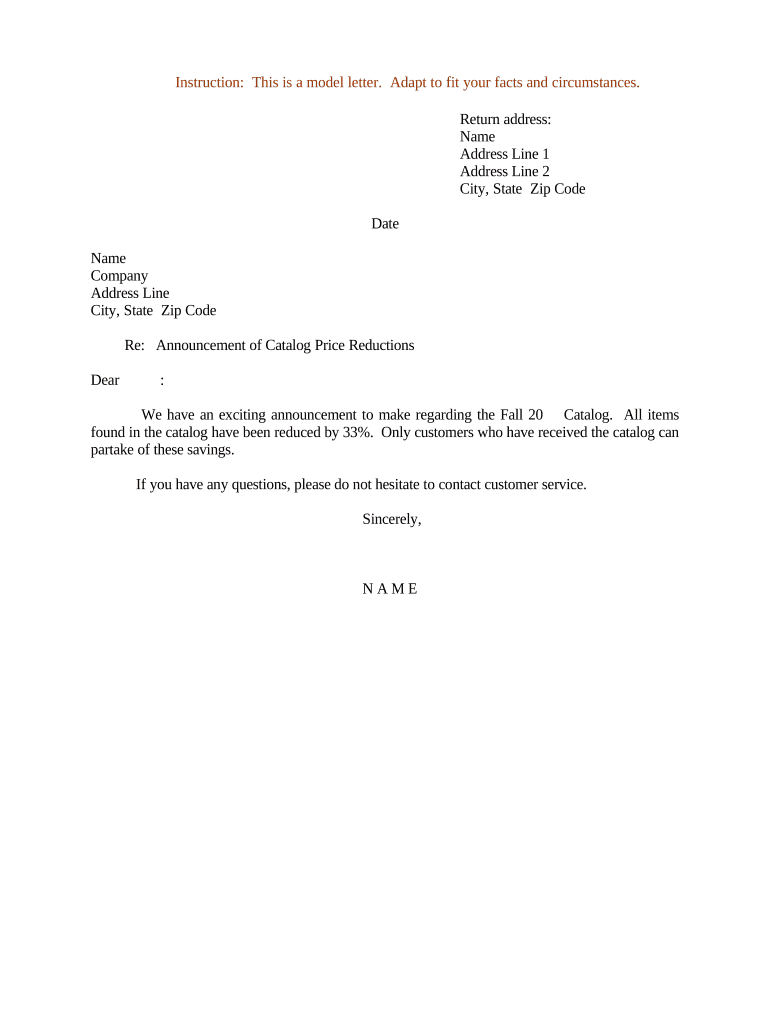
A Letter Announcing Catalog Price Reductions is a formal business notice that informs customers, partners, distributors, or internal stakeholders that prices in a product or service catalog will be lowered. It typically states which items are affected, the new price(s), the effective date, any limitations or exclusions, and instructions for reconciling prior orders or promotions. The letter can serve both operational and compliance purposes by documenting the change, controlling customer expectations, and providing a record that supports later inquiries or audits. Use clear dates, SKU references, and consistent price formatting.

Why sending a clear price-reduction letter matters

A concise, documented notification reduces disputes, supports customer service consistency, and creates a verifiable record for accounting and audit purposes. Well-structured letters improve internal coordination among pricing, inventory, billing, and sales teams while protecting contractual and regulatory interests.

Why sending a clear price-reduction letter matters

Who typically issues or receives this letter

Common senders include pricing managers, commercial operations, merchandising teams, or legal departments; recipients are customers, resellers, channel partners, and internal stakeholders.

  • Pricing Manager — Prepares the new price schedule and approves effective dates with finance and sales.
  • Sales and Account Teams — Receive the notice to align customer conversations and CRM updates.
  • Distribution Partners — Receive SKUs and effective dates so catalogs and storefronts reflect new prices.

Use role-specific distribution lists and maintain a copy of the letter in your records for reconciliation and audit trails.

Essential elements to include in the price-reduction letter

A professional notice combines factual pricing details, scope, timing, and any terms that affect prior commitments.

Effective Date

State the exact MM/DD/YYYY effective date so recipients know when the reduced prices apply and accounting systems can be updated.
Scope

List affected SKUs, categories, or service codes and explicitly note any exclusions to avoid ambiguity in fulfillment or billing.

New Prices

Present new unit prices and discounts in a tabular format with currency, unit of measure, and rounding rules for clarity.

Legacy Orders

Explain whether recently placed orders are honored at prior prices or adjusted, and include reconciliation steps if applicable.

Contacts

Provide a specific contact for pricing questions and a team contact for billing disputes to streamline issue resolution.

Legal Terms

Include governing law, whether the change amends existing agreements, and any reservation of rights to avoid contract confusion.

Step-by-step: preparing and issuing the price-reduction letter

Follow a standard sequence to reduce errors and ensure alignment across teams.

  • 01
    Prepare details: Compile SKUs, prices, and effective date.
  • 02
    Internal approvals: Obtain sign-off from pricing and finance.
  • 03
    Distribute notice: Send to customers and partners through chosen channels.
  • 04
    Archive record: Store signed letter and distribution log for audits.

Typical digital workflow settings for online completion

Configure document routing and authentication to match your risk profile and recipient types.

Field Configuration
Authentication Level Email + optional SMS code for partners
Routing Order Sequential: Pricing → Legal → Signatory
Signature Type Electronic signature with audit trail
Record Retention Retain signed copy in secure archive

How digital signing and distribution typically work

Digital workflows speed distribution and create verifiable records of each step.

  • Upload document: Sender uploads the prepared letter and attachments.
  • Place fields: Add signature, date, and custom fields for SKUs or attachment checklists.
  • Send to signers: Signers receive an email or link and complete authentication.
  • Capture audit trail: Signed copies and event logs are saved automatically.

Selecting technical delivery channels and authentication

Choose delivery and signer authentication based on recipient type and legal risk profile.

  • Email Delivery: Suitable for most customers; low friction.
  • Secure Portal: Use for large enterprise or confidential lists.
  • Two-Factor Auth: Recommended for high-value contract changes.

Ensure delivery choices align with retention, audit, and any industry-specific privacy or consent obligations before distributing the notice.

Key timing considerations and recommended internal deadlines

Set practical lead times for approvals, notification windows, and system updates to ensure operational readiness.

Price Freeze Date:

Cutoff for last-minute pricing changes prior to announcement.

Announcement Date:

When the letter is sent to customers and partners.

Effective Date:

When new catalog prices apply in commerce and billing.

Systems Update Deadline:

ERP and storefront must reflect new prices by this date.

Dispute Window:

Internal deadline to resolve customer disputes on prior orders.

Milestone timeline for the price-change process

Sequence the major milestones from decision to archive to create a clear project timeline.

01

Decision

Management approves catalog reductions.

02

Draft Notice

Legal and pricing prepare the letter.

03

Notify Recipients

Distribution occurs through selected channels.

04

Archive

Signed copies and logs are stored for retention.

Common pitfalls to avoid when preparing the notice

  • Vague scope descriptions that omit SKUs or quantities, which lead to billing disputes and operational confusion.
  • Failing to coordinate ERP updates and storefront changes, which causes inconsistent pricing across channels.
  • Overlooking contractual price-protection clauses with distributors or key accounts, risking breach of contract claims.
  • Insufficient documentation of approvals and distribution lists, complicating later audit or compliance reviews.

Legal and operational risks from incorrect or incomplete letters

Contract Breach: May trigger claims if reductions conflict with prior agreements.
Billing Errors: Incorrect invoices and refunds increase operational costs.
Regulatory Scrutiny: Industry rules may require disclosures; noncompliance risks fines.
Customer Disputes: Ambiguity can lead to reputational and financial costs.
Tax Impact: Price changes can affect reporting; consult tax advisor.
Data Privacy: Improper recipient handling can violate privacy obligations.

Security and compliance essentials to protect records

Encryption: TLS 1.2/1.3 in transit; AES-256 at rest
Audit Trail: Timestamped events, IP, and action logs
ESIGN/UETA: Meets ESIGN and UETA legal requirements
HIPAA: BAA required when PHI is involved
21 CFR Part 11: Controls available for regulated records
Certifications: SOC 2 Type II and ISO 27001 compliance

Representative eSignature vendor pricing and features for executing notices

Compare standard pricing and feature indicators to decide which platform aligns with your volume, compliance, and integration needs.

signNow DocuSign Adobe Sign PandaDoc HelloSign
Starting Price $8/user/mo $15/user/mo $14/user/mo $19/user/mo $15/user/mo
Free Trial 7-day free trial Varies Varies Varies Varies
Bulk Send Yes (plan dependent) Yes Yes Yes Varies
Audit Trail Yes Yes Yes Yes Yes
HIPAA Compliant Yes (BAA) Yes (BAA) Yes (BAA) No No

Real-world examples of electronic notices supporting commercial changes

Organizations use signed digital notices to record price and policy changes and to speed reconciliation across sales and finance.

Optica Ventures — COO

Optica used digital letters to coordinate pricing updates across partners

  • Faster internal approvals maintained price integrity across channels
  • "The interface is simple and easy-to-use for our team; more importantly, it is just as easy for our customers." — Brian Fitzgibbons

Martin Properties — Founder

Property management teams issue price changes for service fees and amenities

  • Mobile signing reduced turnaround for tenant notices
  • "I can process and execute all of these documents online with 100% compliance and built-in security. Whether on mobile or working offline, I can get forms back to their necessary parties efficiently." — Tim Martin

Typical signatories and their authority

Pricing Manager

A Pricing Manager typically has delegated authority to set list prices and coordinate notifications; they approve the SKU list, effective dates, and revenue recognition impact after consulting finance.

Chief Legal Officer

The Chief Legal Officer or delegated counsel reviews terms and legal language, confirms compliance with contracts and regulations, and signs or countersigns notices that modify contract pricing.

Practical tips for accurate and efficient completion

Follow these practices to minimize downstream errors and customer confusion.

Use precise SKU and price tables
Provide an attached SKU-price table with clear currency and rounding rules to prevent mismatches during ERP and storefront updates.
Coordinate with finance and sales
Confirm effective dates and reconciliation procedures with finance and sales to avoid conflicting invoices or promotional overlaps.
Document approvals
Record approvals from pricing, legal, and finance in the document history to create an auditable trail.
Choose appropriate authentication
Use two-factor or higher authentication for high-value or contract-modifying notices to strengthen attribution and non-repudiation.

Frequently asked questions about price-reduction letters

Answers to common questions about format, legal validity, distribution, and retention for price-reduction notices.


Need help? Contact support

be ready to get more
Join over 28 million airSlate SignNow users