Establishing secure connection…Loading editor…Preparing document…

Letter Offering Assistance During Employee Illness

This template is fully customizable. Edit the text, fill out the fields, and send it for signature. Give it a try!
Letter Offering Assistance During Employee Illness

What this letter is and when it's used

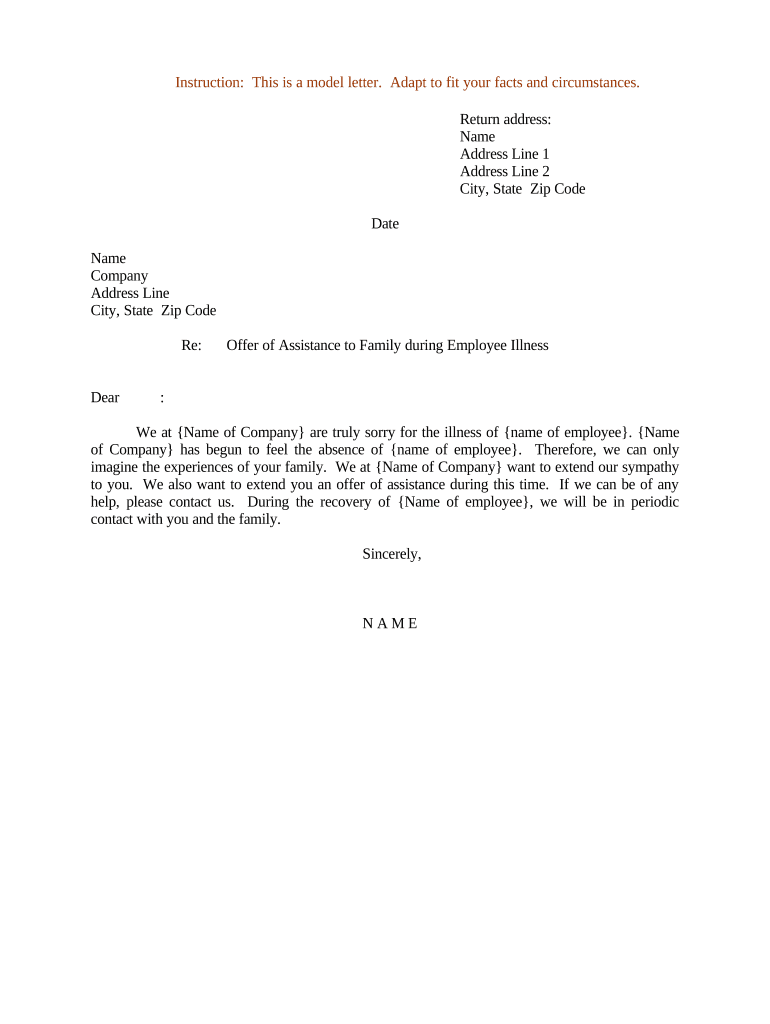
A Letter Offering Assistance During Employee Illness is a written employer communication that informs an employee who is ill about available support, reasonable accommodations, leave options, pay and benefits implications, and return-to-work steps. Employers typically use it after learning of a health-related absence, to document outreach, protect privacy, and to begin interactive processes required by workplace laws and policies. The letter clarifies what the employer will provide, what documentation is needed from the employee or provider, and how to contact HR for follow-up while maintaining confidentiality.

Why employers and HR teams prepare this letter

A clear assistance letter documents employer outreach, reduces misunderstandings about leave options and accommodations, and creates a record useful for compliance with leave and disability laws while protecting employee privacy.

Why employers and HR teams prepare this letter

Who prepares and receives this letter

Typical senders include HR professionals, direct managers, and benefits administrators acting on behalf of the employer.

  • Human resources staff who manage leave, benefits, and accommodation requests.
  • Direct supervisors who coordinate operational coverage and return-to-work planning.
  • Employees or their authorized representatives who have reported illness or requested assistance.

The letter should be tailored to the recipient while maintaining consistency with company policy, ADA obligations, FMLA processes, and applicable privacy rules.

Step-by-step: preparing and sending the letter

Follow these steps to prepare a compliant, clear assistance letter and to record the outreach properly.

  • 01
    Confirm details: Verify employee identity, dates of absence, and contact information.
  • 02
    State assistance: Describe available accommodations, leave types, and benefits eligibility.
  • 03
    Request documentation: Specify medical documentation format and reasonable deadlines.
  • 04
    Record and follow up: Log the notice and schedule the next check-in or review.

Key parts of a professional assistance letter

A well-structured letter balances clarity, compliance, and privacy — cover these six essential components.

Opening

State the purpose of the letter, reference the employee by name, and cite the reason for outreach without revealing protected health details.
Support Options

Describe practical assistance such as leave types, temporary duty modifications, schedule flexibility, and return-to-work adjustments.

Documentation Request

Specify what medical or certification documents are required, acceptable formats, and submission deadlines to process accommodations or leave.

Privacy Assurance

Affirm confidentiality measures and that medical information will be stored separately, consistent with HIPAA and company policy where applicable.

Legal Context

Reference relevant employer obligations (for example FMLA procedures or ADA interactive process) without offering legal advice to the employee.

Contact Details

Provide the HR representative's name, phone, email, and next steps including timeline for employer follow-up.

Data and privacy notes to include

Minimal data: Limit health detail entries.
Separate storage: Keep medical records apart from general HR files.
Access control: Restrict to authorized personnel only.
Retention policy: Follow legal retention schedules.
HIPAA caution: Use BAAs when third parties handle PHI.
Record audit: Log access and changes.

Common drafting and delivery mistakes to avoid

  • Using diagnostic language or medical conclusions that exceed the employer's knowledge and risk violating privacy.
  • Failing to provide clear next steps and deadlines, creating confusion about documentation and response requirements.
  • Sending sensitive details via unsecured email or channels that are not approved for protected health information.
  • Neglecting to record the outreach in personnel files, which reduces traceability for future compliance reviews.

Legal and operational risks from incorrect letters

Privacy breach: Potential HIPAA exposure
Discrimination claim: ADA/FMLA risk
Recordkeeping gaps: Compliance audit problems
Payroll errors: Incorrect pay adjustments
Operational impact: Coverage planning failures
Reputational harm: Trust erosion with staff

Typical administrative workflow for sending the letter

A standard workflow moves from intake to documentation, decision, and follow-up — use consistent routing to avoid delays.

  • Intake: Employee report logged in HR system.
  • Draft: HR prepares letter with required fields.
  • Send: Deliver via secure channel and record delivery.
  • Follow-up: Track documentation and next check-in.

Configuring a digital workflow for the letter

Set up a repeatable workflow that captures metadata, stores copies securely, and triggers reminders for both HR and the employee.

Field Configuration
Sender account Use HR group mailbox or verified HR user account.
Signer(s) Include HR approver and employee as recipient.
Authentication Email link or SMS code; higher assurance if required.
Reminders Enable automated follow-up reminders at set intervals.

Technical delivery options and system requirements

Choose secure channels that preserve confidentiality, support audit trails, and integrate with HR systems.

  • Secure email: TLS-capable mail with internal DLP controls.
  • eSignature platform: Supports audit trail and document retention.
  • HRIS integration: Push metadata to personnel records.

Integrations with common platforms (HRIS, document storage, SSO) reduce manual steps and improve recordkeeping consistency.

Recommended timing and response expectations

Timely outreach and clear deadlines help both parties manage leave and accommodations; adjust timelines to internal policy and legal requirements.

Initial outreach:

Send as soon as employer is aware of the illness.

Documentation deadline:

Provide a reasonable period, commonly 5–14 business days.

Employer response:

Acknowledge receipt within 2–5 business days of documentation.

Interim check-ins:

Schedule regular status updates during extended absences.

Return-to-work plan:

Begin planning at least one week before expected return.

Common eSignature vendor comparison for sending assistance letters

Basic pricing and capability differences can affect cost and compliance; signNow is listed first per vendor-comparison conventions.

signNow DocuSign Adobe Sign PandaDoc HelloSign
Starting Price $8/user/mo $15/user/mo $14/user/mo $19/user/mo $15/user/mo
Free Trial Yes, 7-day trial Varies by plan Varies by plan Varies by plan Varies by plan
Bulk Send Yes Yes Yes Yes Yes
Audit Trail Yes Yes Yes Yes Yes
HIPAA Compliant Yes Yes Yes No No
Envelope Cap No cap 100 envelopes/user/year Varies Varies Varies

How organizations use structured outreach in practice

Real-world examples show how a standardized letter improves clarity and compliance across industries.

Fertility Centers of Illinois

Their HR team centralized assistance letters to streamline patient-staff scheduling

  • They required secure handling of medical paperwork
  • The process reduced follow-up time and preserved patient confidentiality while aligning with clinical operations and compliance needs.

Optica Ventures LLC

Optica standardized outreach letters to improve return-to-work planning

  • The company used clear documentation timelines
  • Standardization reduced ambiguity, improved cross-team coordination, and made audit reviews more efficient for HR and leadership.

Practical tips for clear, compliant letters

Adopt consistent language, preserve privacy, and coordinate with legal and benefits teams when adapting the template.

Use neutral, factual language
Avoid medical diagnoses in the letter; request necessary documentation without speculating about prognosis or treatment.
Limit health details
Record only what is necessary for leave and accommodation decisions; store medical information separately and restrict access.
Provide clear deadlines
State submission dates for documentation and the timeline for employer decisions to reduce delays and appeals.
Keep an audit trail
Document delivery, acknowledgments, and all follow-up steps in the employee file for future reference.

Frequently asked questions about the letter and e-signing

Answers to common questions about form content, delivery methods, and legal validity help HR act consistently and defensibly.


Need help? Contact support

be ready to get more
Join over 28 million airSlate SignNow users