Establishing secure connection…Loading editor…Preparing document…

Letter Regarding Admission of Service

This template is fully customizable. Edit the text, fill out the fields, and send it for signature. Give it a try!
Letter Regarding Admission of Service

What a Letter Regarding Admission of Service Is

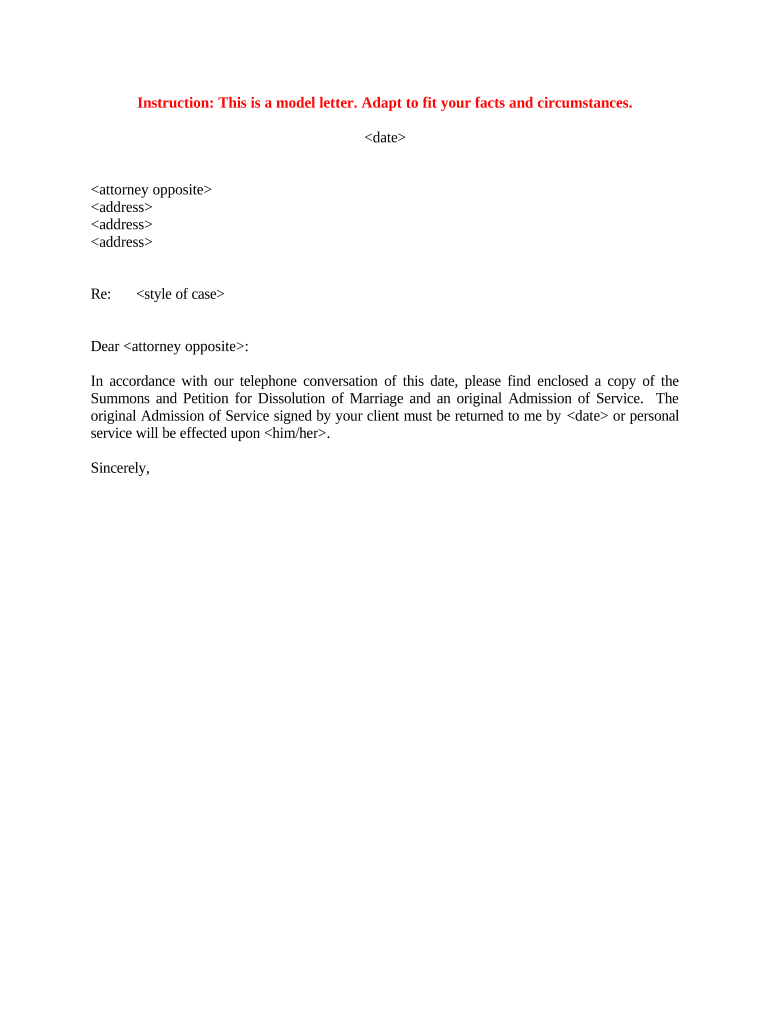
A Letter Regarding Admission of Service is a signed written acknowledgment that a party or an authorized representative received legal process or papers in a litigation matter. It records who accepted service, when and how service was made, and whether the party agrees that the documents constitute valid service for case purposes. The letter can be filed with the court or retained in counsel files to avoid disputes about notice. When executed electronically, it must meet ESIGN Act and applicable UETA requirements to be enforceable in the United States.

Why this letter matters in litigation

A Letter Regarding Admission of Service creates a clear record that service was made and accepted, reduces disputes over timeliness or validity, preserves procedural defenses, and provides the factual basis needed by counsel or the court to proceed without contest over service-related issues.

Why this letter matters in litigation

Typical users and stakeholders

Typical users include plaintiffs' counsel, defendants or their counsel, process servers, and court clerks who need a formal record of accepted service.

  • Plaintiff's counsel seeking proof of service for filing or settlement negotiations.
  • Defendant or authorized representative acknowledging receipt to avoid default or confusion.
  • Process servers documenting acceptance when personal delivery is disputed or impractical.

Core elements to include in the letter

A professional Letter Regarding Admission of Service combines clear identification, factual details of delivery, signatory authority, and an auditable signature or acknowledgment for use in litigation.

Case Information

Include the case caption, docket number, court name, and full party names so the admission unmistakably relates to the pending action; mismatched case identifiers can render the admission ineffective for filing or proof.
Service Details

Describe the method of service (personal, mail, email, RON), date and time, address or medium used, and the name of the individual who received the documents to establish how and when service occurred.

Acceptance Statement

A clear statement that the signer admits receipt of the specified documents and accepts that such delivery satisfies legal service requirements for the listed filings or proceedings.

Signatory Authority

Identify whether the signer is the named party, an officer, an attorney, or an authorized agent and include job title or capacity to confirm authority to admit service on behalf of the party.

Signature Block

Provide a dated signature line with printed name, title, and contact information; include electronic signature metadata when signing digitally to support attribution under ESIGN and UETA.

Certificate of Service

Include a certificate or notation indicating how copies were delivered to opposing counsel and the court, including dates and methods, to document notice to all parties in the case record.

Step-by-step: complete and preserve the letter

Follow these steps to complete and preserve the admission letter for filing or counsel records.

  • 01
    Prepare Document: Draft letter with case info and documents served.
  • 02
    Add Details: Record method, date, time, and recipient name.
  • 03
    Obtain Signature: Have authorized signer sign and date the letter.
  • 04
    File/Distribute: File with court if appropriate and send copies.

Configuring an online workflow for the letter

Configure online workflow fields, signer authentication, and document routing before sending the admission letter for electronic signature.

Field Configuration
Case Caption Auto-populate from case template or CRM.
Signature Field Require signer block with date and role.
Authentication Email or SMS code; use higher KBA if needed.
Save Settings Preserve PDF/A and audit trail metadata.

Where to file, send, or submit the letter

Typical routing includes counsel, opposing parties, and optional court filing; follow local rules for acceptable filing methods.

  • File with Court: Submit to court clerk per local e-filing rules.
  • Send Opposing Counsel: Email or e-file served copies to opposing counsel.
  • Retain in File: Store executed letter in client and case files.
  • Serve via Process Server: Use process server affidavit if required in jurisdiction.

Technical and security considerations for eSubmission

For eSubmission, confirm supported file types, authentication level, and that the platform captures an audit trail and signature metadata.

  • File Formats: PDF, DOCX and text formats.
  • Integrations: Salesforce, NetSuite, Google Workspace supported.
  • Security: TLS in transit, AES-256 at rest.

Required information and fields at a glance

Full Legal Names: Enter names exactly as on pleadings.
Docket Number: Use the court-assigned identifier.
Service Date: Record date using MM/DD/YYYY format.
Service Method: Personal, mail, email, or RON.
Recipient Name: Person who accepted service, printed.
Signature Info: Signed name, title, and date.

Common mistakes to avoid

  • Omitting the docket number or wrong case caption can disconnect the admission from the litigation and make it inadmissible as proof of service.
  • Failing to identify signer capacity or authority invites disputes about whether the acceptance was valid for the named party or an unauthorized agent.
  • Using informal language or vague terms about which documents were served creates ambiguity and may prompt the court to require supplemental evidence.
  • Not preserving electronic signature metadata or audit trails can undermine enforceability if the opposing party challenges the authenticity of the admission.

Consequences of incorrect or insufficient admissions

Default Judgment: Risk of default judgment.
Evidence Excluded: Court may reject ambiguous admission.
Sanctions: Possible court sanctions for false statements.
Delay: Litigation delays and extra costs.
Perjury Risk: False sworn admissions may have criminal exposure.
Missing Deadlines: Procedural defenses may be forfeited.

Timelines and deadlines tied to the admission

Key timing relates to service date, response deadlines, and any court filing deadlines tied to the admission.

Service Date Recorded:

Start response clock on the recorded service date.

Response Deadline:

Calculate deadline per local rules from service date.

File Admission:

File with court when parties stipulate admission.

Preserve Evidence:

Keep original letter in case file for evidence and audit.

Update Case Docket:

Notify clerk or update e-filing system as required.

Key milestones from service to retention

Milestones from service through filing and retention create a clear sequence to protect procedural rights and the record.

01

Service Event

Document delivery and acceptance recorded.

02

Acknowledgment Signed

Signer signs and dates acceptance statement.

03

Filing Decision

Decide whether to submit letter to the court.

04

Long-term Retention

Store letter according to retention schedule and rules.

eSignature pricing and capability comparison

Comparing common eSignature plans can help organizations choose a platform for executing and storing admission letters and related court filings.

signNow DocuSign Adobe Sign PandaDoc HelloSign
Starting Price $8/user/mo $15/user/mo $14/user/mo $19/user/mo $15/user/mo
Free Trial 7-day free trial, no credit card required Varies by vendor Varies by vendor Varies by vendor Varies by vendor
Bulk Send Yes Yes Yes Yes No
Audit Trail Yes Yes Yes Yes Yes
HIPAA Compliant Yes Yes Yes No No
Envelope Cap No envelope cap 100 envelopes/user/year Varies Varies Varies

Real-world scenarios where the letter helps

Practical examples show how an admission letter resolves service disputes and simplifies case management across common scenarios.

Defense Counsel Example

A defense attorney in a multi-jurisdictional matter accepted service on behalf of an out-of-state client to avoid contested personal delivery.

  • Admission clarified the service date and method.
  • Counsel filed the letter with the court and updated the case management system; the clear written admission eliminated a motion to quash and preserved the client's right to timely respond without added discovery on service.

Plaintiff's Counsel Example

A plaintiff’s paralegal received a signed admission from opposing counsel after attempted substituted service was challenged in writing.

  • This fixed the date for computing deadlines.
  • The plaintiff filed the admission with the clerk, avoiding additional affidavit requirements and streamlining scheduling; the court relied on the letter as prima facie evidence of service for motion practice.

Practical best practices for reliable admissions

Follow best practices to ensure the letter is admissible, clear, and durable for litigation or case administration.

Always include precise case identifiers and caption
Include the full caption, docket number, court name, and party names exactly as they appear in filings. Small discrepancies can invalidate linkage to the case and create motion practice over service authenticity, increasing time and cost.
Confirm and document signer authority in writing
If an agent signs, attach proof of agency or power to act. For corporate recipients, include officer title or corporate resolution. Clear authority statements reduce disputes and avoid motions challenging the validity of service.
Preserve originals, signatures, and metadata securely
Store the signed paper or a certified PDF along with audit logs, timestamps, IP addresses, and any authentication records. These elements support admissibility and respond to challenges about timing or signature authenticity.
File when appropriate per local court rules
Check local court rules before filing the admission. Some courts accept letters as informal records, while others require formal filings or attachments; improper filing can lead to rejection or procedural objections.

Frequently asked questions about admissions of service

Answers to frequently asked questions about preparing, executing, and filing a Letter Regarding Admission of Service in U.S. courts.


Need help? Contact support

be ready to get more
Join over 28 million airSlate SignNow users