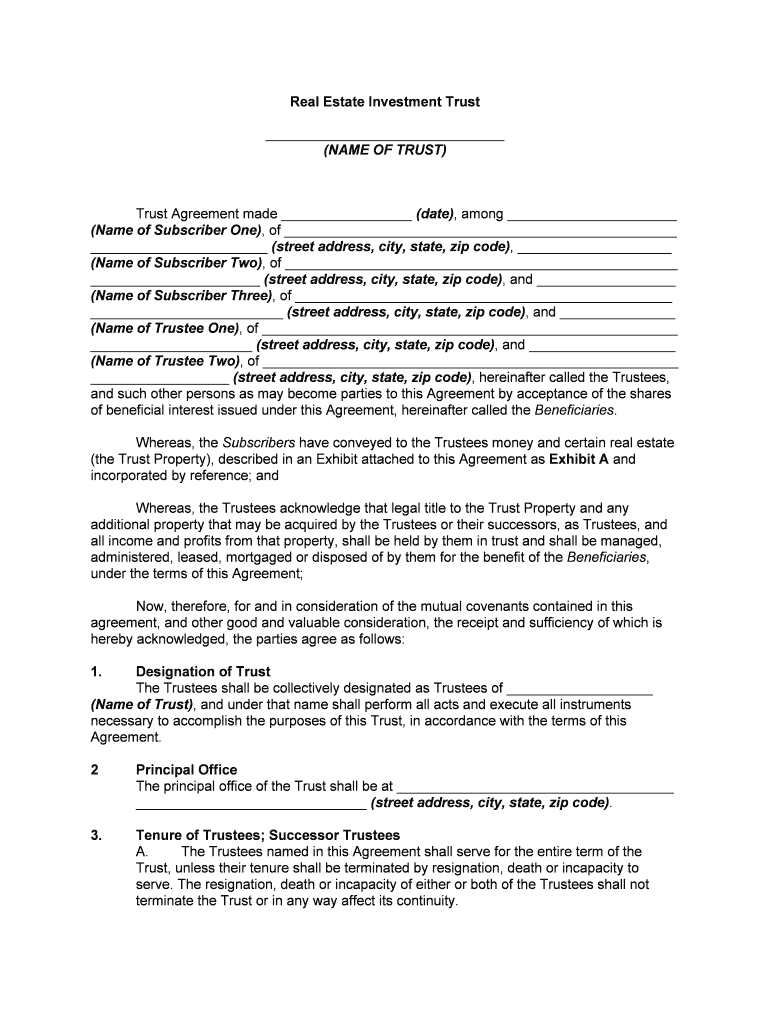
Trust Agreement for Real Estate Investment Trust
What a Trust Agreement for Real Estate Investment Trust Is and Does
Why a Clear Trust Agreement Matters for REITs
A clear Trust Agreement for Real Estate Investment Trust defines trustee authority, investor rights, distribution mechanics, and compliance steps required for REIT tax treatment. It reduces governance disputes, documents fiduciary duties, and creates operational rules that support regulatory compliance and investor transparency.
Who Uses This Trust Agreement and When It’s Relevant
Trustees, sponsors, asset managers, legal counsel, and institutional investors use this Trust Agreement for Real Estate Investment Trust to define governance and operational rules.
- Trustees and fiduciaries: document powers, duties, limitations, and indemnification provisions for trustee actions.
- Sponsors and asset managers: specify capital contributions, acquisition authority, asset management, and distribution formulas.
- Investors and lenders: set reporting obligations, transfer restrictions, priority of distributions, and repayment terms.
Step-by-Step: Prepare, Execute, and Maintain the Trust Agreement
-
01Prepare draft: Assemble provisions on trustees, powers, distributions, and tax compliance.
-
02Review terms: Seek counsel for fiduciary duties and REIT qualification issues.
-
03Execute documents: All trustees and authorized signatories sign and date in presence of witnesses or notary.
-
04Record and store: Keep originals and certified copies; save searchable electronic copies with audit trail.
Common Risks and Potential Penalties to Watch For
Where to File, Send, and Maintain the Trust Agreement
-
State Recording: County recorder if instrument affects real property.
-
Tax Filings: Send required tax schedules to IRS and investors.
-
Investor Notices: Deliver by contractual method: mail, email, or e-delivery.
-
Regulatory Filings: Provide copies to SEC counsel if offering to public.
Configuring an Online Signing Workflow for the Trust Agreement
| Field | Configuration |
|---|---|
| Signer order and routing sequence | Set sequential or parallel signing and conditional routing. |
| Required fields and validation rules | Mark trustee signature, date, and EIN fields as required |
| Signer authentication method and strength | Choose email, SMS code, or KBA depending on risk level |
| Document retention and export formatting settings | Enable PDF/A export, include audit trail, and secure storage |
Platform Capabilities to Support Trust Agreement Workflows
Ensure platform compatibility for large files, templates, and secure e-signing when managing Trust Agreement for Real Estate Investment Trust workflows.
- File formats: PDF, DOCX support with form fields
- Integrations: Salesforce, NetSuite, Microsoft 365 integrations available
- Authentication: SMS codes, SSO, and advanced options
Timelines and Filing Deadlines to Track
Document execution and effective date:
Execute all signatures by authorized signatories on or before effective date.
Investor notification and delivery timelines:
Deliver offering materials per agreement and state securities rules.
Tax reporting and EIN deadlines:
File required IRS schedules annually; report distributions to investors.
Recordation of property interests where applicable:
Record deeds or declarations at county recorder when trust holds title.
Annual compliance and review schedule:
Review trust operations, update documents, and confirm REIT tests annually.
Pricing and Feature Snapshot for eSignature Vendors
| signNow | DocuSign | Adobe Sign | PandaDoc | HelloSign | |
|---|---|---|---|---|---|
| Starting Price | $8/user/mo | $15/user/mo | $14/user/mo | $19/user/mo | $15/user/mo |
| Free Trial | 7-day free trial, no card | Varies by plan | Varies by plan | Varies by plan | Varies by plan |
| Bulk Send | Yes | Yes | Yes | Yes | No |
| Audit Trail | Yes | Yes | Yes | Yes | Yes |
| HIPAA Compliant | Yes | Yes | Yes | No | No |
| Envelope Cap | No envelope cap | 100 envelopes/user/year | Varies by plan | Varies by plan | Varies by plan |
Common Questions and Practical Answers for Trust Agreement Preparation
-
Is an electronic signature legally binding?
Yes — electronic signatures generally carry the same legal effect as handwritten signatures under the federal ESIGN Act (15 U.S.C. ch. 96) and state UETA rules (where adopted). Exceptions include wills, certain court filings, and other statutorily excluded document types.
-
Do Trust Agreements require notarization or witnesses?
Notarization is often required to record property-related instruments and transfer title; witness requirements vary by state. Remote online notarization (RON) is permitted in most states with identity proofing and recording requirements. Verify county recorder and state notary commission rules.
-
Who must sign the Trust Agreement?
Authorized trustees, settlors, and any required corporate officers must sign. If a trustee is an entity, an authorized representative signs on its behalf. Lender consents or investor guarantors may also sign when the agreement specifies.
-
Can the Trust Agreement be amended later?
Yes; include amendment procedures specifying who may propose, approve, and execute amendments, notice periods, and vote thresholds. File or record amendments when they affect title or material investor rights. Maintain version history and dated signatures for enforceability.
-
What supporting documents are typically required?
Common attachments include schedules of assets, property exhibits, investor subscription agreements, capitalization tables, tax rulings, trustee resolutions, and attorney opinion letters. If the trust holds titled real estate, include recorded deeds, title insurance commitments, and environmental reports where requested.
-
How to avoid common preparation mistakes?
Use consistent legal names and EINs, define trustee powers precisely, specify distribution mechanics, require required signatures and notarizations, and obtain legal and tax review. Digital workflows reduce omissions; retain audit trails and executed originals for legal certainty.