Establishing secure connection…Loading editor…Preparing document…

Letter Approving Telecommuting

This template is fully customizable. Edit the text, fill out the fields, and send it for signature. Give it a try!
Letter Approving Telecommuting

What the Letter Approving Telecommuting Is

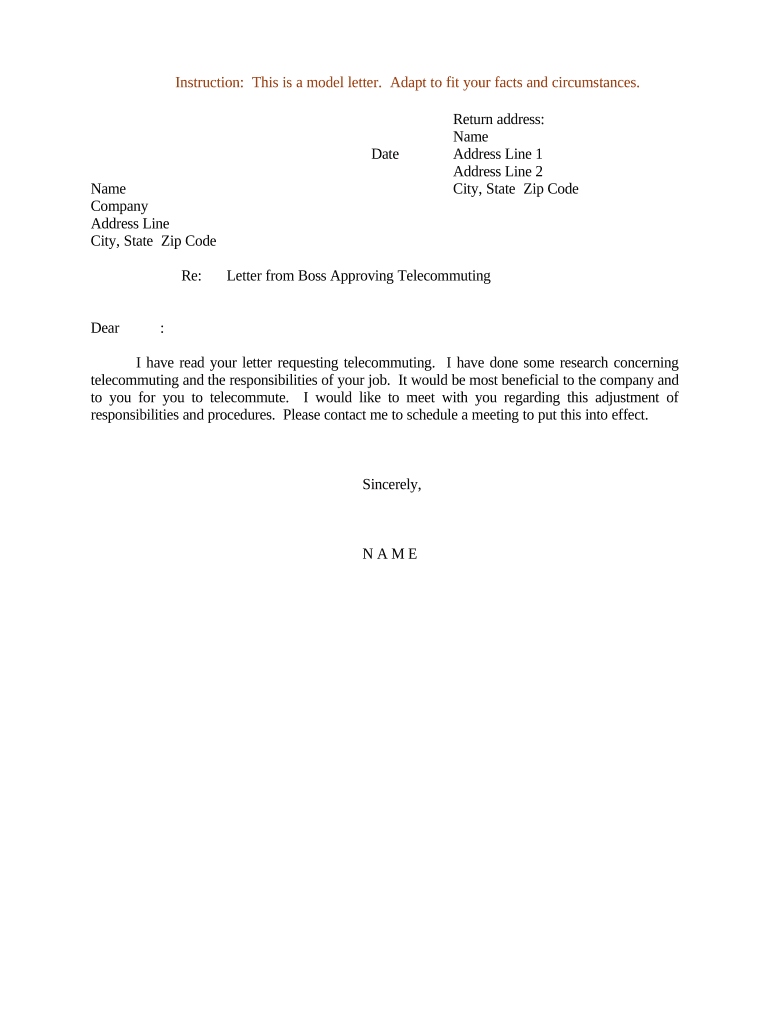
A Letter Approving Telecommuting is a formal employer-issued document that authorizes an employee to perform work remotely either full time or on a hybrid schedule. It records the telecommuting arrangement, defines work hours, equipment and security expectations, and sets the effective date and review cadence. The letter also clarifies supervisory responsibilities, performance metrics, and any conditions that may lead to modification or termination of remote work. Use it to create a clear, retrievable record that supports payroll, tax, and HR compliance.

Why a Formal Approval Letter Matters

A written approval provides legal clarity for both employer and employee, reduces ambiguity about expectations, and documents consent to remote work terms. It supports consistent HR administration and preserves a record for audits or later dispute resolution.

Why a Formal Approval Letter Matters

Who typically issues or receives this letter

Use the letter to ensure consistent treatment across cases and to create an auditable record retained in personnel files.

  • Human resources teams and managers who authorize remote schedules for compliance and recordkeeping.
  • Employees requesting telecommuting as part of flexible-work arrangements or accommodations.
  • Payroll and IT teams that need written confirmation to set access, equipment, and tax withholding.

Typical signers and their roles

HR Manager

Human Resources approves telecommuting terms, documents the arrangement in the employee file, and coordinates any equipment or policy exceptions. HR ensures compliance with wage, hour, and benefits rules and communicates review schedules to managers and employees.

Employee

The employee acknowledges the telecommuting conditions, confirms home-workplace suitability, and agrees to security and timekeeping rules. Signing binds the employee to the stated obligations and preserves evidence of mutual consent to remote work.

Step-by-step: completing the letter

Follow these steps to prepare a clear, enforceable telecommuting approval letter.

  • 01
    Gather details: Collect employee name, job title, and supervisor information.
  • 02
    Define terms: Specify remote schedule, hours, and location.
  • 03
    Set responsibilities: List equipment, security, and performance expectations.
  • 04
    Sign and retain: Obtain signatures and store in the personnel record.

Essential elements every approval letter should include

Include these items to make the letter substantive, enforceable, and useful for future reference.

Parties

Identify employer and employee by legal name and business unit so the agreement clearly binds the correct parties and connects to payroll records.
Scope

Describe job duties permitted to be performed remotely and any tasks that still require on-site presence to avoid misunderstandings.

Duration

State whether the arrangement is temporary, pilot, or permanent and include review dates to reassess fit and compliance.

Compensation

Confirm salary, hourly pay, overtime rules, and expense reimbursement to prevent compensation disputes and comply with wage laws.

Equipment and costs

Specify what employer provides versus employee responsibilities for devices, internet, and maintenance, and outline reimbursement if applicable.

Policy compliance

Require adherence to company policies, data protection rules, and any industry-specific regulations such as HIPAA or FERPA when handling protected data.

Security and privacy data points to record

Device Encryption: AES-256 or equivalent
Secure Access: VPN and MFA required
Data Classification: Define permitted data types
Incident Reporting: Report within 72 hours
HIPAA BAA: Signed when PHI handled
Logging: Maintain access logs

Common legal and operational risks

Wage-and-hour risk: Overtime exposure
Tax misreporting: Incorrect withholding
Data exposure: HIPAA violations
Workers' comp: Coverage disputes
Contract breach: Unclear deliverables
Policy noncompliance: Disciplinary action

Frequent mistakes to avoid when preparing the letter

  • Failing to state the effective date precisely, which creates ambiguity about when remote-work rights and obligations begin.
  • Omitting the telecommute address or listing a P.O. box only, complicating tax nexus and jurisdictional questions.
  • Not specifying equipment responsibilities and reimbursement obligations, leading to disputes about costs or replacements.
  • Ignoring applicable data-protection obligations (HIPAA/FERPA) when the employee will access or store sensitive information remotely.

How the approval and record process typically flows

A clear routing and retention process ensures the letter is authorized, stored, and accessible.

  • Request: Employee submits telecommute request to manager.
  • Review: Manager and HR evaluate role suitability.
  • Approval: Manager signs and HR finalizes letter.
  • Retention: Store signed letter in HR personnel file.

Digital workflow settings for online completion

Configure the document for e-signature and auditability using these fields and settings.

Field Configuration
Signature Block Require primary and witness signature fields
Date Field Auto-fill with signer date
Conditional Section Show expense clause if reimbursable selected
Access Control Set signer authentication level

Requirements for digital signing and secure delivery

Confirm the platform meets any industry-specific compliance needs (HIPAA, FERPA, 21 CFR Part 11) and maintains tamper-evident records.

  • Document formats: PDF, DOCX supported
  • Integrations: HRIS and cloud storage
  • Authentication: Email, SMS, or stronger

Key dates and review schedules to include

Document timelines clearly so parties know review and termination points.

Effective Date:

The MM/DD/YYYY the remote arrangement starts.

Review Date:

Schedule periodic review, commonly 90 or 180 days.

Notice Period:

State notice required to change telework, e.g., 14 days.

Equipment Return:

Deadline for returning employer devices on exit.

Record Retention:

Specify retention period for the signed letter.

Typical processing milestones after approval

Track milestones from request to periodic review so responsibilities are clear.

01

Request Submitted

Employee submits request and supporting information for review.

02

Manager Review

Manager evaluates job suitability and risk factors.

03

HR Finalization

HR completes the letter, ensures policy alignment, and adds signatures.

04

Ongoing Reviews

Conduct scheduled performance and compliance checks at defined intervals.

Comparing eSignature vendors for telecommuting approvals

Basic pricing and feature comparisons help determine the right eSignature fit for HR workflows; signNow listed first per vendor comparison rules.

signNow DocuSign Adobe Sign PandaDoc HelloSign
Starting Price $8/user/mo $15/user/mo $14/user/mo $19/user/mo $15/user/mo
Free Trial 7-day free trial Vendor-specific Vendor-specific Vendor-specific Vendor-specific
Bulk Send Yes Yes Yes Yes Yes
Audit Trail Yes Yes Yes Yes Yes
HIPAA Compliant Yes Yes Yes No No

Real-world examples of approved telecommuting letters

Below are two concise scenarios showing how letters are used and what they resolve.

Case Study 1

A mid-size employer formalized a permanent hybrid schedule for a project manager to reduce commute time and retain talent.

  • The letter specified days in-office, equipment, and performance metrics.
  • Documented terms removed ambiguity, supported payroll setup, and provided a clear review timeline for HR and the manager.

Case Study 2

A healthcare clinic approved remote charting for an administrative role with PHI access, conditional on encrypted devices and VPN use.

  • The letter required a signed BAA and logging.
  • The agreement aligned IT, compliance, and HR expectations and reduced regulatory risk while maintaining remote productivity.

Practical tips for accurate and efficient letters

Follow these best practices to reduce rework and improve enforceability.

Use a template
Maintain an approved template that includes mandatory clauses (scope, duration, equipment, security) to ensure consistency and speed up approvals across similar requests.
Include measurable metrics
Define performance indicators or deliverables so managers and employees have objective standards for evaluating remote work success and compliance.
Record consent
Capture employee assent via signature and an audit trail that includes signer identity, timestamp, and IP address to meet ESIGN and UETA standards.
Coordinate with IT
Ensure IT provisions secure access, documents the devices used, and confirms encryption and MFA to reduce data security exposure.

Frequently asked questions about the Letter Approving Telecommuting

Answers to common questions about completion, validity, and digital signing of the telecommuting approval letter.


Need help? Contact support

be ready to get more
Join over 28 million airSlate SignNow users