Establishing secure connection…Loading editor…Preparing document…

Letter Regarding Corrected Warranty Deed

This template is fully customizable. Edit the text, fill out the fields, and send it for signature. Give it a try!
Letter Regarding Corrected Warranty Deed

What the Letter Regarding Corrected Warranty Deed Is

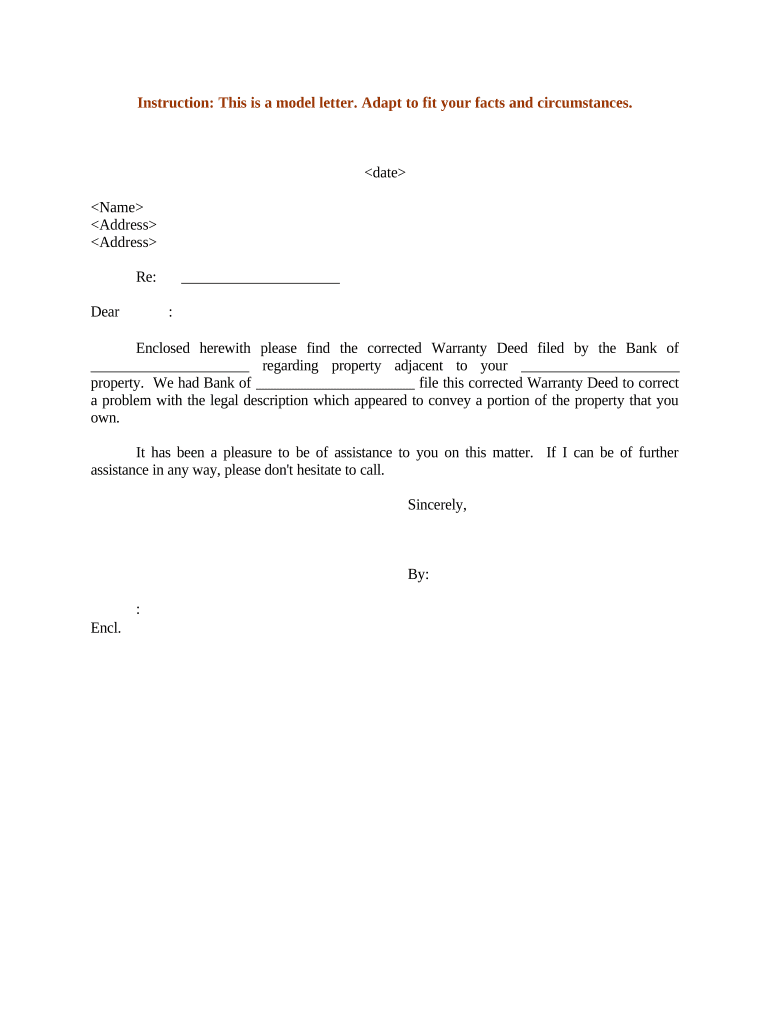
A Letter Regarding Corrected Warranty Deed is a formal written notice used to explain, request, or confirm modifications to a previously recorded warranty deed. It accompanies or precedes a corrected deed to clarify the error being corrected—such as a misspelled name, incorrect legal description, or clerical date error—and documents the parties' intent to replace or amend the original instrument. The letter helps title companies, county recording offices, lenders, and other stakeholders understand the correction, summarizes the legal basis for the amendment, and identifies the corrected document to be recorded in place of or in addition to the original deed.

Why a Clear Correction Letter Matters

A precise correction letter reduces recording confusion, speeds title review, and creates a straightforward audit trail linked to the corrected warranty deed. It helps prevent duplicate recordings, supports lien and mortgage updates, and provides evidence of mutual intent to correct the original instrument.

Why a Clear Correction Letter Matters

Who Typically Prepares or Receives This Letter

Common preparers and recipients include property owners, closing attorneys, title companies, mortgage lenders, and county recorders involved in deed corrections.

  • Property owners or grantors notifying the recorder and grantee of the correction to be recorded.
  • Title companies requesting clarification before issuing an updated title policy.
  • Closing attorneys or settlement agents preparing corrected deeds and supporting letters for recording.

Use the letter to document the specific correction, identify the corrected deed by book/page or instrument number, and attach any corrected exhibit or replacement deed.

Primary Roles and Who Signs

Property Owner / Grantor

The grantor is usually the person or entity that signed the original deed and must sign correction paperwork when the error affects grantor identity or signature. The letter should state the grantor's corrected name or details and explain the reason for correction, signed and dated by the grantor.

Closing Attorney / Title Officer

A closing attorney or title officer often prepares the letter to ensure the correction meets local recording requirements and to provide a professional explanation for the county recorder and title insurer; their signature validates the explanation and identifies enclosed corrected instruments.

Essential Data Elements to Include

Document ID: Instrument number
Original Date: MM/DD/YYYY
Grantor Name: As on corrected deed
Grantee Name: As on corrected deed
Property Description: Legal description
Reason: Nature of error

Consequences of Incomplete or Incorrect Letters

Recording Delay: Processing delays
Title Exceptions: Unresolved title issues
Mortgage Issues: Lien misapplication
Increased Costs: Additional filings
Insurance Risk: Policy issuance delays
Legal Disputes: Potential litigation

Common Preparation Pitfalls to Avoid

  • Failing to reference the original instrument number or recording citation, which forces clerks to search and delays filing.
  • Providing an unclear legal description or truncated parcel text that does not match county assessment records.
  • Omitting signatures or notarization where required, resulting in rejection or return by the recorder.
  • Using ambiguous language about intent to amend versus replace, creating uncertainty for title insurers and lenders.

Step-by-Step: Preparing a Correction Letter

Follow these steps to produce a clear, recorder-friendly letter supporting a corrected warranty deed.

  • 01
    Identify: Locate original instrument citation
  • 02
    Describe: State exact error and the correct information
  • 03
    Attach: Include corrected deed or exhibit
  • 04
    Sign: Have required parties sign and notarize

How the Letter and Corrected Deed Flow Through Recording

Recording workflow typically follows a standard send/review/record pattern; align the letter with the corrected deed to simplify county processing.

  • Prepare Package: Letter, corrected deed, and attachments
  • Notarize: Notary acknowledgment as required
  • Submit: Deliver to county recorder (paper or e-file)
  • Confirm: Obtain recording citation and return copies

What a Professional Correction Letter Should Contain

A professional letter is concise, references specific recorded instruments, explains the correction clearly, and includes verifiable contact and signature information.

Header

Date the letter and include recipient details (county recorder or title officer), the sender's contact, and the recording citation for the original deed for quick reference.

Correction Summary

Concise statement describing the exact error in the recorded deed and the corrected text; use identical phrasing to the corrected deed to avoid ambiguity.

Supporting Documents

Attach the corrected warranty deed, any affidavits, attorney letterhead or company authorization, and copies of IDs when identity clarification is required.

Signature Block

Provide signature lines for the grantor and preparer with printed names, titles, dates, and notarization where county rules require it.

Practical Tips for a Recorder-Friendly Letter

Small formatting and content choices reduce rejection risk and streamline title work.

Use precise citations
Reference county recording book/page or instrument number and the original recording date to allow clerks and title examiners to link documents quickly.
Match legal descriptions
Copy the full legal description exactly as it appears on the corrected deed; truncated or paraphrased descriptions can cause confusion.
Avoid ambiguous terminology
State whether the corrected deed is intended to replace, amend, or supplement the original instrument to prevent conflicting recordings.
Keep attachments organized
Number exhibits and reference them by exhibit letter or number in the letter to make the package easy to review and scan.

Timing Considerations and Typical Processing Expectations

Recorders and title companies operate on different schedules; plan for local processing times and lender or insurer deadlines.

Local Recorder Turnaround:

Varies by county; same-day to several weeks

Lender Requirements:

Submit before loan sale or payoff processing

Title Insurance Update:

Allow 5–10 business days for endorsement review

Notary or RON Timing:

Schedule in advance to avoid delaying recording

Escrow Cutoffs:

Meet escrow or settlement deadlines to prevent closing delays

Six Elements That Reduce Objections and Rejections

Include these elements to make the letter actionable and acceptable to recorders, lenders, and title insurers.

Clear Identification

Identify the original instrument by book/page or instrument number and record date so clerks can directly tie the correction to the prior record.
Exact Correction Text

Provide the corrected wording verbatim, including the corrected spelling, numbers, or parcel references to avoid interpretive errors.

Authority Statement

State who has authority to make the correction (grantor, attorney-in-fact, court order) and attach proof of authority if required.

Attachment List

Enumerate all attached documents—corrected deed, affidavits, IDs, power of attorney—so recipients can verify a complete package.

Notarization Details

Note whether the corrected deed and letter are notarized or executed via RON, and include the notary block or RON certificate as required.

Contact and Signature

Provide signer names, printed titles, telephone numbers, and email addresses so recorders or title officers can follow up promptly.

Real-World Examples of Use

Two short examples illustrate typical scenarios where a correction letter clarifies and supports recording.

Title Company Request

A title officer finds a name typo on the recorded deed

  • The grantor signs a corrected deed
  • The letter explains the typographical error, references the original instrument, attaches the corrected deed, and requests re-recording to clear title within the chain of title.

Clerical Legal Description Fix

A legal description used an incorrect lot number

  • Parties prepare a corrected warranty deed
  • The letter describes the error, cites the correct parcel, includes municipal tax ID cross-reference, and asks the recorder to accept the correction for accurate county indexing.

How to Configure a Digital Correction Workflow

Set up a clear electronic workflow for drafting, signing, notarizing, and filing corrected deeds and supporting letters.

Field Configuration
Document Upload PDF/A preferred
Signature Order Grantor then preparer
Notarization RON or in-person per state
Recorder Submission E-file or courier

Digital Tools and Integrations to Consider

Use document management and e-signature platforms that support notarization options, audit trails, and PDF/A export for recording.

  • File Formats: PDF, PDF/A, DOCX conversion supported
  • Integrations: Works with title systems, CRMs, cloud storage
  • Authentication: Multi-factor or KBA options available

Ensure the chosen platform can attach a certificate of completion and produce an unalterable signed PDF suitable for title review and county submission.

How Correction Letters Differ from Other Real Estate Notices

A comparison clarifies when to use a correction letter versus other common documents in real estate recordkeeping.

Document Type Purpose When to Use
Correction Letter explain correction paired with corrected deed
Affidavit of Scrivener clerical error affidavit minor typographical fixes
Release of Lien remove lien claim release of mortgage or lien
Quitclaim Deed transfer or clarify interest use when transferring uncertain title

Typical eSignature and Platform Pricing for Correction Packages

Platform pricing varies by plan and feature; signNow appears first as a representative option for secure e-signing, notarization support, and bulk workflows.

signNow DocuSign Adobe Sign PandaDoc HelloSign
Starting Price $8/user/mo $15/user/mo $14/user/mo $19/user/mo $15/user/mo
Free Trial 7-day free trial Varies Varies Varies Varies
Bulk Send Yes Yes Yes Yes No
Audit Trail Yes Yes Yes Yes Yes
Envelope Cap No cap 100 envelopes/user/year Varies Varies Varies

Frequently Asked Questions about Correction Letters

Answers to common questions about when, how, and where to use a Letter Regarding Corrected Warranty Deed.


Need help? Contact support

be ready to get more
Join over 28 million airSlate SignNow users