Establishing secure connection…Loading editor…Preparing document…

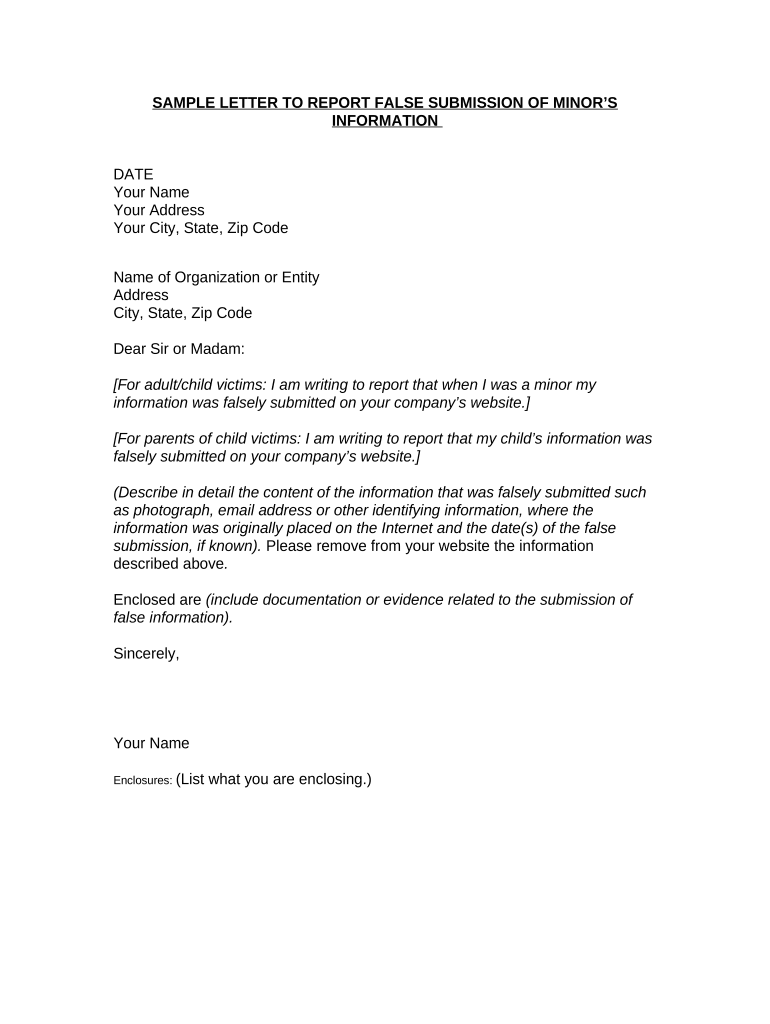
Letter to Report False Submission of Minor's Information

This template is fully customizable. Edit the text, fill out the fields, and send it for signature. Give it a try!
Letter to Report False Submission of Minor's Information

What this letter is and when it’s used

A Letter to Report False Submission of Minor's Information is a concise written notice filed with an organization, agency, school, or service provider to correct or dispute information that was submitted about a minor and that the reporter reasonably believes to be false, misleading, or fraudulent. The letter documents the reporter’s identity and relationship to the minor, states which facts are incorrect, provides evidence where available, and requests correction, removal, or an investigation. It can serve as the first formal record in administrative, civil, or criminal follow-up and should be retained with supporting documents for compliance and potential downstream disputes.

Why a formal written report matters

A clear written letter creates an auditable record, establishes the reporter’s intent and attribution, triggers internal review or legal processes, and helps preserve rights under federal and state law such as ESIGN/UETA and relevant privacy rules. It reduces ambiguity compared with an informal phone call and supports later escalation if the recipient fails to correct the record.

Why a formal written report matters

Who typically prepares and files this letter

Organizations and individuals use this letter whenever a minor’s personal data appears inaccurately in records and formal correction is required.

  • Parent or legal guardian reporting false identity or DOB submitted without authorization to a school or provider.
  • School or district official documenting a disputed enrollment or records entry affecting a minor.
  • Service provider or benefits administrator correcting eligibility or account information tied to a minor.

Use the letter to document your request, attach supporting evidence, and request an explicit remediation timeline from the recipient.

Primary signer roles

Guardian

A parent or legal guardian who can assert authority on behalf of the minor and who provides identification and proof of relationship when required. The guardian’s statement typically explains why the submission is false and requests corrective action.

Institution Official

A records manager, registrar, or administrator who receives the report and logs the dispute. Their duties include acknowledging receipt, initiating an internal review, and documenting corrective steps taken or reasons for denial.

Step-by-step: preparing and sending the letter

Follow these practical steps to prepare an accurate, verifiable letter and to ensure the report reaches the correct record-holder with supporting evidence.

  • 01
    Gather ID: Collect government ID and proof of guardianship to attach.
  • 02
    Document error: Describe the false submission precisely and cite where it appears.
  • 03
    Attach evidence: Include screenshots, forms, or official records showing the incorrect info.
  • 04
    Send and log: Send via recorded delivery or eSubmission and keep proof of transmission.

Typical processing flow after submission

Organizations generally follow a repeatable workflow after receiving a report: intake, verification, decision, and remediation. Knowing these stages helps set expectations.

  • Intake: Recipient logs the claim and issues an acknowledgment.
  • Verification: Records and attached ID are reviewed for authenticity.
  • Decision: Organization accepts, denies, or requests more information.
  • Remedy: Correction applied, or the reporter is given appeal instructions.

Core elements every professional letter should include

A complete, professional letter groups core elements for clarity: reporter identity, relationship, explicit description of the false data, specific evidence, requested remedy, and a dated signature block.

Reporter Identity

Full legal name, contact phone number, mailing address, and an attachment copy of government-issued photo ID or equivalent verification.
Relationship Statement

Concise declaration of your relationship to the minor (parent, legal guardian) and citation of supporting document used to prove authority.

False Itemization

Itemized list of each incorrect entry including exact text, where it appears, and why you believe it is false or fraudulent.

Supporting Evidence

Attach copies of birth certificates, school records, emails, form screenshots, or other documents that corroborate your claim and help the recipient verify quickly.

Requested Action

Specify whether you seek correction, removal, a formal investigation, or confirmation that the change was made; include a requested response timeframe.

Signature and Date

Signed and dated by the reporting guardian. Add notarization if the recipient requires sworn statements or a higher level of verification.

Essential data fields to include

Minor's Name: Full legal name
Minor's DOB: MM/DD/YYYY
Reporter Contact: Phone and email
Relationship: Parent/guardian
Submission Location: Website, school, or agency
Evidence Attached: IDs, screenshots

Common mistakes that delay resolution

  • Submitting vague descriptions that do not identify the exact incorrect text or record location, forcing the recipient to request clarifying details.
  • Failing to include proof of guardianship or identity, which causes verification holds and may require in-person follow-up.
  • Sending the letter to the wrong office or an email inbox that is not monitored for records disputes, delaying intake and acknowledgement.
  • Using informal chat or social media messages instead of a dated, signed written statement, which provides weak evidence for formal correction.

Consequences of improper or inaccurate reporting

Delay of Remedy: Lost time for the minor
Denial of Request: Insufficient evidence
Civil Liability: Potential defamation claims
Criminal Risk: False statements may have penalties
Tax Impact: Incorrect W-9 issues backup withholding
Privacy Breach: Unauthorized disclosures risk HIPAA

Typical eSubmission setup for this letter

When submitting electronically, configure fields and authentication to balance speed with identity assurance.

Field Configuration
Authentication Email link plus optional SMS code
Signature Type Typed name or drawn signature
Notary Option Support RON or in-person notarization
Attachments Support PDFs, images, and police reports

Technical considerations for eSubmission and eSignatures

Choose an e-signature workflow that provides audit trails, secure attachments, and flexible signer authentication for guardian-signed reports.

  • Audit Trail: Timestamp, IP, and action log
  • File Formats: PDF and DOCX preferred
  • Integrations: Works with CRMs and cloud storage

Ensure the chosen platform can export a tamper-evident copy and retain the record to meet statutory retention requirements and any request for future verification.

Timeframes and response expectations

Expect different timelines depending on the recipient; set a reasonable follow-up plan and keep copies of all correspondence and proof of delivery.

Upon Discovery:

Send the letter immediately upon identifying the false submission

Acknowledgment Window:

Ask for written receipt within 7–14 days

Investigation Period:

Allow up to 30 days for a substantive response

Escalation Step:

If no action, escalate to supervisor or oversight body

Recordkeeping:

Retain all records until resolution plus retention period

Key milestones from submission to closure

Track these numbered stages to maintain momentum and evidence of timely follow-up throughout the correction process.

01

Stage 1: Prepare Submission

Compile IDs, evidence, and draft the signed letter

02

Stage 2: Send and Log

Transmit via tracked method and record delivery

03

Stage 3: Await Acknowledgment

Expect confirmation within two weeks

04

Stage 4: Remediate or Escalate

Confirm correction or pursue appeal/legal steps

How this letter differs from related documents

Compare the letter to common alternatives so you can choose the right document for correcting a minor’s record.

Document Type Notarization Required Typical Use
Letter to Report recommended notify record-holder and request correction
Affidavit of Facts often required sworn statement for legal proceedings
Police Report must be sworn for alleged criminal identity misuse
Parental Consent varies authorizes medical or school actions

Typical eSignature vendor comparison for preparing and submitting the letter

A secure eSignature provider can reduce turnaround and provide an audit trail; compare entry-level price, bulk features, audit capabilities, and HIPAA support when confidentiality is a factor.

signNow DocuSign Adobe Sign PandaDoc HelloSign
Starting Price $8/user/mo $15/user/mo $14/user/mo $19/user/mo $15/user/mo
Free Trial 7-day free trial Varies Varies Varies Varies
Bulk Send Yes Yes Yes Yes No
Audit Trail Yes Yes Yes Yes Yes
HIPAA Compliant Yes Yes Yes No No

Frequently asked questions about reporting false minor information

Answers to common questions about evidence, timing, notarization, eSigning, record retention, and next steps if a recipient does not correct the record.


Need help? Contact support

be ready to get more
Join over 28 million airSlate SignNow users