Establishing secure connection…Loading editor…Preparing document…

Letter Requesting Default Judgment

This template is fully customizable. Edit the text, fill out the fields, and send it for signature. Give it a try!
Letter Requesting Default Judgment

What a Letter Requesting Default Judgment Is

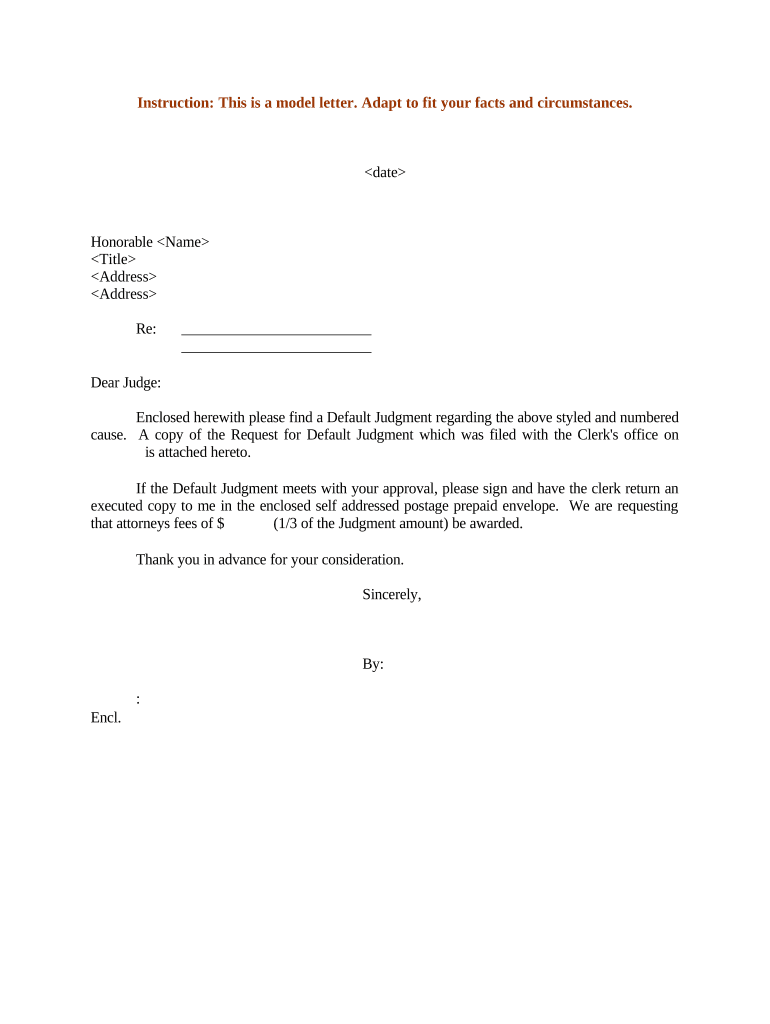
A Letter Requesting Default Judgment is a formal court submission asking the clerk or judge to enter judgment when a defendant fails to answer or otherwise defend within the timeframe required by applicable rules. It typically accompanies proof of service, an affidavit of default, and evidence of the plaintiff's claim, and it follows procedural rules such as Federal Rule of Civil Procedure 55 or comparable state rules. The letter summarizes the procedural posture, the relief requested, and the attachments supporting entry of default and judgment.

Why a Clear, Rule-Compliant Letter Matters

A concise, properly formatted letter helps the court process a default judgment efficiently and reduces return or denial risk; it also documents the plaintiff's compliance with service and notice obligations under ESIGN/UETA where electronic filing or signature is used.

Why a Clear, Rule-Compliant Letter Matters

Who Typically Prepares a Letter Requesting Default Judgment

Plaintiffs, their attorneys, and court clerks commonly prepare or receive this letter when a defendant fails to respond to a complaint or petition.

  • Plaintiff or counsel preparing supporting affidavits and exhibits for clerk/judge review.
  • Court clerk assessing procedural compliance and completeness before docketing judgment.
  • Collection agencies or creditors seeking entry of judgment after proper service and notice.

The letter should be prepared by the party responsible for the case record and must include clear references to supporting filings and dates.

Step-by-Step: Preparing a Letter Requesting Default Judgment

Follow these sequential steps to assemble a compliant request for entry of default judgment.

  • 01
    Prepare: Confirm the defendant's deadline passed and entry of default exists on the docket.
  • 02
    Draft Letter: State the case caption, default date, relief sought, and list attached evidence.
  • 03
    Attach Proof: Include affidavit of service, affidavit of default, invoices, or declarations supporting damages.
  • 04
    Submit: File with the clerk per local e-filing rules and serve all parties following court procedures.

How the Submission and Court Review Process Works

The letter, attachments, and proof of service travel from the filing party to the court and to opposing parties for review prior to clerk action or judge decision.

  • File With Clerk: E-file or deliver paper bundle to the clerk per local civil filing rules.
  • Clerk Review: Clerk verifies docket entry of default and completeness of supporting documents.
  • Serve Opposing Party: Provide the defendant with the filed letter and exhibits if not already served.
  • Entry or Hearing: Court either enters judgment under the clerk's authority or schedules a hearing for additional proof.

Configuring an Online Workflow for the Letter

Set up your e-filing or e-sign workflow to capture required fields, attachments, and authentication for court submissions.

Document format PDF/A preferred for court filing and long-term retention
Signer authentication Email + SMS code or organizational SSO for counsel verification
Notary option Enable RON or in-person notarization if affidavit requires notarized signature
Bulk send Useful for multiple related matters; check plan limits
Retention settings Preserve audit trail and attachments for the required retention period

Electronic Filing and Signing Requirements

Courts and clerks often require specific file types, signature evidence, and authentication for electronic submissions.

  • File types: PDF/A, DOCX accepted by many e-filing systems
  • Integrations: Connect to e-filing portals, CM/ECF, or document management
  • Authentication: Email verification, SMS codes, or stronger KBA for identity

Confirm local court rules before e-filing; ensure the platform captures an immutable audit trail and stores copies per retention requirements.

Essential Parts of an Effective Letter Requesting Default Judgment

Include these key sections so the court can verify procedural compliance and evaluate the requested relief without additional requests.

Letter Header

Full court caption, docket number, and contact information for the filing party so the clerk can associate materials with the correct case.
Statement of Default

Concise recitation of the defendant's failure to plead by the deadline with citation to the docket entry or clerk's default notation.

Relief Requested

Precise description of the judgment sought, including breakdown of monetary damages, interest, costs, and statutory basis for each element.

Supporting Evidence

List of attachments such as the complaint, affidavit of service, ledger or invoice, declarations, and any exhibits supporting damages.

Legal Authority

Cite applicable rules (e.g., FRCP 55) or state statutes that authorize entry of default judgment and the specific relief requested.

Signature Block

Name, title, firm, contact information, and date; include bar number for counsel and notarization if required by local rules.

Security and Compliance Considerations

Encryption: TLS 1.2/1.3 in transit; AES-256 at rest
Audit Trail: Complete timestamp, IP, and action log
HIPAA: BAA required for protected health information
ESIGN / UETA: Electronic signatures valid under 15 U.S.C. ch. 96
Access Control: Role-based permissions and SSO available
Certifications: SOC 2 Type II and ISO 27001 compliant

Risks When the Letter Is Incorrect or Incomplete

Default Denied: Court may refuse relief
Case Dismissal: Procedural errors risk dismissal
Service Failure: Improper service can void judgment
Limited Relief: Judge may restrict awarded damages
Sanctions Risk: False statements can trigger sanctions
Reopening Risk: Default may be set aside for excusable neglect

Common Mistakes to Avoid When Preparing the Letter

  • Failing to reference the correct docket number or caption causes clerks to misfile or return the submission to the filer.
  • Omitting the affidavit of service or providing inconsistent service dates leads courts to deny or delay judgment entry.
  • Requesting speculative or unsubstantiated damages without ledgers, invoices, or declarations invites a hearing or limited award.
  • Using generic language instead of citing specific rules (e.g., FRCP 55 or local rule section) can create procedural objections.

Key Deadlines and Timing Expectations

Timing varies by jurisdiction; observe federal and local rules for service, default entry, opposition periods, and clerk processing.

Service Deadline:

Must precede default motion; verify local service timeframes

Motion Timing:

Follow FRCP 55 and local rules for moving after default entry

Opposition Period:

Often 14–21 days for responses, check local rules

Clerk Processing:

Clerk may enter judgment upon verifying default and papers

Hearing Scheduling:

Court may set hearing if damages need proof

Milestone Timeline for a Default-Judgment Request

A simple sequential milestone view of the typical process from filing to judgment entry.

01

File Complaint

Initiate the case with proper caption and filing fee.

02

Serve Defendant

Complete service and obtain affidavit of service within required timeframe.

03

Record Default

Request and confirm clerk's entry of default on the docket.

04

Request Judgment

Submit letter, affidavits, and evidence for clerk or judge decision.

eSignature Vendor Pricing Snapshot for Document Workflows

Compare starting prices and plan capabilities commonly relevant to filing and signing legal documents; signNow is listed first per platform comparison conventions.

signNow DocuSign Adobe Sign PandaDoc HelloSign
Starting Price $8/user/mo $15/user/mo $14/user/mo $19/user/mo $15/user/mo
Free Trial 7-day free trial Varies by plan Varies by plan Varies by plan Varies by plan
Bulk Send Yes (Business Premium+) Yes Yes Yes No
Audit Trail Yes Yes Yes Yes Yes
HIPAA Compliant Yes Yes Yes No No

Frequently Asked Questions About Letters Requesting Default Judgment

Answers to common procedural and technical questions about preparing, filing, and serving a letter requesting default judgment.


Need help? Contact support

be ready to get more
Join over 28 million airSlate SignNow users