Establishing secure connection…Loading editor…Preparing document…

Letter Requesting Patient Medical Records

This template is fully customizable. Edit the text, fill out the fields, and send it for signature. Give it a try!
Letter Requesting Patient Medical Records

What a Letter Requesting Patient Medical Records Is

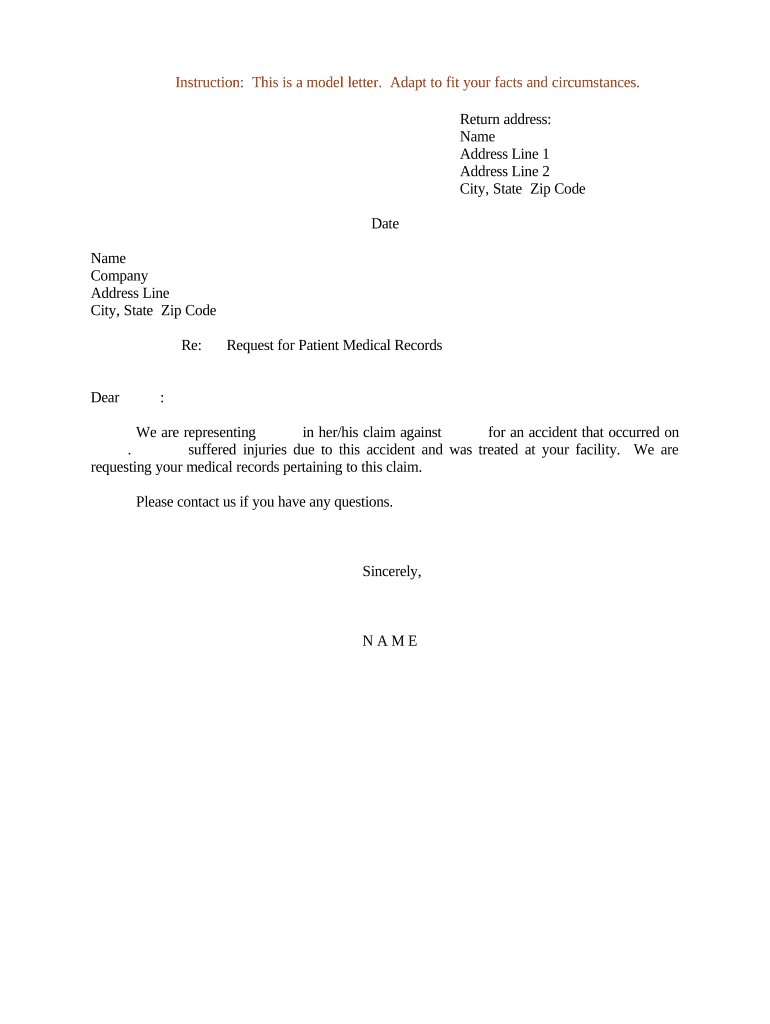
A Letter Requesting Patient Medical Records is a written authorization or request that a patient, authorized representative, or third party submits to a health care provider to obtain copies of medical records. It identifies the patient, specifies the types and dates of records sought, names the recipient, and documents consent for disclosure. In the United States, such requests must conform to HIPAA access rules and any applicable state privacy or copying-fee limits; providers commonly accept signed written forms, electronic authorizations, or certified subpoenas when appropriate.

Why a Clear Request Letter Matters

A well‑structured request speeds delivery, reduces fees and disputes, and provides an auditable record of consent. Clear authorizations help providers meet HIPAA access timelines and protect patient privacy while ensuring accurate routing to payers, legal counsel, or new providers.

Why a Clear Request Letter Matters

Who Typically Prepares and Sends These Letters

Common requesters include patients, designated family members, attorneys, and insurance representatives who need medical records for care continuity, claims, or legal matters.

  • Patient or personal representative — requests records for continuity of care or personal use, must show ID and sign authorization.
  • Attorney or legal representative — requests records for litigation or claims, often attaches a client authorization or subpoena.
  • Insurance or billing agent — requests records for claims processing or appeals, typically requires documented patient consent.

Include clear identity proof, scope of release, and delivery instructions to avoid processing delays or fee disputes.

Core Elements Every Request Letter Should Include

A complete Letter Requesting Patient Medical Records balances patient identity, scope, time period, purpose, delivery, and signature details to satisfy HIPAA and state rules.

Patient Identity

Provide the patient’s full legal name, date of birth, and medical record number to ensure staff locate the correct file and avoid mismatches.
Scope of Records

Specify the exact documents requested (e.g., office notes, operative reports, imaging, lab results) so the provider can assemble the correct files without unnecessary delays.

Dates of Service

List the date range for records requested. Broad ranges cause longer processing times; narrow ranges reduce the risk of incomplete deliveries.

Recipient Details

Name the individual or organization receiving the records and include full address, fax, or secure email to prevent misdelivery.

Purpose

State the reason for disclosure (continuity of care, insurance claim, legal review) when required by the provider or state law.

Signature & Expiry

Include the signer’s signature, date, and an expiration date for authorization; unsigned or undated authorizations are often rejected.

Required Data Elements at a Glance

Patient Name: Full legal name
Date of Birth: MM/DD/YYYY
Medical Record No.: Hospital/clinic ID
Recipient Info: Name and contact
Scope/Dates: Specific records/dates
Signature: Signer and date

Step-by-Step: Preparing and Sending a Request

Follow these sequential steps to create a complete, compliant request that providers can act on quickly.

  • 01
    Gather ID: Collect government ID and patient identifiers before preparing the letter.
  • 02
    Specify Records: Clearly list record types and dates you need to avoid ambiguity.
  • 03
    Choose Delivery: Decide secure delivery method: encrypted email, fax, or mailed copies.
  • 04
    Send & Track: Submit via provider portal, mail, or secure e‑delivery and keep a copy of the signed authorization.

Customizing an Online Request Workflow

When using a portal or eSignature platform, configure fields and authentication to match HIPAA and provider requirements.

Field Configuration
Patient ID Field Make required; use auto-validate when MRN available.
Date Fields Enforce MM/DD/YYYY and range validation.
Signature Field Require signer signature and date.
Auth Proof Upload Allow attachment of POA or guardianship documents.

Where to Send a Letter Requesting Patient Medical Records

Route requests to the provider’s medical records or health information management (HIM) office using the provider’s preferred delivery method.

  • Provider Portal: Secure upload directly to the health system speeds processing.
  • Records Office Fax: Use the provider’s designated release-of-information fax number when required.
  • Mail: Send to HIM office address with return postage for copies.
  • Email: Use encrypted or secure email only when provider allows it.

Digital Signing and eSubmission Considerations

Electronic authorizations are acceptable when they meet ESIGN/UETA standards and, for health data, HIPAA privacy requirements including audit trails and access controls.

  • Authentication: Use email verification, SMS OTP, or stronger methods for identity assurance.
  • Audit Trail: Capture signer IP, timestamp, and action log for compliance.
  • Encryption: Encrypt documents in transit and at rest to protect PHI.

Choose a platform that supports secure delivery, audit trails, and HIPAA Business Associate Agreement options if handling protected health information.

Typical Timelines and Provider Response Expectations

Understanding common deadlines helps you set realistic expectations for receiving records and responding to requests.

Provider Acknowledgment:

Many providers acknowledge receipt within 5–10 business days.

HIPAA Access Time:

HIPAA generally requires access within 30 days; one 30-day extension is permitted (45 CFR §164.524(b)).

Expedited Requests:

Emergency requests may be prioritized but protocols vary by provider.

Delivery Time:

Processing and copying can take 7–30 days depending on scope and format.

Fees and Billing:

Providers must disclose any copying fees before charging in some states.

Key Processing Milestones

Track these numbered milestones to monitor progress from submission to delivery.

01

1. Prepare Request

Complete authorization, attach ID and any legal proof of representation.

02

2. Submit to HIM

Send via portal, fax, or mail per provider instructions.

03

3. Provider Review

Records office verifies ID, scope, and legal sufficiency.

04

4. Release & Delivery

Provider compiles records, applies allowable fees, and delivers to recipient.

Common Mistakes That Delay Record Delivery

  • Incomplete identification: Missing DOB or MRN forces providers to request more information and delays release.
  • Vague scope: Requesting 'all records' without dates or types can trigger extended retrieval time and higher fees.
  • Wrong recipient details: Incorrect fax, address, or email leads to misdelivery or rejection for privacy reasons.
  • Unsigned forms: Providers routinely reject unsigned or undated authorizations; electronic signatures must show intent and attribution.

Risks and Consequences of Incorrect Requests

Privacy Breach: Potential HIPAA liability
Delayed Care: Treatment or claims delayed
Denial of Request: Provider may refuse incomplete forms
Fee Disputes: Unexpected or excessive charges
Legal Exposure: Improper disclosure risk
Authentication Failures: Request returned for better ID

Real-World Examples of Request Letters and Outcomes

Practical examples show how clear authorizations reduce collection time and improve patient experience.

Fertility Clinic Example

A clinic patient completed an electronic authorization and included MRN and DOB

  • The HIM office processed the request in one business week
  • The signed electronic record and audit trail satisfied both HIPAA and the receiving clinic’s intake requirements, avoiding repeat tests and appointment delays.

Attorney Request Example

An attorney attached a signed client authorization with claim numbers

  • The provider released relevant operative reports only
  • Properly scoped requests limited costs, produced admissible records, and shortened discovery timelines for the case.

Practical Tips for Faster, Compliant Requests

Small improvements in wording and delivery reduce processing time and legal risk.

Be Specific and Concise
List exact record types and date ranges instead of 'all records' to speed retrieval and lower copying fees; include identifiers like MRN and DOB to prevent misidentification.
Verify Recipient Details
Double-check recipient addresses, secure email addresses, and fax numbers; incorrect delivery details can constitute an impermissible disclosure under privacy rules.
Use Secure Delivery
When sending PHI electronically, use encrypted email, secure portals, or authenticated eSignature platforms that produce an audit trail as required by HIPAA.
Document Authority
If signing on behalf of a patient, attach documentation proving authority (power of attorney, guardianship) to avoid rejections and protect privacy.

Sample eSignature Pricing Comparison for Medical Record Requests

Compare basic pricing and compliance features when choosing an eSignature vendor for handling health information and release authorizations.

signNow DocuSign Adobe Sign PandaDoc HelloSign
Starting Price $8/user/mo $15/user/mo $14/user/mo $19/user/mo $15/user/mo
Free Trial 7-day free trial Varies by plan Varies by plan Varies by plan Varies by plan
Bulk Send Yes Yes Yes Yes No
Audit Trail Yes Yes Yes Yes Yes
HIPAA Compliant Yes Yes Yes No No
Envelope Cap No envelope cap 100 envelopes/user/year Varies Varies Varies

FAQs About Requesting Patient Medical Records

Answers to common questions about authority, timelines, fees, and electronic authorization for medical records.


Need help? Contact support

be ready to get more
Join over 28 million airSlate SignNow users