Establishing secure connection…Loading editor…Preparing document…

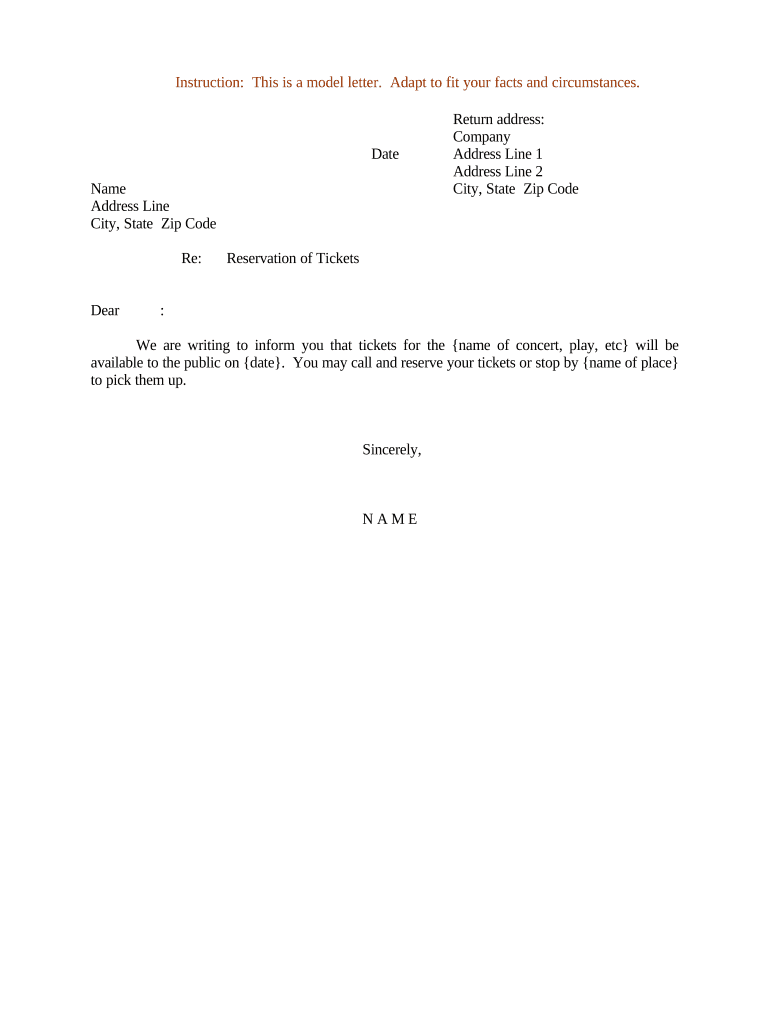
Letter for Reservation of Tickets

This template is fully customizable. Edit the text, fill out the fields, and send it for signature. Give it a try!
Letter for Reservation of Tickets

What a Letter for Reservation of Tickets Is and When to Use It

A Letter for Reservation of Tickets is a brief, written notice from an individual or organization that requests the temporary hold or allocation of event admission(s) for specified dates, quantities, and purchaser details. It documents the request, records contact information, and states payment or deposit terms when applicable. The letter can be used for concerts, theatre, sporting events, conferences, private receptions, or group bookings and may be delivered by email, postal mail, fax, or submitted electronically with an audit trail for proof of intent.

Why a Formal Reservation Letter Matters

A written reservation creates a clear record of the request, the number of tickets held, any deposit or payment terms, and contact details for follow-up. It reduces misunderstandings between purchaser and issuer and provides evidence if a dispute arises over availability, pricing, or cancellation.

Why a Formal Reservation Letter Matters

Common users and scenarios for ticket reservation letters

Organizations and individuals use reservation letters when securing seats for groups, VIPs, or timed events and when a written acknowledgment of hold is needed.

  • Event planners and promoters reserving blocks of tickets for clients or sponsors.
  • Corporate coordinators securing seats for employee outings or client hospitality.
  • Individuals requesting a temporary hold pending payment or final headcount.

Essential elements to include in the Letter for Reservation of Tickets

A professional reservation letter contains standard components that make the hold enforceable and easy to act on: clear party identities, event specifics, quantity, pricing and deposit details, expiration of the hold, and signature or acceptance mechanism.

Sender

Full name and organization of the person requesting the reservation, with phone and email for rapid contact and verification.
Recipient

Name of the ticketing agent, promoter, or venue and mailing address or email where the reservation should be acknowledged.

Event Details

Event name, date, start time, seat section or type, and any package or ticket codes needed to identify the inventory being reserved.

Quantity & Price

Number of tickets requested, per-ticket price or tier, total amount due, and any taxes or service fees included.

Deposit Terms

Deposit amount, due date, acceptable payment methods, refund policy, and consequences for non-payment or late payment.

Expiration & Signature

Clear hold-expiration date and the signature block for the requester; include instructions for the recipient to confirm acceptance in writing or electronically.

Step-by-step: How to draft and send a reservation letter

Follow these sequential steps to prepare a clear reservation request and obtain confirmation from the ticketing party.

  • 01
    Draft the request: Write event specifics, ticket count, and payment terms.
  • 02
    Include contact details: Add phone, email, and billing address for follow-up.
  • 03
    Set hold expiration: State a firm date/time when the hold lapses.
  • 04
    Send and track: Deliver by email or eSubmission and retain delivery proof.

Common routing and confirmation paths for reservation letters

Reservation letters move through a short routing process; understanding each step clarifies who must act and when the hold becomes effective.

  • Submit Request: Sender emails or uploads the letter to the ticketing contact.
  • Ticketing Review: Ticket desk reviews availability and pricing.
  • Confirmation: Recipient returns written acceptance or conditional hold.
  • Finalization: Payment or deposit secures the reservation.

Configuring an online reservation workflow

If you digitize the reservation letter, set up these fields and steps to streamline processing and preserve an audit trail.

Field Configuration
Requester Name Required text field; auto-validate for duplicates
Event Code Single-line field; link to inventory system
Deposit Amount Currency field with validation and payment link
Confirmation Method Email acknowledgment or signed acceptance

Delivery formats, integrations, and technical needs

Choose delivery and signing methods that preserve intent, enable verification, and integrate with back-office systems.

  • File Formats: PDF, DOCX, or HTML accepted
  • Integrations: Salesforce, Microsoft 365, NetSuite
  • Authentication: Email link, SMS code, or stronger KBA

Typical timelines and deadlines to specify in the letter

Include explicit deadlines in the letter so both parties understand when the hold expires and when payment is due.

Hold Expiration Date:

Specify exact MM/DD/YYYY and time when hold lapses

Deposit Due Date:

State payment due date or terms for partial deposit

Final Payment Deadline:

Indicate when remaining balance is payable

Cancellation Notice:

Set the required notice period for cancellations

Confirmation Window:

Allow 24–72 hours for ticketing party to confirm

Key milestones from request to confirmed tickets

Track the request lifecycle as numbered milestones so responsibilities and timing are clear to both parties.

01

Request Submitted

Sender delivers reservation letter and contact details.

02

Availability Check

Ticketing party verifies inventory and pricing.

03

Hold Placed

Ticketing party issues conditional hold notice.

04

Payment and Confirmation

Deposit received and final confirmation issued.

Common mistakes to avoid when preparing a reservation letter

  • Vague event identification: omitting event code or performance date leads to misapplied holds or delays in confirmation.
  • Unclear payment terms: failing to specify deposit amounts and due dates results in cancelled holds or billing disputes.
  • Missing contact details: without a direct phone or monitored email, confirmations can be missed and holds may lapse.
  • No expiration stated: holds without expiration can create open-ended obligations and inventory uncertainty for the ticketing party.

Risks and potential consequences of errors in the reservation letter

Hold rejection: Missing details may cause ticketing party to decline the request
Deposit forfeiture: Late or missed payments can result in loss of deposit
Overbooking: Incorrect quantity may lead to insufficient tickets
Billing dispute: Unclear pricing invites invoice challenges
Reputational risk: Repeated errors harm organizer credibility
Legal uncertainty: Lack of written confirmation can complicate dispute resolution

Real-world examples showing the benefit of an auditable reservation process

These condensed case notes show how organizations use digital records and clear reservation letters to reduce friction and clarify obligations.

Tim Martin — Martin Properties

Tim Martin highlights mobile execution for field teams

  • Rapid on-site confirmation reduces delays
  • "I can process and execute all of these documents online with 100% compliance and built-in security. Whether on mobile or working offline, I can get forms back to their necessary parties efficiently."

Brian Fitzgibbons — Optica Ventures LLC

Optica uses simple interfaces for customers

  • Clear reservation letters improve customer experience
  • "The interface is simple and easy-to-use for our team; more importantly, it is just as easy for our customers."

Frequently asked questions about Letters for Reservation of Tickets

Answers below cover execution, electronic validity, cancellations, and recordkeeping to help avoid common problems when placing or confirming a ticket hold.


Need help? Contact support

be ready to get more
Join over 28 million airSlate SignNow users