Establishing secure connection…Loading editor…Preparing document…

Letter of Complaint to Insurance Company

This template is fully customizable. Edit the text, fill out the fields, and send it for signature. Give it a try!
Letter of Complaint to Insurance Company

What a Letter of Complaint to Insurance Company Is and Why It Matters

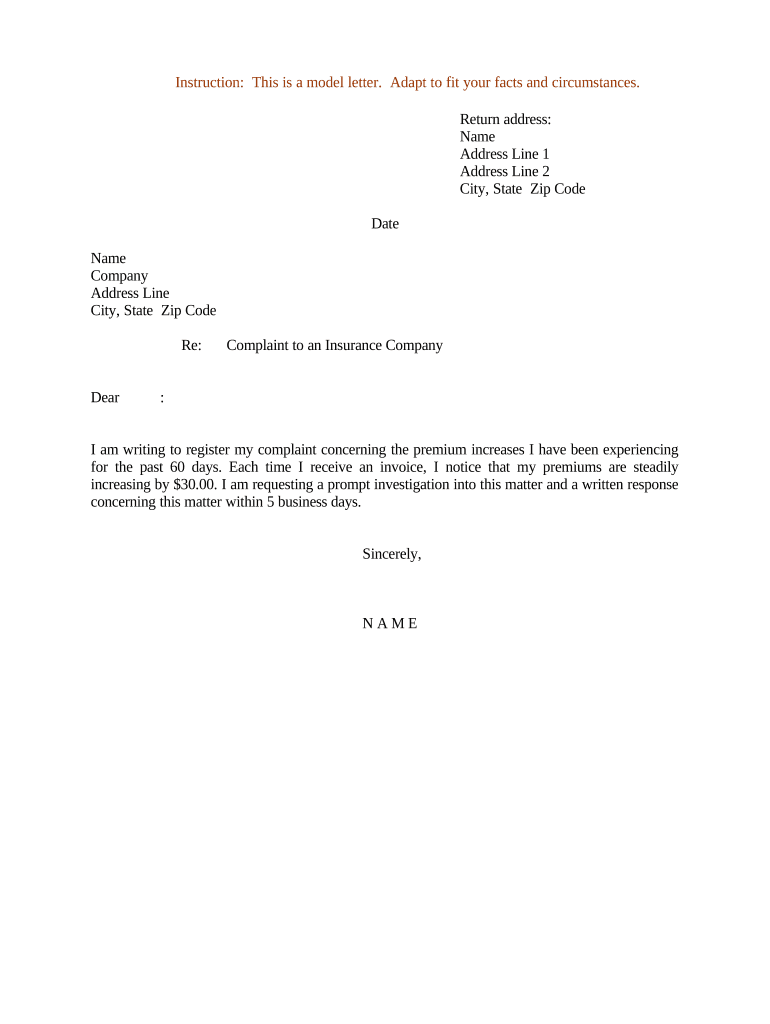
A Letter of Complaint to Insurance Company is a formal written notice from an insured party or claimant that describes a dispute, denial, delay, coverage question, or service concern related to an insurance policy or claim. The letter documents facts, dates, policy numbers, the specific outcome requested, and any supporting evidence so the insurer has a clear record of the issue and the complainant’s expectations. Well‑crafted complaint letters help create an auditable paper trail useful for internal appeal, regulatory complaints, or potential legal claims while preserving deadlines and statutory rights.

Why Sending a Clear Complaint Letter Helps Your Case

A focused letter clarifies your position, establishes a record for appeals or regulators, and often prompts faster internal review or corrective action by the insurer.

Why Sending a Clear Complaint Letter Helps Your Case

Who Typically Prepares This Letter

Tailor tone and content: individuals should be clear and concise; representatives may include contractual or statutory references.

  • Policyholders — Consumers disputing claim denials, payment amounts, or coverage interpretations with their insurer.
  • Claims representatives — Third parties such as medical providers or contractors seeking payment on assignment or subrogation claims.
  • Legal or consumer advocates — Attorneys, consumer protection groups, or public adjusters drafting formal complaints on behalf of clients.

Core Elements to Include in Every Complaint Letter

A professional complaint letter organizes facts and requested remedies so the insurer can respond efficiently and in writing.

Heading

Include your name, policy number, claim number, insurer name, and the date at the top to identify the record immediately.
Statement of Issue

Summarize the problem in one or two sentences—what happened, when, and which policy provision or claim decision you dispute.

Factual Timeline

List key dates and actions (e.g., incident, claim filing, adjuster contacts, denials) to create a clear chronological record.

Evidence Summary

Describe and enumerate attachments (invoices, photos, medical records, correspondence) so reviewers can match documents to claims.

Requested Remedy

State what outcome you seek—reconsideration, payment amount, coverage clarification, reimbursement, or an internal appeal—clearly and specifically.

Contact Info

Provide daytime phone, email, mailing address, and preferred contact method so the insurer can acknowledge and respond in writing.

Step-by-Step: How to Draft and Send Your Complaint Letter

Follow these sequential steps to prepare and submit a complaint that the insurer can process without delay.

  • 01
    Collect Documents: Gather policy, claim correspondence, invoices, and photos before drafting the letter.
  • 02
    Draft Concisely: Write a one‑page summary followed by a short chronology of events and attachments list.
  • 03
    Specify Remedy: State the exact outcome you want and any deadline for a response.
  • 04
    Send and Record: Deliver via certified mail or eSubmission and retain proof of delivery and a copy of the letter.

How to Customize an Online Complaint Workflow

Set up an online template to standardize complaint intake, routing, and proof of delivery for repeatable handling.

Field Configuration
Policy Number Mandatory, auto-validated
Claim Attachment Allow PDF, JPG up to 10MB
Preferred Contact Email or phone selection
Escalation Route to supervisor after 14 days

Where to Send or Submit Your Complaint Letter

Choose the insurer contact specified for appeals, the assigned adjuster, or the insurer’s customer service address for formal submission.

  • Primary Insurer Contact: Send to the claims or appeals department listed on your policy documents.
  • Assigned Adjuster: Copy the adjuster handling your claim to maintain file continuity.
  • State Department: If unresolved, file with the state insurance department or commissioner.
  • Preserve Proof: Use certified mail, overnight carrier, or verified eSubmission to prove delivery.

Digital Submission and eDelivery Options

Digital portals and eSubmission provide timestamps and file receipts; retain copies of all confirmations for later reference.

  • Email Submission: Acceptable if insurer acknowledges receipt in writing.
  • Web Portal: Preferred for structured intake and attachments.
  • Certified Mail: Provides legal proof of service.

Key Deadlines and Response Expectations to Track

Monitor insurer response times and regulatory deadlines to preserve appeal rights and regulatory complaints.

Acknowledge Receipt:

Insurers typically acknowledge within 10–30 days, depending on jurisdiction and policy terms.

Internal Appeal Window:

Check your policy for the insurer’s internal appeal deadline—often 30–180 days.

State Complaint Filing:

Deadlines for filing with a state insurance department vary; file promptly to avoid time bars.

Evidence Preservation:

Retain records and supporting documents until appeal and regulatory review complete.

Statute of Limitations:

Legal filing deadlines depend on state law; consult counsel to preserve litigation rights.

Typical Milestones After Submitting a Complaint

Track these key milestones from submission through resolution to maintain control of the process.

01

Submission

You send the complaint and retain proof of delivery.

02

Acknowledgement

Insurer confirms receipt and assigns a file or appeal number.

03

Review

Insurer conducts internal review and requests additional information if needed.

04

Decision or Escalation

Insurer issues a written decision or you escalate to regulator or legal counsel.

Common Mistakes That Weaken a Complaint Letter

  • Missing key identifiers such as policy or claim numbers that prevent the insurer from locating your file and delay resolution.
  • Vague or emotional language that obscures the facts; concise chronology and clear evidence references are more effective.
  • Failure to state a specific requested remedy, which makes it harder for the insurer to address your expectations in a single response.
  • Not preserving original documents or submission proofs; lack of receipts, delivery confirmations, or logged correspondence weakens appeals.

Practical Risks from an Incomplete or Late Complaint

Loss of Appeal Rights: May forfeit internal or statutory appeal windows.
Delayed Payment: Incorrect filings can postpone claim reconsideration.
Regulatory Rejection: State departments may decline incomplete complaints.
Evidence Gaps: Missing records weaken later legal or regulatory actions.
Potential Fees: Legal or filing costs can increase with late resolution.
Credit or Coverage Impact: Unresolved disputes might affect renewals or underwriting.

Real-World Examples of Complaint Letters and Outcomes

These brief examples show typical use and operational outcomes when complaint letters are complete and documented.

Optica Ventures — Claims Follow-up

A small business documented denied property damage claim facts and sent a detailed timeline

  • The insurer reopened the file for review
  • The structured submission and clear remedy request helped secure a partial payment and faster internal escalation for final resolution.

Martin Properties — Renters’ Reimbursement

A property manager submitted photos, invoices, and the policy section in one packet

  • The insurer requested one supplemental record
  • Consolidated evidence shortened the review and resulted in timely reimbursement for repairs.

eSignature Pricing and Feature Snapshot for Complaint Letters

Compare baseline pricing and core capabilities across common eSignature vendors; signNow is listed first per comparison conventions.

signNow DocuSign Adobe Sign PandaDoc HelloSign
Starting Price $8/user/mo $15/user/mo $14/user/mo $19/user/mo $15/user/mo
Free Trial 7-day free trial, no card Varies Varies Varies Varies
Bulk Send Yes Yes Yes Yes No
Audit Trail Yes Yes Yes Yes Yes
HIPAA Compliant Yes (BAA) Yes (BAA) Yes (BAA) No No

Frequently Asked Questions About Complaint Letters

Answers to common questions about drafting, sending, and escalating complaints to insurers and regulators.


Need help? Contact support

be ready to get more
Join over 28 million airSlate SignNow users