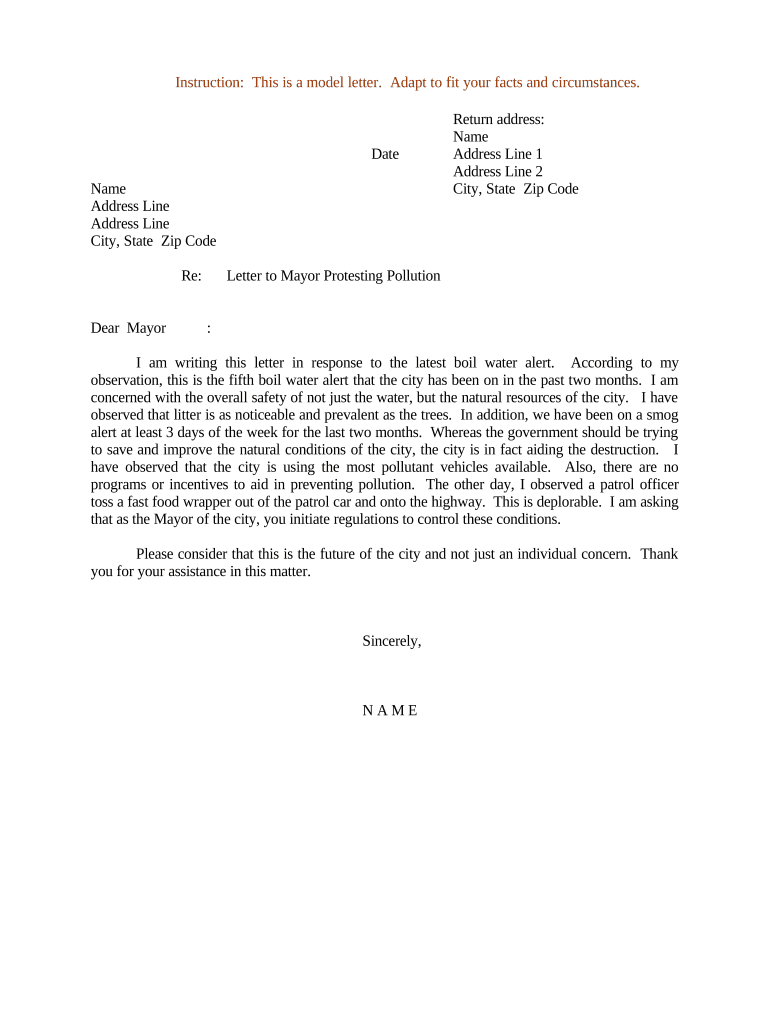
Letter to Mayor Protesting Pollution
What a Letter to Mayor Protesting Pollution Is and When to Use It
Why a Formal Letter Matters for Pollution Concerns
A formal letter creates an official municipal record, clarifies the community’s specific concerns, signals seriousness to city staff, and helps trigger administrative review or regulatory enforcement while documenting requests for future reference.
Who Typically Sends This Type of Letter
Businesses, local health professionals, and legal representatives also send these letters when pollution affects commercial operations, patient safety, or legal rights; the format adapts to the sender and desired remedies.
- Residents and neighbors reporting local air, water, or soil contamination and seeking municipal response.
- Neighborhood or homeowner associations coordinating collective complaints and shared evidence.
- Environmental nonprofits or advocacy groups documenting impacts and requesting policy or enforcement measures.
Step-by-Step: Drafting and Submitting the Letter
-
01Draft: Write a factual summary with dates, locations, and observed impacts.
-
02Attach Evidence: Include photos, lab results, or witness statements where available.
-
03Address Properly: Send to the mayor’s office and the city clerk or environmental division.
-
04Track Delivery: Request acknowledgement and retain proof of submission.
Where to Send the Letter and How Municipal Routing Works
-
Mayor’s Office: Primary recipient for executive attention and policy escalation.
-
City Clerk: Official repository for public records and requests; retain copy.
-
Environmental Department: Directs inspections and regulatory enforcement actions.
-
Council Members: Copy your district council member for elected oversight and hearings.
Delivery Methods: Paper, Email, and Online Submission
Retain copies and delivery confirmations regardless of channel. For secure eSubmission and signature tracking, eSignature platforms that comply with ESIGN and UETA capture timestamps and audit trails useful for follow-up.
- Certified Mail: Proof of delivery via postal service.
- Email: Sends time-stamped delivery and reply trail.
- City Portal: Many cities offer an online submission portal.
Typical Timelines and Expectations After Submission
Acknowledgement Period:
Expect an initial acknowledgement within 7–30 days in many municipalities.
Inspection Scheduling:
Inspections often occur within 14–60 days depending on priority and workload.
Council Agenda Cutoff:
Council meeting inclusion may require submission weeks before scheduled hearings.
Public Comment Period:
Environmental reviews often include 30–60 day public comment windows.
Escalation Timeline:
If unresolved, follow up every 30 days and escalate to regulators or elected officials.
Key Milestones from Draft to Resolution
Draft and Collect Evidence
Prepare letter, attach photos or test results, collect witness statements for credibility.
Submit to Offices
Send to mayor, city clerk, and environmental division with proof of delivery.
Request Acknowledgement
Ask for a written receipt or tracking number to document municipal intake.
Follow-Up and Escalate
If no adequate response, escalate to council members or state environmental agencies.
Common Mistakes to Avoid When Preparing the Letter
- Vague complaints without dates or locations make it difficult for officials to investigate and often delay response.
- Failing to attach evidence or mislabeling photos prevents inspectors from linking observations to the complaint.
- Sending only social media posts or informal messages instead of a formal letter may mean no official record is created.
- Using inflammatory or accusatory language can reduce cooperation; stick to facts and observed impacts.
Risks and Legal Considerations to Keep in Mind
Realistic Use Scenarios and Outcomes
Community Complaint Campaign
Residents documented persistent odor and visible discharge over three months with photos and timestamps
- Collective petition of 120 signatures requested expedited air monitoring
- The city scheduled an inspection and issued a notice to the facility while retaining complaint records for follow-up enforcement.
Single-Property Health Concern
A clinician documented respiratory symptoms near an industrial site and attached anonymized patient exposure reports
- The letter requested short-term testing and temporary mitigation measures
- The health department prioritized sampling, notified regulatory agencies, and shared remediation recommendations with the mayor’s office.
Practical Tips for Accurate and Efficient Letters
Configuring an Online Letter Workflow
| Field | Configuration |
|---|---|
| Document Upload | Allow PDF and JPEG attachments; label required evidence fields. |
| Signature Field | Enable typed or drawn signatures and capture timestamp. |
| Authentication | Use email confirmation or SMS code for attribution. |
| Routing | Auto-copy mayor, city clerk, and environmental division. |
eSignature Vendor Comparison for Submitting and Tracking the Letter
| signNow | DocuSign | Adobe Sign | PandaDoc | HelloSign | |
|---|---|---|---|---|---|
| Starting Price | $8/user/mo | $15/user/mo | $14/user/mo | $19/user/mo | $15/user/mo |
| Free Trial | 7-day free trial | No | No | Yes, limited | Yes, limited |
| Bulk Send | Yes | Yes | Yes | Yes | No |
| Audit Trail | Yes | Yes | Yes | Yes | Yes |
| Envelope Cap | No cap | 100 envelopes/user/year | Varies by plan | Varies by plan | Varies by plan |
Frequently Asked Questions About Using a Letter to Mayor Protesting Pollution
-
Is an emailed letter legally valid?
Yes, an emailed complaint is typically accepted as a record by municipalities; for signed records, electronic signatures meet federal standards under the ESIGN Act (15 U.S.C. ch. 96) and intrastate rules under UETA where adopted, provided intent and attribution are recorded.
-
Do I need to notarize the letter?
Most complaint letters do not require notarization. If you attach an affidavit or seek evidentiary weight, a notarized statement or RON session may be appropriate; verify with the receiving office.
-
Can I sign electronically?
Yes. Electronic signatures are generally enforceable under ESIGN and UETA when intent, consent, attribution, and retention are demonstrable; include a clear signature block and audit trail to support attribution.
-
What if the mayor’s office does not respond?
If there is no adequate response, follow up with the city clerk, request status in writing, copy council members, and consider filing a complaint with the state environmental agency or seeking legal advice.
-
Can the letter be used in legal actions?
A well-documented letter with dated evidence and preserved audit trails can support later administrative or legal proceedings, but consult an attorney for strategy and to avoid inadvertent disclosure risks.
-
How should I protect sensitive health information?
Avoid including identifiable patient health details in a public letter. For healthcare-related exposures, follow HIPAA guidance and provide anonymized summaries or submit identifiable data only through secure channels or with appropriate authorizations.